Abstract
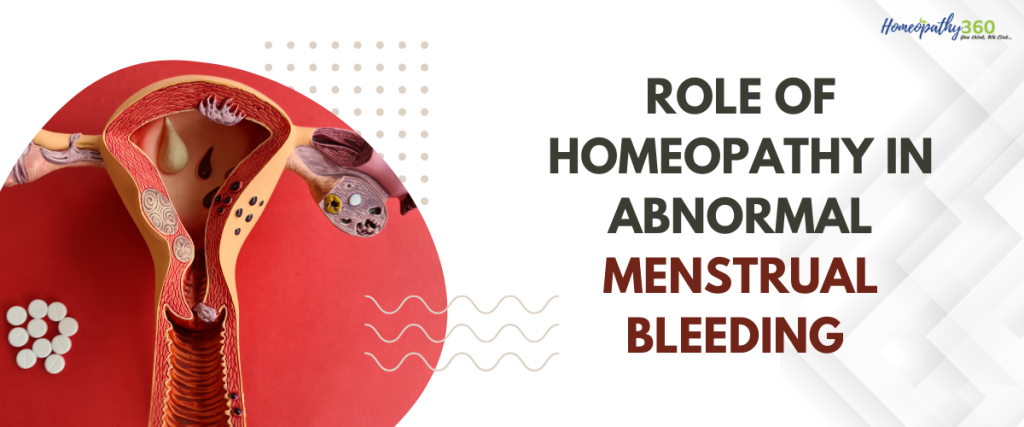
⮚ Abnormal menstrual bleeding (AMB), also known as abnormal uterine bleeding (AUB), is
a prevalent gynecological issue affecting women of all age groups. It encompasses any
deviation from the normal menstrual cycle in terms of regularity, frequency, duration,
or volume. Conventional treatments often rely on hormonal therapies and surgical
interventions, which may have side effects or be invasive. Homeopathy, a holistic
system of medicine, offers individualized treatment aimed at addressing the root cause
of bleeding irregularities with minimal side effects. This article explores the
pathophysiology, clinical presentation, and homeopathic management of AMB through
repertorial analysis and remedy selection.
Epidemiology
● AMB affects 10–30% of women of reproductive age worldwide.
● Most common in adolescents (due to anovulatory cycles) and perimenopausal women
(due to hormonal imbalance).
● Accounts for 1/3rd of all gynecological consultations.
Risk Factors
● Hormonal Imbalance (Estrogen excess, anovulation)
● Polycystic Ovarian Syndrome (PCOS)
● Thyroid disorders (Hypo-/Hyperthyroidism)
● Uterine Fibroids/Polyps
● Endometrial hyperplasia or malignancy
● Coagulopathies (e.g., von Willebrand disease)
● Iatrogenic causes (e.g., IUD, anticoagulant use)
● Obesity, diabetes, stress, and eating disorders.
Pathogenesis
Abnormal menstrual bleeding is broadly classified into:
- Structural causes (PALM: Polyp, Adenomyosis, Leiomyoma, Malignancy)
- Non-structural causes (COEIN: Coagulopathy, Ovulatory dysfunction, Endometrial,
Iatrogenic, Not otherwise classified)
Ovulatory dysfunction leads to unopposed estrogen stimulation, resulting in endometrial
overgrowth and irregular shedding. Endometrial and myometrial abnormalities cause vascular
fragility, leading to menorrhagia or metrorrhagia.
Clinical Features
● Menorrhagia: Heavy bleeding (>80 mL), prolonged >7 days
● Metrorrhagia: Irregular, intermenstrual bleeding
● Polymenorrhea: Cycles <21 days apart
● Oligomenorrhea: Cycles >35 days apart
● Amenorrhea: Absence of menstruation for ≥3 cycles
● Symptoms: Fatigue, anemia, pelvic pain, emotional disturbances
Investigations
- History & Physical Examination
- Blood tests: CBC, TSH, coagulation profile, hormonal assays
- Pelvic ultrasound
- Endometrial biopsy (if indicated)
- Hysteroscopy or MRI (for structural abnormalities)
Complications
- Anemia
- Infertility
- Endometrial hyperplasia or cancer
- Psychological distress
- Quality of life impairment
Synthesis Repertorization (Examples)
Common rubrics from Synthesis Repertory:
- MIND – Anxiety, menses, before
- GENITALIA FEMALE – Menses – profuse
- GENITALIA FEMALE – Menses – irregular
- GENITALIA FEMALE – Menses – too frequent
- GENITALIA FEMALE – Menses – prolonged
- GENITALIA FEMALE – Haemorrhage – uterus – metrorrhagia
Remedies in 3 marks (commonly appearing):
- Calcarea carbonica
- Pulsatilla
- Sepia
- Nux vomica
- Lachesis
- Phosphorus
Homeopathy medicines:-
Pulsatilla
● Indications: Late, scanty, or irregular menses; flow that changes in quality and timing;
often associated with weepiness and emotional sensitivity.
● Bleeding Type: Dark, thick or intermittent flow; may stop and return (stop–start
bleeding).
● Mental State: Mild, timid, weepy, seeks consolation.
● Modalities: Worse in a warm room, better in open air; worse in the evening.
Key Symptoms:
● Menses suppressed by getting feet wet
● Irregular, changeable nature of symptoms
● Craves attention and affection.
Sepia
● Indications: Scanty or suppressed menses, irregular cycles, bearing down sensation as if
pelvic organs would fall out.
● Bleeding Type: Often associated with dark blood and a feeling of heaviness in the
uterus.
● Mental State: Indifferent, irritable, aversion to family and duties, depressive state.
● Modalities: Worse before or during menses, better with exercise or vigorous activity.
Key Symptoms:
● Sagging uterine feeling
● Pain from back to front
● Aversion to sexual activity
Calcarea Carbonica
● Indications: Profuse, prolonged menses, occurring too frequently.
● Bleeding Type: Bright red, heavy flow; may last for more than 7 days.
● Mental State: Anxious about health, overburdened, sluggish, fears misfortune.
● Modalities: Worse from cold, exertion; better with warmth and rest.
Key Symptoms:
● Chilly and sweaty patient
● Craves eggs, indigestible things
● Obesity with delayed development
Phosphorus
● Indications: Bright red, profuse bleeding with tendency to hemorrhage; menses too
early and too long.
● Bleeding Type: Gushing flow, non-coagulating blood.
● Mental State: Sensitive, fearful, excitable, sympathetic.
● Modalities: Worse from cold, exertion, fasting; better with sleep, company.
Key Symptoms:
● Frequent nosebleeds
● Weakness after menses
● Craving for cold drinks and ice cream
Lachesis
● Indications: Suppressed or scanty menses that return with vengeance; profuse, dark,
offensive, clotted bleeding.
● Bleeding Type: Starts with mental symptoms; flow relieves emotional/physical
complaints.
● Mental State: Jealous, loquacious, suspicious, intensely emotional.
● Modalities: Worse on waking, touch, left side; better with discharge flow.
Key Symptoms:
● Menses aggravate all complaints
● Left-sided ovarian pain
● Cannot bear tight clothes
Nux Vomica
● Indications: Short, irregular menstrual cycles with irritable temperament and pelvic
congestion.
● Bleeding Type: Scanty or excessive with strong urging to pass stools.
● Mental State: Ambitious, easily offended, hypersensitive to stimuli.
● Modalities: Worse from stimulants, cold, anger; better with rest and warmth.
Key Symptoms:
● Menses every 15–20 days
● Constipation with ineffectual urging
● Overwork and sedentary lifestyle
Sabina
● Indications: Profuse uterine bleeding with clots, bright red and hot blood; often during
or after miscarriage.
● Bleeding Type: Continuous flow of bright red, mixed with clots.
● Mental State: Irritable, excitable, nervous.
● Modalities: Worse from motion and warm rooms.
Key Symptoms:
● Pain extends from sacrum to pubis
● Threatened abortion at 3rd month
● Uterine fibroids with hemorrhage.
Trillium Pendulum
● Indications: Gushing of bright red blood; sensation as if hips and back were falling apart.
● Bleeding Type: Profuse, gushing, bright red, may occur mid-cycle.
● Mental State: Anxious, debilitated from blood loss.
● Modalities: Worse from movement; better lying down.
Key Symptoms:
● Menorrhagia with faintness and cold sweat
● Fibroid or peri-menopausal bleeding
● Bleeding every two weeks
Ferrum Metallicum
● Indications: Pale, anemic women with flushing and pulsating headaches during menses.
● Bleeding Type: Profuse flow, pale blood, leading to great weakness.
● Mental State: Alternates between strength and exhaustion.
● Modalities: Worse from midnight, noise; better from walking slowly.
Key Symptoms:
● Anemia with red face
● Irregular menses
● Flow increases with slightest movement
Millefolium (Achillea)
● Indications: Passive, painless uterine bleeding, especially after trauma or heavy lifting.
● Bleeding Type: Bright red or mixed with clots, often without pain.
● Mental State: Calm or indifferent.
● Modalities: Worse from motion and lifting.
Key Symptoms:
● Post-traumatic or post-partum bleeding
● Hematuria and hemoptysis with easy bleeding tendency
● Varicose veins and pelvic congestion
BIBLIOGRAPHY
- Boericke, W. Pocket Manual of Homeopathic Materia Medica. B. Jain Publishers.
- Kent, J.T. Repertory of the Homeopathic Materia Medica.
- Schroyens, F. Synthesis Repertory. RadarOpus.
- Allen, H.C. Keynotes and Characteristics with Comparisons of Some of the Leading Remedies.
- Davidson’s Principles and Practice of Medicine – 23rd Edition.
- ACOG Practice Bulletin on Abnormal Uterine Bleeding.
- National Institute for Health and Care Excellence (NICE) Guidelines.