

Homoeopathic Management of Right-Sided Urinary Stone: A Case Report
Abstract:
Urolithiasis is a commonly encountered condition in clinical practice and frequently presents with flank pain and urinary disturbances due to obstruction in the urinary tract. Stones in the lower ureter are often more symptomatic and may lead to secondary changes such as hydronephrosis. This case report describes a 58-year-old male diagnosed with a right-sided ureteric calculus confirmed by CT urography. He presented with colicky flank pain and associated urinary complaints. Homoeopathic treatment was prescribed based on the totality of symptoms and the patient’s general characteristics. Regular follow-ups were done with clinical evaluation and repeat imaging. The patient showed gradual symptomatic relief, and follow-up radiological findings indicated improvement. This case highlights the supportive role of homoeopathic management in cases of ureteric calculi when assessed with proper diagnostic investigations.
Keywords: Renal calculus, Vesicoureteric junction stone, Lycopodium clavatum, Sciatica, Homoeopathy, Case report
Introduction:
Urolithiasis is a frequently encountered condition in routine clinical work and affects a large adult population. It involves the development of stones within the urinary tract and often leads to sudden and intense discomfort. Stones that lodge in the lower segment of the ureter usually produce more severe symptoms because this portion is anatomically narrow and more prone to blockage.
Most patients complain of acute, gripping pain in the flank area, which may spread toward the lower abdomen or groin. Other associated complaints can include painful or burning urination, increased urinary frequency, nausea, vomiting, visible or microscopic blood in urine, and marked restlessness during pain episodes. Clinical examination and imaging studies may reveal ureteric blockage along with secondary changes such as dilatation of the ureter and swelling of the affected kidney.
Even with current advances in diagnostic tools and treatment options, repeated stone formation continues to be a challenge in many patients. Homoeopathy evaluates such cases using a holistic approach, where medicines are selected according to the total symptom profile of the individual. This approach focuses not only on the present pathology but also on the person’s underlying susceptibility and general health tendencies, supporting broader and longer-term management.
Case Report:
Patient Information
Date of First Consultation: 22/4/23
A 58-year-old male visited the clinic with complaints of:
- Pain in the right flank region for one week, colicky in nature, occasionally radiating toward the lower abdomen, aggravated by movement, before urination and relieved after passing urine
- Increased frequency of urination
ODP: The patient was a previously diagnosed case of renal stone confirmed through imaging reports. He reported recurrent colicky pain episodes for which he used allopathic pain-relieving medicines on and off for temporary relief. Apart from these painkillers taken during acute attacks, no regular or definitive treatment had been undertaken before starting homoeopathic care.
Associated Complaints:
- Right-sided sciatica Since 6 months- Pain radiating from lower back to posterior aspect of right leg up to calf muscle Aggravated while standing and relieved while lying down
- Gastric Complaints- Occasional gas and acidity Aggravation after consumption of fatty and fast food
Past History:
- Chickenpox at 10 years of age – recovered
- Jaundice at 35 years of age – treated allopathically- recovered
No addictions
No known allergies
Physical Generals:
Appetite: three times/ day, adequate
Desire: for Sweets ++
Thirst:3 liters/day
Bowel: Once in day, satisfactory
Urine: frequency increased 7-8 times/day, free flow
Sleep: Sound, onset-gradual, position- changeable, Dreams- not remember
Thermal- Ambithermal
Perspiration- profuse more on face, bland in nature
Family History:
Father-HTN- Death
Mother-Death
Brother- alive- HTN
Sister- alive- healthy
Physical examination:
- General Build- moderate
- Weight- 62 kg
- Pulse- 74/min
- Bp- 124/82 mm Hg
- Tongue- clear
- Teeth- white
- Nails- NAD
Mental Generals:
- Easily irritated when things do not go according to his wishes and tends to raise his voice at family members when opposed or contradicted
- Duty-oriented
- Disciplined and responsible
Systemic Examination:
CVS- S1S2 Heard
CNS- Conscious and well oriented
GIT- Abdomen soft and non ternder
RS- Bilateral clear air entry
Investigations:
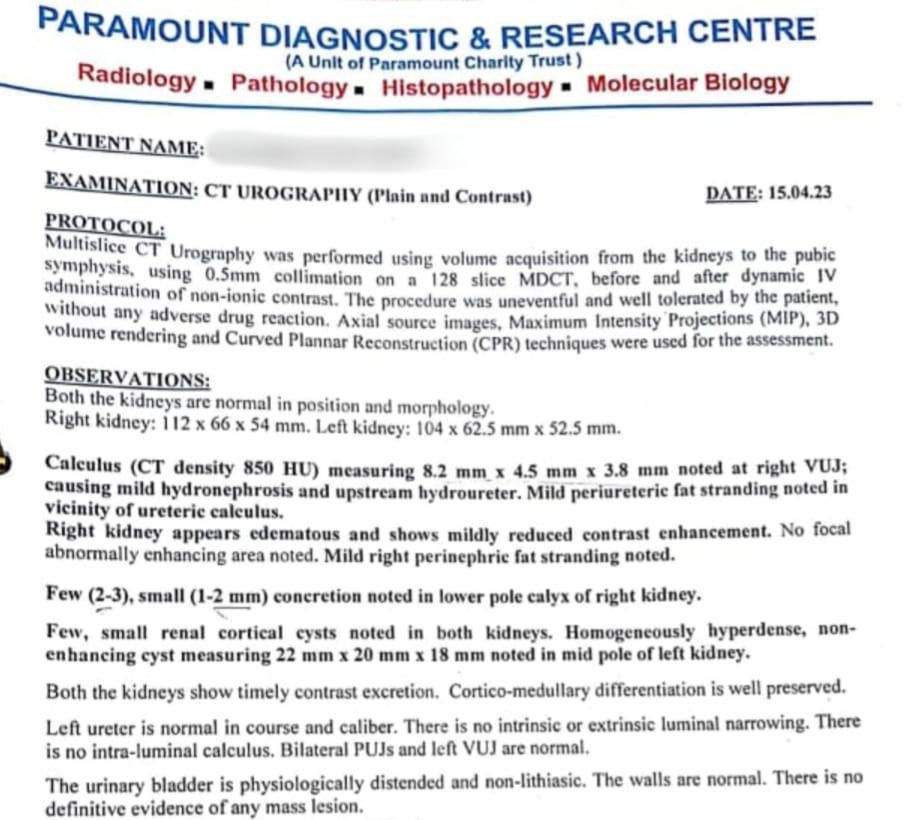
CT Urography (15.04.2023):
- Calculus measuring 8.2 × 4.5 × 3.8 mm- Located at right vesicoureteric junction (VUJ)
- CT density: 850 HU
- Mild right hydronephrosis
- Upstream hydroureter
- Mild perinephric fat stranding
- Few small (1–2 mm) concretions in lower pole calyx of right kidney
Before Treatment:
Diagnosis: Right-sided ureteric calculus confirmed on CT urography.
The totality of symptoms:
- Pain in the right flank region for one week, colicky in nature, aggravated by movement, before urination and relieved after passing urine
- Increased frequency of urination
- Marked right-sided complaint
- Right-sided sciatica- Pain radiating from lower back to posterior aspect of right leg up to calf muscle Aggravated while standing and relieved while lying down
- gas and acidity Aggravation after consumption of fatty and fast food
- Desire for Sweets ++
- Profuse perspiration more on face
- Marked irritability from contradiction; becomes angry and raises his voice when opposed
- Duty-oriented
- Responsible
These characteristic features closely matched the symptom picture of Lycopodium clavatum. The remedy was chosen through a direct Materia Medica comparison with the patient’s totality of symptoms. A non-repertorial method was used, focusing on the constitutional drug profile rather than repertory-based analysis.
Prescription:
- Lycopodium clavatum 200C- Two doses given 12 hours apart
Followed by Saccharum lactis (placebo) TDS for 15 days
During acute colic episodes:
- Berberis vulgaris Mother Tincture – 10 drops in water TDS- SOS
- Magnesium phosphorica 6X – SOS
Follow-Up:
15 Days:
- Frequency of colicky pain had reduced from about 4–5 episodes in the previous 15 days to only 2 episodes after starting treatment.
- Sciatica pain significantly reduced
- Gas and acidity complaints improved
- Improvement in urine frequency
1 Month:
- No acute colic
- Sciatica improved approximately 50%
- Gastric complaints reduced.
2 Months:
- Patient reported passage of stone
- No flank pain
- Urination normal
- Repeat sonography confirmed absence of calculus.
After Treatment:
KUB Sonography (30.06.2023):
- Both kidneys normal in size and position
- No calculi seen
- No obstructive changes noted
- Radiological evidence confirmed complete clearance of the calculus.
Discussion:
The chosen constitutional remedy suited the patient’s overall symptom pattern, including right-sided complaints, urinary trouble, digestive discomfort after heavy food, and a tendency to get irritated when opposed. After starting treatment, relief was observed not only in the acute kidney symptoms but also in the long-standing sciatica pain, suggesting that the medicine acted at a deeper level and not just on one complaint.
Imaging reports also confirmed the clinical progress, which adds objective support to the results. Baseline ultrasonography showed a left mid-pole renal cyst measuring approximately 22 × 20 × 18 mm in three dimensions. On follow-up imaging, the cyst size was noted to be about 1.3 × 1.6 cm (maximum diameter ~16 mm), indicating an overall reduction in size. Improvement was thus documented not only in renal calculi status but also in the associated renal cyst. Along with this, relief was observed in kidney symptoms, musculoskeletal pain, and digestive complaints, suggesting a whole-person response to individualized homoeopathic treatment rather than isolated symptomatic relief.
Conclusion:
This case, supported by radiological evidence, suggests that an individualized constitutional homoeopathic approach can help in managing vesicoureteric junction stones along with related long-standing complaints. However, studies on a larger group of patients are needed to confirm and strengthen these observations.
Patient Consent:
Written informed consent was obtained from the patient for publication of clinical details and radiological findings.
References:
- Innes JA, Dover AR, Fairhurst K, editors. Davidson’s Principles and Practice of Medicine. 24th ed. Edinburgh: Elsevier; 2022.
- Boericke W. Pocket Manual of Homoeopathic Materia Medica. New Delhi: B. Jain Publishers; 2007.
- Hahnemann S. Organon of Medicine. 6th ed. New Delhi: B. Jain Publishers; 2002.


