Abstract – Epidermoid cysts are one of the skin color lesions including lipomas, rheumatoid nodules, neurofibromas etc. [1]. Epidermoid cysts are usually found in the areas of neck, scalp, behind the ear, back and the trunk.[2]. These cysts are a type of keratinized cysts contain white cheesy material often confused with sebaceous cysts. Usually these cysts are firm, painless and has punctum at the center. A case report-A young male student, 23 years of age, developed a cystic growth suspecting as an epidermoid cyst on his sternum suffering for six months which was successfully treated with homoeopathic medicine within two months.
Keywords: Epidermoid cysts, cystic growth, cysts, homoeopathy, homoeopathic medicines.
Introduction
Epidermoid cysts mostly seen on the face and on the upper trunk. Since they are situated in the epidermis, they uplift the epidermis containing yellowish, white or skin colored, firm, round, elastic, protuberances that may be mobile and may have a central keratin filled punctum.[2][3]So basically, epidermoid cysts are the cysts which contains keratin and its breakdown products covered by an epidermoid layer. [1]. There sizes may vary from millimeters to more than 5 centimeters. They gradually enlarge and become tender and inflamed.
Age and Sex– Epidermoid cysts are frequently found in young and middle age adults in either of the sex.
Associated disease– Gardener Syndrome[1]
Pathophysiology- Generally an epidermoid cyst is the consequence of squamous metaplasia of a damaged sebaceous gland. Some of are the result of inflammation of surrounding pilosebaceous follicle.[1][4]
Complications
• Suppuration with offensive discharge.
• Dystrophic calcification of scrotal cysts.
• Rarely malignant degeneration of cysts.[1]
Differential diagnosis
• Keloid
• Trichilemmal cysts.
• Lipomas.
• Cutaneous leishmaniasis.
Prognosis– usually excellent.
Investigations- Diagnosis is clinical and may confirmed by biopsy. Management
• Medication: oral antibiotics are generally given in case of infection and inflammation.
• Uncomplicated cases do not require treatment.
• Cysts which are inflamed is better incised and drained in modern practices.
A Case report -A 23 years male student consulted on 15/01/2026 for the treatment of a cystic growth on the sternum which was firm, movable, painless for six months. He consulted many of the physicians of different mode of practices who ultimately suggested him for surgical treatment. He was treated with homoeopathic medicines also but did not get relief as such. The diagnosis of the cyst is made as epidermoid cyst.
Personal History: Patient by occupation is a student belonging to middle class socio-economic family.
Past History: Vaccinated in the childhood & has a history of typhoid, pneumonia, jaundice.
Family History: None
On examination: Firm, movable, painless growth of around 1 centimeter on sternum.
Mental generals: He reported fear of impending diseases and has a desire for company. The patient is emotionally sensitive.
Physical generals
• Appearance: – Tall, Lean and thin person
• Thermal – Chilly
• Thirst – normal
• Appetite – normal
• Desire – Sweets++
• Aversion – Karela
• Perspiration – Axilla
• Stool – unsatisfactory sometimes
• Urine- normal
• Sleep – sound
Totality of symptoms
Mental generals-
• Fear of impending diseases
• Emotionally sensitive
• desire for company
Physical generals-
• Desire for sweets
• Lack of vital heat
• Generalized weakness from slight exertion
• chilly patient
Particulars-
• swelling over sternum
• painless
• firm growth
• movable
Repertorial totality:
• MIND – COMPANY – desire for
• MIND – FEAR – disease, of impending
• MIND – SENSITIVE
• GENERALS – HEAT – lack of vital heat
• GENERALS – WEAKNESS – exertion, agg – slight exertion
• GENERALS – FOOD and DRINKS – sweets – desire
Repertorization
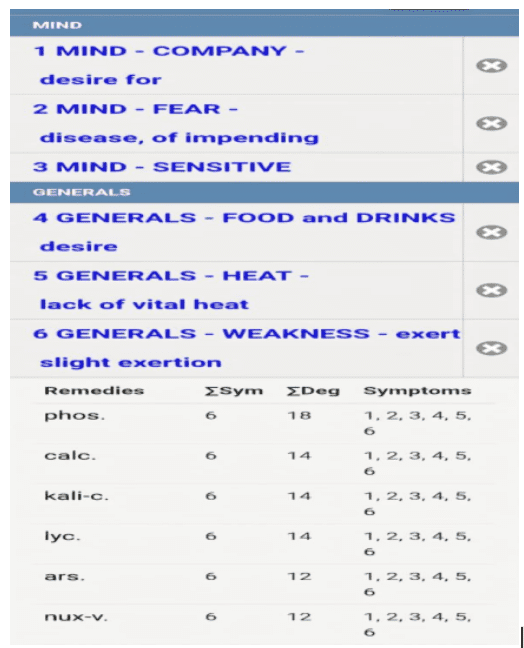
Remedy selection and prescription • Remedy: Phosphorus 200C OD for 2 days and Placebo /BD for 15 days[5]
Follow ups
| Date | Symptoms | Medicine | Dose |
| 31/01/2026 | No relief as such, but patient cooperated well and shown belief in treatment | Phytum met 250 | BD/4pills For 15 days |
| 16/02/2026 | There were redness and pain on the growth and mildly feverish last night. | Phosphorus 200 Sac lac 350 | Stat For 15 days/4pills BD |
| 24/02/2026 | The cyst burst with a cheesy material and exfoliation of skin. A foul odor was there. | Nihillinum 30 Phytum met 250 | Stat For 15 days/4pills TDS |
| 10/03/2026 | The cystic swelling completely healed with a scar mark. | Rubrum met 30 | Stat. |
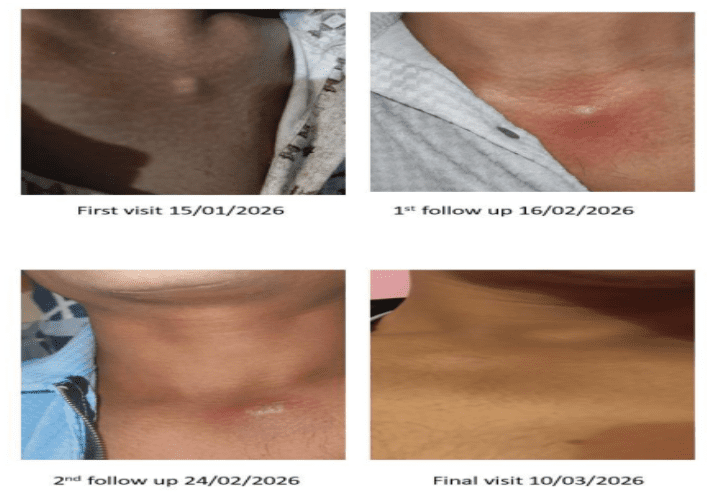
Discussion and Conclusion: Homoeopathic medicines are effective in the treatment and management of skin conditions. Patients have zero side effects. Thus homoeopathic medicines are safe and can be used as an alternative line of treatment.
Conflict of Interest- Not available
Financial Support- Not available
Guided By –
Assistant Professor (Dr.) Bharat Singh Poosam, M.D. (Hom.), Department of Physiology, Government Homoeopathic Medical College and Hospital, Bhopal, M.P., India
References
1. Griffiths C, Barker J, Chalmers R, Bleiker T, Creamer D, editors. Rook’s textbook of dermatology, 4 volume set. 9th ed. Nashville, TN: John Wiley & Sons; 2016.
2. Sardana K, editor. Compendium of dermatology for examination. 2nd ed. New Delhi, India: CBS Publishers & Distributors; 2021.
3. Harrison’s principles of internal medicine. New Delhi, India: Om Books International; 2025.
4. Patrawala AS. Non-Invasive resolution of Epidermoid Cyst with Homoeopathic Surgeon’s Knife – Silica – A case report [Internet]. homeopathy360. 2023 [cited 2026 Apr 21]. Available from: https://www.homeopathy360.com/non-invasive-resolution of-epidermoid-cyst-with-homoeopathic-surgeons-knife-silica-a-case-report/
5. Boericke W. Pocket manual of homeopathic materia medica & repertory. New Delhi, India: B Jain; 2023.