
Abstract
Chronic eczema is a frequently encountered dermatological condition marked by periodic exacerbations and significant discomfort. Its recurrent nature often reflects deeper constitutional disturbances. This case describes a 28-year-old female presenting with recurrent dryness and itching over the breast region for two years. A detailed homoeopathic case-taking, emphasizing mental and emotional characteristics alongside physical generals, guided the selection of a constitutional remedy. The patient responded favorably, with gradual resolution of symptoms and reduction in recurrence, underscoring the role of individualized homoeopathic management in chronic skin conditions.
Introduction
Eczema, or dermatitis, is characterized by inflammation of the skin presenting with dryness, itching, and sometimes fissuring. While conventional approaches largely aim at symptomatic suppression, relapses are common. Homoeopathy, on the other hand, approaches the patient as a whole, considering not only the pathology but also the individual’s mental and emotional state, lifestyle, and constitutional tendencies. This case illustrates how such an individualized approach can lead to sustained improvement.
Case Presentation
A 28-year-old unmarried female, a student pursuing MBA, presented on 2nd December 2023 with complaints of recurrent dryness and itching over the breast region.
She reported that the problem began approximately two years ago, initially affecting the left breast. The onset was gradual, with dryness followed by itching and occasional pain. Over time, the condition spread and later involved the right breast. The affected areas developed small cracks but were not associated with any discharge.
She had experienced similar episodes in the past, for which she had taken treatment and obtained temporary relief. However, the complaint recurred after a gap of several months.
At the time of consultation, she complained of mild dryness and itching over the right breast, with occasional discomfort.
Associated Features
- Hyperpigmentation around the areola
- No discharge
- No marked modalities
Personal History
The patient followed a vegetarian diet with a good appetite and a preference for warm food. She had a marked desire for sweets. Thirst was adequate, consuming approximately 3–4 liters of water daily.
Bowel movements were occasionally constipated. Urination was normal. Perspiration was generalized and at times offensive.
Thermally, she felt more comfortable in cooler environments and was intolerant to heat.
Sleep was sound but not refreshing, and she frequently reported dreams related to daily life events, including those involving her boyfriend.
Menstrual History
Her menstrual cycle was regular, occurring every 24–26 days, with a duration of 3–4 days. The flow was normal, red in color, and without clots. There were no associated complaints.
Mental and Emotional Symptoms
A deeper exploration of her mental state revealed significant emotional factors.
During childhood, she perceived a lack of affection from her mother and often felt compared unfavorably in terms of appearance and abilities. These experiences left a lasting impression, leading to feelings of inadequacy and emotional isolation.
She described herself as a quiet, obedient child who rarely expressed her desires. She tended to suppress her emotions and avoided confrontation.
In school, she remained reserved, maintained limited friendships, and was sensitive to reprimands, often dwelling on such incidents for long periods.
As an adult, she reported being socially interactive but found it difficult to form deep or lasting connections. Emotional experiences continued to affect her internally, though she seldom expressed them outwardly.
Clinical Examination
No significant abnormalities were noted on general physical examination apart from the local skin findings.
Diagnosis
Chronic recurrent eczematous dermatitis of the breast
Analysis and Evaluation
| Symptoms | Type | intensity |
| Sensitive to criticism | Uncommon | 3+ |
| Consolation aggravation | Uncommom | 3+ |
| Forsaken feeling | Uncommon | 2+ |
| Disappointed in love | Uncommon | 2+ |
| Suicidal thoughts | Uncommon | 2+ |
| Suppressed emotions | Uncommon | 2+ |
| Desires for sweets | Common | 2+ |
| Hot patient | Common | 2+ |
| Dryness of skin | Commom | 1+ |
These elements pointed toward a deep constitutional disturbance rather than a purely local pathology
Miasmatic Analysis
- Psora: Desire for sweets, sensitivity, disappointment
- Sycosis: Suppressed emotions, consolation aggravation
- Syphilis: Suicidal tendency
Totality of Symptoms
- Suicidal disposition
- Forsaken feeling
- Sensitive to criticism
- Disappointment in love
- Dryness of skin
Repertorial Analysis
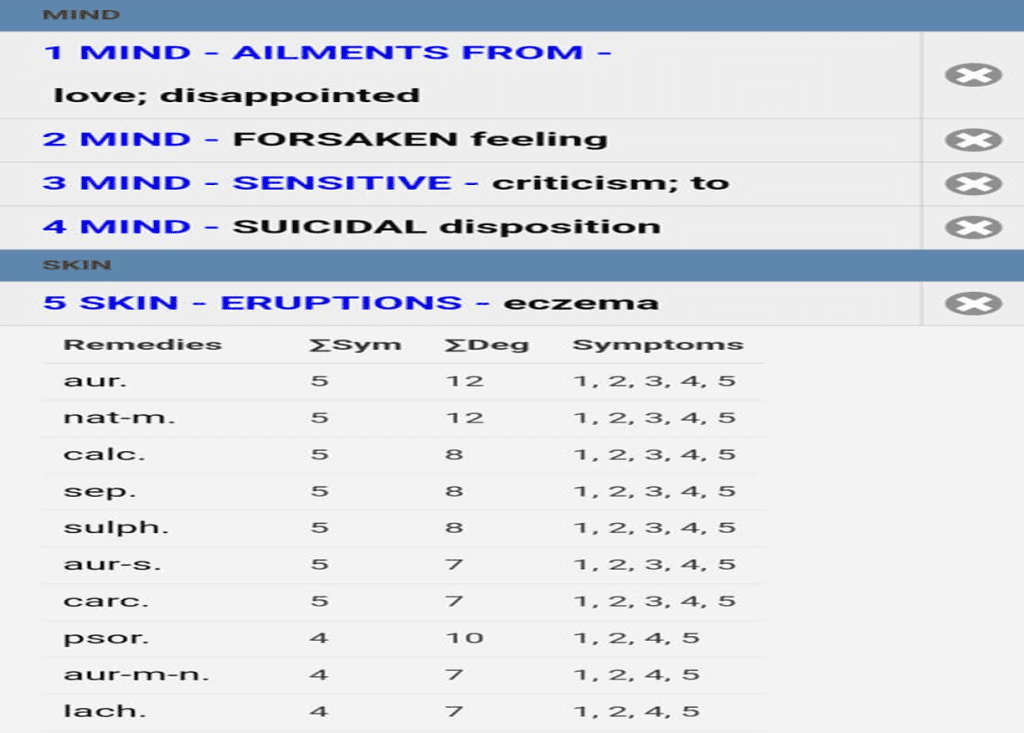
Prescription
First Prescription (02/12/2023):
- Natrum muriaticum 30 – single dose
- Placebo for 15 days
Follow-ups
| Date | Mental symptoms | Physical symptoms | Evaluation of case | Prescription |
| 02/12/23(first visit) | Forsaken feeling, sensitive to criticism, disappointment in love, suicidal thoughts, suppressed emotions | Dryness of right breast, slight itching, occasional pain, hyperpigmentation | Case taken, totality formed | Natrum muriaticum 30, single dose & Placebo30/bd/15days |
| 09/12/23 | Feeling slightly better, more hopeful about recovery, reduced anxiety | Dryness increased, small cracks present, itching reduced, occasional pain | Initial aggravation followed by improvement | Natrum muriaticum 200, single dose & Placebo30/bd/15days |
| 26/12/23 | Marked improvement, positive attitude, started meditation, better self-worth, reduced suicidal thoughts | Dryness improved, cracks healing, slight itching persists | Improvement in both physical and mental generals | Phytum 200, single dose & Placebo30 /bd/15days |
Result
The patient showed marked improvement in symptoms with gradual disappearance of dryness and itching. No recurrence was observed during the follow-up period.
Discussion
This case highlights the importance of considering mental and emotional factors in chronic dermatological conditions. The patient’s suppressed emotions and long-standing sense of neglect played a significant role in disease manifestation.
Individualized homoeopathic treatment not only relieved symptoms but also reduced recurrence, indicating action at a deeper constitutional level.
Conclusion
Homoeopathy proved effective in managing this case of recurrent eczema by addressing the underlying constitutional disturbance. This case emphasizes the importance of individualized treatment and holistic case-taking.
References
- Organon of Medicine. 6th ed. New Delhi: B. Jain Publishers; 2002.
- Repertory of the Homoeopathic Materia Medica. New Delhi: B. Jain Publishers; 2009.
- Pocket Manual of Homoeopathic Materia Medica. New Delhi: B. Jain Publishers; 2007.
- The Guiding Symptoms of Our Materia Medica. New Delhi: B. Jain Publishers; Reprint edition.
- Textbook of Dermatology. 9th ed. Oxford: Wiley-Blackwell; 2016.
- Atopic Dermatitis. In: Harrison’s Principles of Internal Medicine. 20th ed. New York: McGraw Hill; 2018.