Abstract
Coriander (Coriandrum sativum), often known as Dhania in India or Cilantro in the United States, is an annual herb belonging to the Apiaceae (parsley family). Coriander is an important spice crop having a prime position in flavoring food. The aim of this experiment was to study the yield of coriander plants and leaves in comparison with plain water. It was a comparative study where I have taken 20 healthy seeds, divided them into 2 groups of 10 seeds each and treat accordingly as mentioned in the methodology. T Test Analysis?. At the end of the study I came to the conclusion that the group treated with KN showed faster growth with a number of leaves with a good aroma compared to the plain water group.
Keywords
Agro Homoeopathy; Comparative Study; Coriander; Homoeopathy; Kali Nitricum 6C; Leaf Yield; Plant Growth; Water
Introduction
Coriandrum sativum is commonly known as dhaniya. It is an annual herb and used as a spice from ancient times. The fresh leaves of this plant are called Cilantro. The seeds, leaves, and fruits of this plant are edible and have an aromatic odor, and are used as a flavor in curries, soup, and other Indian dishes. Fruit of this plant is used in the preparation of pastries, buns, cakes and also for the preparation of curry powder and other flavors. Coriander seed is also known for its medicinal importance especially the seeds of this plant are used for the preparation of Ayurveda medicines as well As used traditionally in different tribes for the preparation of various ailments. Coriander plant is considered as a medicinal herb in traditional medicine System as it has various properties like they act as anti-diuretic, anti-diabetic, anti-hypertensive, aphrodisiac, anti-microbial, anti-oxidant, analgesic, Anti-inflammatory and anti-asthmatic agent. Coriander is one of the significant and earliest seed spices in the world since the Historical backdrop of Queen of Sheba. India is the greatest producer, Purchaser, and exporter of coriander in this world with a yearly Production of around three lakh tons.The seeds and green leaves Of the plant are consumed and added in the various dishes as Garnishee due to their fragrance and color. Various parts of the Coriander plants have been accounted for various health functions and organic activities like coriander oil have been utilized in the Cosmetic industry for body care products and perfumes.
On reviewing the literature of the last five years, some of the homoeopathic medicines found to have a good impact on growth and development of plants including coriander. Now study on coriander plant, which requires specific climate and soil, sowing time in respect to temperature along with proper methodology as per article available at website iksadyayinevi.com. In present study i.e. efficacy of Kali nitricum 6C and NPK fertilizer in yield of coriander plant, research methodology is adapted as per study done by Kangaban R et al growth of cilantro, Published at international journal of homoeopathic science (2023).
Aims & Objective
To study the yield of coriander with Kali nitricum in comparison to plain water, with AGR within month.
Materials & Methods
MATERIALS –
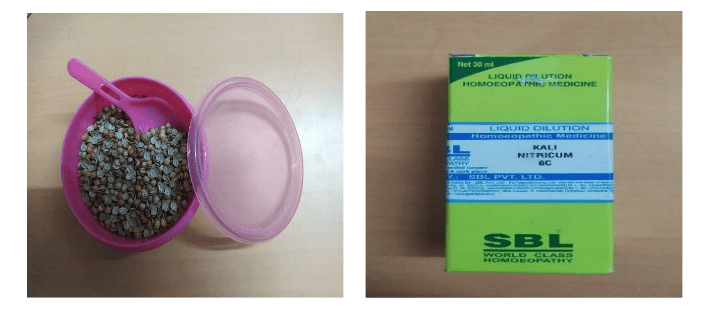
- Indigenous Coriander seeds from an authentic seed supplier from APMC, Sayajipura (Vadodara).
- Homoeopathic drug Kali nitricum 6C from an authentic pharmaceutical company (SBL Pvt Ltd).
- Small sized plastic pots.
- Soil (local- Sayajipura; ~~13.04025 N) free from organic & inorganic fertilizers or pesticides.
- Potable/Tap water.
- Garden water dispenser.
- Plastic measuring cup for liquids.
- Scale (to measure the height of plants)
METHODS –
- Sample Size-4 plants (Group 1- 2 plants & Group 2- 2 plants)
- Study Location-Pioneer Homoeopathic Medical College, Sayajipura, Vadodara (Google Map plus Code: 6X6R+F4V).
- Study site – Area allotted by the repertory department at Pioneer Homoeopathic Medical College campus
- Study Settings- 2 groups.
- Group 1: Kali nitricum 6C
Group 2: Plain water - This method ensured unbiased allocation and minimized selection bias.
- Study Period- 17 days
- Type of study – Randomized comparative experimental study
- Inclusion /exclusion criteria – Certain plants fail to grow, or if growth is halted during the study, then such plants shall be excluded.
Methodology
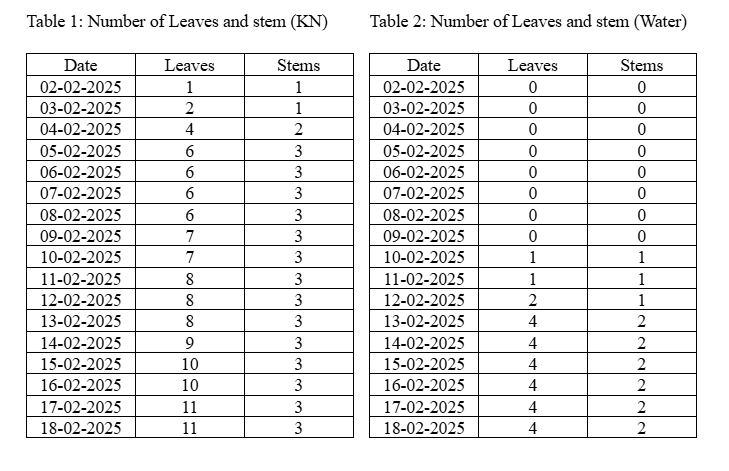
An experimental comparative study was conducted with two groups: Group 1 (Kali nitricum 6C) and Group 2 (plain water). Twenty healthy coriander seeds were randomly allocated into two equal groups (n = 10 each) to minimize selection bias. In Group 1, a 1:9 (v/v) dilution was prepared by mixing 2 ml of Kali nitricum 6C with 18 ml of distilled water to obtain a total volume of 20 ml, whereas Group 2 seeds were soaked only in distilled water. After 24 hours, the seeds were planted in separate plastic pots and kept under identical sunlight conditions. The number of leaves and stems was recorded every 24 hours as shown in the tables below.
Result
The observations of plant growth parameters, including number of leaves and stems, were recorded daily for both groups over 17 days. The raw observations are presented in Table 1 and Table 2.
Visual comparison of initial and final plant conditions (Fig. 1) further illustrates the difference in growth progression between the two groups.
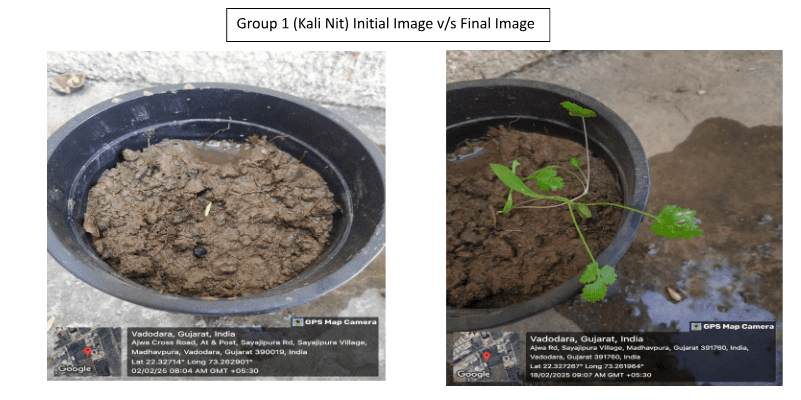
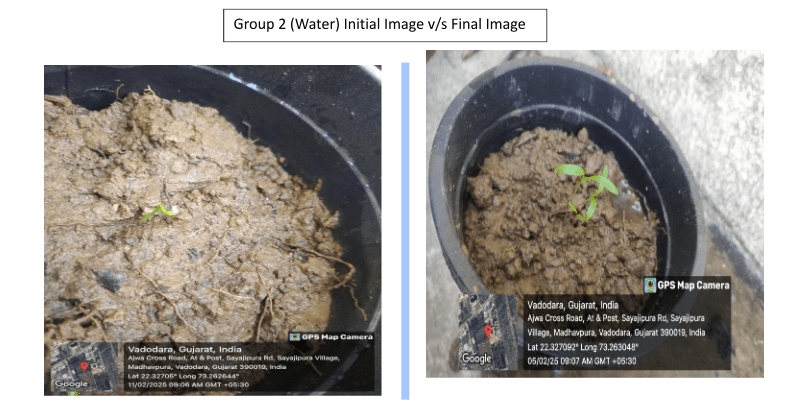
Fig. 1 Initial Image v/s Last Image
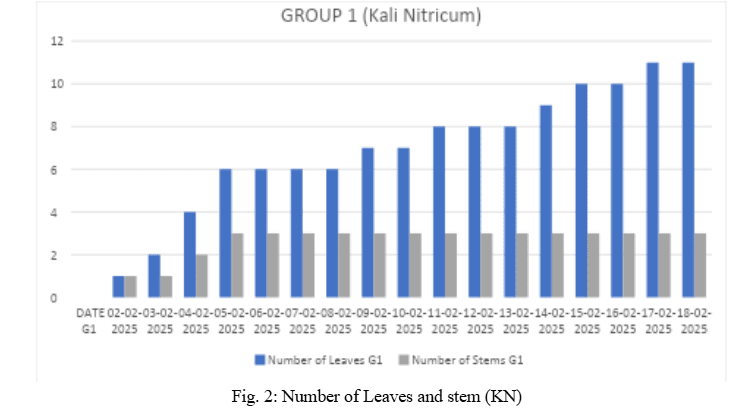
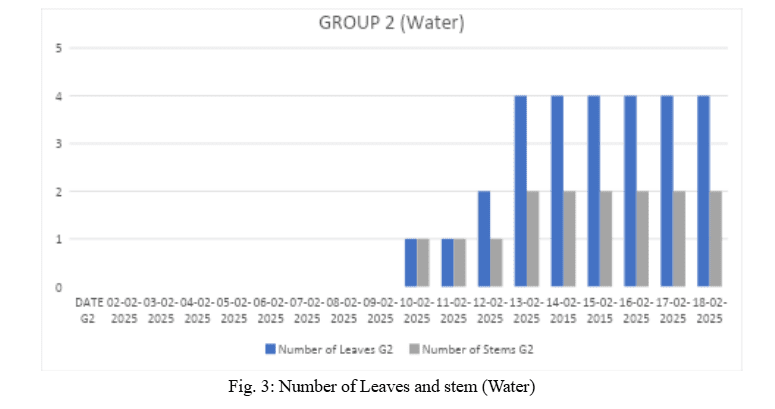
Figure 2 and Figure 3 shows Group 1 demonstrated earlier plant growth and a higher number of leaves. In contrast, Group 2 exhibited delayed growth, with germination occurring after 8 days of planting and producing comparatively fewer leaves than Group 1.
Table 3. Comparative Growth Statistics Between Groups
| Parameter | Group 1 (Kali nitricum) Mean ± SD | Group 2 (Water) Mean ± SD | t-value | p-value |
| Leaves | 7.06 ± 2.86 | 1.65 ± 1.87 | 6.53 | <0.001 |
| Stems | 2.71 ± 0.69 | 0.88 ± 0.93 | 6.52 | <0.001 |
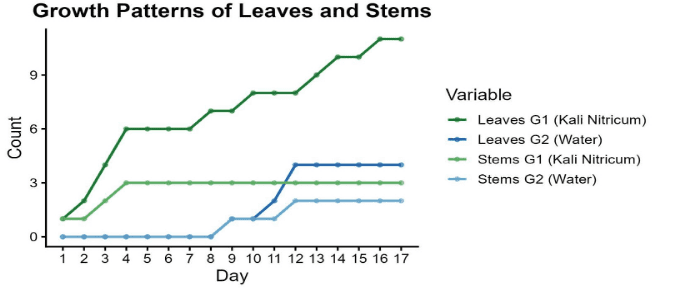
Fig. 4: Comparative Growth Statistics
Descriptive statistical analysis in Table 3, indicates higher mean leaf and stem counts in the treatment group compared to the control group. Independent t-test analysis demonstrated that both leaf number and stem number were significantly higher in the Kali nitricum group than in the water group (p < 0.001). Overall, the treatment group exhibited statistically significant improvement in vegetative growth compared with the control group.
Discussion
The findings of the present study indicate that Kali nitricum 6C has a positive influence on the growth and development of coriander plants when compared to plain water. Plants treated with Kali nitricum 6C demonstrated earlier germination and produced a greater number of leaves under identical environmental conditions, with a statistically significant difference between groups. The observations suggest that Kali nitricum 6C is capable of enhancing vegetative growth. However, as the experiment is done in small scale Larger experimental studies with adequate sample size and longer duration are required to confirm these findings and to evaluate the potentiality of homoeopathic preparations in agricultural fields.
Conclusion
The present study concludes that Kali nitricum 6C has a beneficial effect on the growth of coriander plants compared to plain water. The treatment group showed earlier germination and better vegetative development, as evidenced by faster growth and a higher number of leaves, with statistically significant improvement. Homoeopathic drug Kali nit 6c is effective in cultivating indigenous coriander as per data attained from current study.
References
- Patel MK, Jain A. Coriandrum sativum: review of its botany, medicinal uses, pharmacological activities and phytochemistry. J Drug Deliv Ther. 2025 Aug 1;15(8):294-302.
- Naeem MY, Kizildeniz T, Al Kaddour A, Tursun AO, Movila M. Coriander (Coriandrum sativum L.): a nutritional, aromatic and medicinal herb. [Place of publication]: Iksad Publications; 2022.
- Kangabam R, Patil KC. A comparative observational study on the effectiveness of Magnesium phosphoricum 6X and 6C in the growth of cilantro. Int J Homoeopath Sci. 2023;7(1 Pt D):200-205.
- Ramchandra SM, Paul SE. An experimental study on efficacy of Kalium phosphoricum 6X, 30C and 1M potencies on germination of Vigna radiata using quantitative and qualitative assessment of germination parameters. Indian J Integr Med. 2023 Jul 9;3(2):38-41.
- Sen S, Chandra I, Khatun MA, Chatterjee S, Das S. Agrohomeopathy: an emerging field of agriculture for higher crop productivity and protection of plants against various stress conditions. Int J Res Anal Rev. 2018;5(4):52-54.
- Majewsky V, Arlt S, Shah D, Scherr C, Jäger T, Betti L, et al. Use of homeopathic preparations in experimental studies with healthy plants. Homeopathy. 2009 Oct;98(4):228-243.
- Betti L, Trebbi G, Majewsky V, Scherr C, Shah-Rossi D, Jäger T, Baumgartner S. Use of homeopathic preparations in phytopathological models and in field trials: a critical review. Homeopathy. 2009 Oct;98(4):244-266.
- Jäger T, Scherr C, Shah D, Majewsky V, Betti L, Trebbi G, Bonamin L, Simões-Wüst AP, Wolf U, Simon M, Heusser P. Use of homeopathic preparations in experimental studies with abiotically stressed plants. Homeopathy. 2011 Oct;100(4):275-287.
- Toledo M, Stangarlin J, Bonato C. Homeopathy for the control of plant pathogens. Physiol Mol Plant Pathol. 2011;19(20):21.
CONFLICT OF INTREST – Nil
SPONSORSHIP – Self Sponsorship