

Abstract :
Physiologically, hormonal changes contribute to the development of disease conditions both physical and psychological. The symptoms may range from mild to severe, impacting daily activities and overall well-being enough to disrupt daily life.
According to the Homoeopathic system of medicine, the rapid, gentle, permanent removal of the disease in the shortest and harmless form is the highest ideal of cure. So, treating the disease is not the solution for illness.
This article aims to explore the literature of PMS in relation with Homoeopathic aspect to corelate the scope of Homoeopathy in management of these conditions.
Keywords: PMS, menstrual cycle, rubrics, indicated medicines, Homoeopathy.
Abbreviations: Premenstrual syndrome – PMS, Diagnostic Statistical Manual for Psychiatric Disorders – DSM.
Introduction:
In human beings, Hormones are the internal essences which contribute to a dominant role of different functions. Especially, female individuals come across various cycles of hormonal changes from birth till menopausal age followed by death.
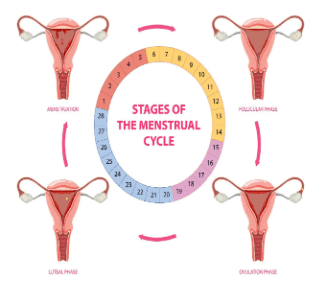
During these periods, body undergone through different changes. Nonetheless, hormonal dysfunction are the precursor of certain health conditions.
Premenstrual syndrome or premenstrual tension (PMT—as it has been commonly called) is characterised by a variety of physical, psychological and behavioural symptoms occurring in the second half of menstrual cycle. Typically, the symptoms start after a few days of ovulation, reach a peak about 4-5 days before menstruation and disappear usually around menstruation. The period between menstruation and next ovulation is normal.
- Clinical features
- Physical symptoms –
- weight fluctuation,
- abdominal bloating
- headache
- breast tenderness
- swollen extremities
- backache
- nausea
- vomiting
- constipation
- Mental & behavioral symptoms –
- Anger outbursts
- Depression
- Irritability
- Anxiety
- Confusion
- Restlessness
- Social withdrawal.
The causes is probably multifactorial. The biological factors include faulty luteinisation, excess of estrogens, and progesterone deficiency. The psychosocial factors encompass education, expectations and attitudes towards menstruation and femininity (‘tension’ about menstruation).[1]
A number of studies all around the world have been done.
A systematic and meta – analysis concluded that the prevalence of premenstrual syndrome in India, is 43 % in adolescent age group. A study was conducted to estimate the prevalence among college students, and was found to be 18.4 %, in which moderate to severe cases of premenstrual syndrome were reported to be 14.7 % and premenstrual dysphoric disorder of 3.7%.[2]
As per American Congress of Obstetrics and Gynaecology, premenstrual syndrome is said to be diagnosed if the symptoms are present in the 5 days before a period for atleast 3 menstrual cycles in a row, and end within 4 days after a period starts and interfere with normal activities of the female.[2]
International Classification of Diseases 11 edition, termed it as premenstrual tension syndrome. A syndrome affecting females that is frequently idiopathic. This syndrome is characterized by certain environmental, metabolic, or behavoural factors that occur during the luteal phase of the menstrual cycle, and leads to cyclic emotional, physical, or behavoural symptoms that interfere with an individual lifestyle. [3]
According to Diagnostic and Statistical Manual of Mental Disorders 4th and 5th editions, premenstrual syndrome is a psychological disorder, in which its premenstrual dysphoric disorder. [4]
- Treatment
1. The treatment of water retention can be by diuretics, and restricting the fluid intake. Thiazide diuretics are often prescribed but spironolactone (an aldosterone antagonist) is probably superior.
2. Psychotherapy may be helpful in some cases where conflicts regarding menstruation and/or femininity are present.
3. Hormonal treatment with oral or parenteral progesterone has been recommended by some, with good results.
4. In resistant cases, other drugs such as lithium, bromocriptine, pyridoxine, antidepressants and anti- anxiety agents have been used with varying success.
- Previous Research Studies
- A Semi – Individualized Homeopathy Add – On Versus Usual Care Only for Premenstrual Disorders: A Randomized, Controlled Feasibility Study.
A multicentric, randomized, controlled pragmatic trial with parallel groups using Daily Record of Severity of Problems for 2 months. In the study, usual care along with homoeopathic treatment in group A and only usual care in group B with intention to treat and per pertocol analysis was used. The study concluded 11 number of homoeopathic medicines namely, Sepia, Natrum muriaticum, Lachesis, Cimicifuga, Lac- caninum, Pulsatilla, Calc carb, Lilium – tiglium, Mag phos, Mag – carb, Phosphorus found to be effective in premenstrual syndrome.[5]
- A Placebo Controlled Double – Blind Randomized Trial Within Individualized Homoeopathic Treatment Using A Symptom Cluster Approach in Women with Premenstrual Syndrome.
A total of 105 patients (Active = 49; Placebo = 56) were randomized to receive individualized homoeopathic treatment or placebo with 2 months follow up. Out of which 43 patients from the active group and 53 from placebo group were analyzed under intention to treat principle. In the study pre – selected homoeopathic medicines were included. A Menstrual distress questionnaire was used. Individualized prescribed homoeopathic medicines were associated with significantly greater improvement of premenstrual scores in women with premenstrual syndrome, compared to placebo.[6]
HOMOEOPATHIC APPROACH:
- FEW RUBRICS from Uterine therapeutics by MINTON [7]
- Abdomen, distention of
- Abdomen, pain in, labor like
- Anxious about trifles
- Apprehensive
- Aversion to noise, loud
- Back, pain in
- Chest, cramps in
- Cholera – like symptoms
- Extremities, lower, swelling, of the
- Fear, full of
- Headache
- Mammae, soreness of
- Mood, sentimental
- Nausea
- Restlessness
- Sadness
- Temper, can scarely keep her
- Vomiting
- Weeping mood
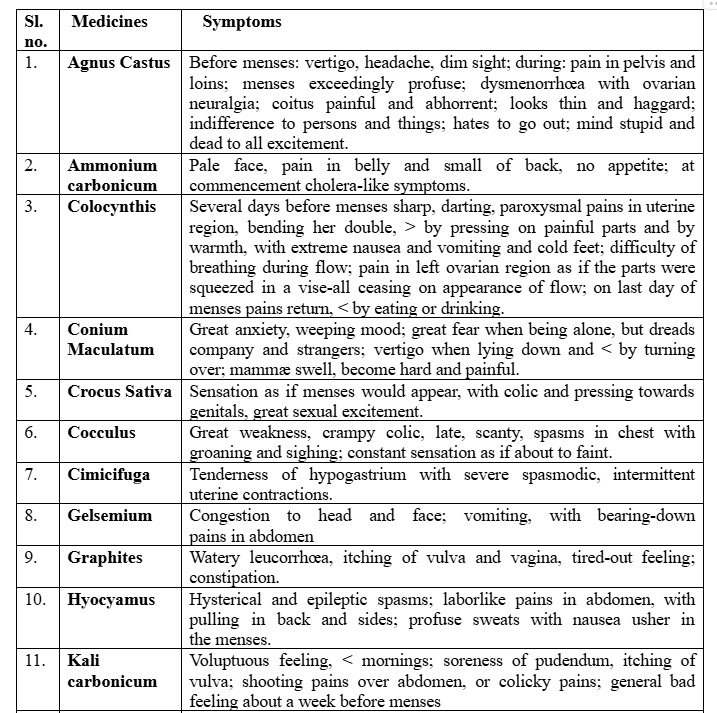
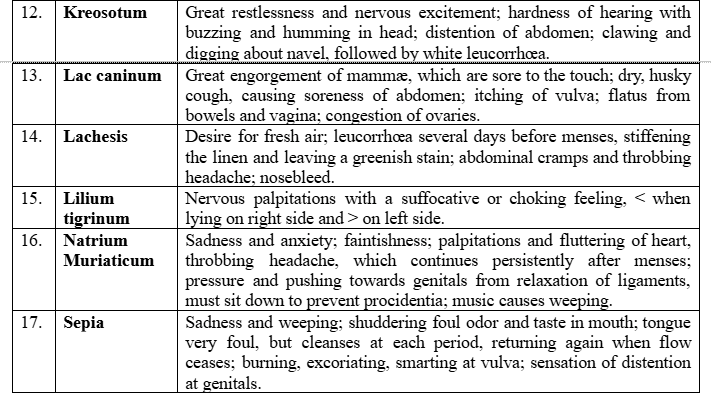
Indicated medicines along with symptoms:- [8][9]
Conclusion:
Homoeopathy treats PMS by considering the whole person – emotional, physical, and behavioral complaints. Individualized Homoeopathic treatment can improve overall well-being and quality of life in women. It is often used as a complementary for management, aiming to address both physical and emotional symptoms holistically. Thus, Homoeopathy may serve as an effective approach, especially for those seeking gentle, holistic, and personalized care.
Reference:
- Dutta DC, Hiralal Konar. DC Dutta’s textbook of gynecology: including contraception. New Delhi: Jaypee; 2016.
- Dutta A, Sharma A. Prevalence of premenstrual syndrome and premenstrual dysphoric disorder in India: A systematic review and meta-analysis. Health Promotion Perspectives. 2021 May 19;11(2):161–70.
- World Health Organization. ICD-11 [Internet]. who.int. World Health Organization; 2019. Available from: https://icd.who.int/en/
- American Psychiatric Association. Diagnostic and statistical manual of mental disorders. 5th ed. Arlington, VA: American Psychiatric Publishing; 2013.
- Klein-Laansma CT, Jong M, von Hagens C, Jansen JPCH, van Wietmarschen H, Jong MC. Semi-Individualized Homeopathy Add-On Versus Usual Care Only for Premenstrual Disorders: A Randomized, Controlled Feasibility Study. The Journal of Alternative and Complementary Medicine. 2018 Jul;24(7):684–93.
- A Placebo-Controlled Double-Blind Randomized Trial with Individualized Homeopathic Treatment Using a Symptom Cluster Approach in Women with Premenstrual Syndrome
- Minton H. Uterine Therapeutics. 1884.
- Dr William Boericke. Pocket manual of homoeopathic materia medica; 2012.
- Allen HC. Keynotes: rearranged and classified with leading remedies of the materia medica and bowel nosodes including repertorial index. Noida, U.P., India: B. Jain Publishers (P) Ltd; 2017.