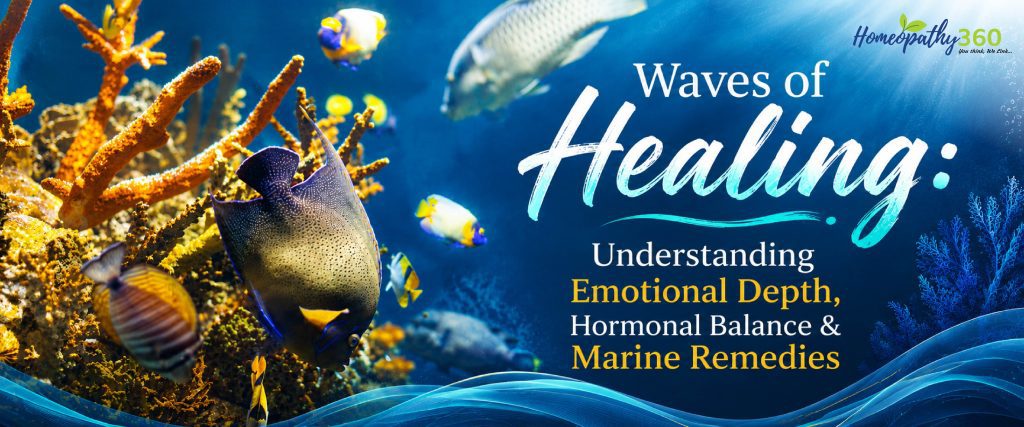
Waves of Healing : Understanding Emotional Depth, Hormonal Balance & Marine Remedies
Abstract
Marine Materia Medica represents a distinctive subgroup within the animal kingdom of homoeopathic remedies. Remedies derived from marine organisms demonstrate unique patterns of symptom expression characterized by sensitivity, hormonal disturbances, emotional depth, fluid imbalance, and instinctive survival responses. The oceanic environment, with its dynamic rhythm and adaptive biological systems, is reflected in the physiological and psychological symptomatology of patients requiring sea remedies. Marine-derived medicines have a significant therapeutic sphere affecting the endocrine system, reproductive organs, respiratory tract, skin, and nervous system. Important remedies such as Sepia officinalis, Spongia tosta, Murex purpurea, Medusa, and Calcarea carbonica demonstrate profound therapeutic action in chronic constitutional states as well as acute pathological conditions. This article explores the conceptual background, classification, therapeutic indications, psychological themes, and clinical significance of marine remedies in homoeopathic practice.
Keywords
Marine remedies; Sea remedies; Homoeopathic therapeutics; Animal kingdom remedies; Marine Materia Medica; Oceanic remedies
Introduction
The oceans represent the earliest cradle of biological evolution, hosting an immense diversity of life forms that have adapted to unique environmental conditions such as high pressure, darkness, salinity, and constant fluid movement. These adaptive mechanisms are reflected in the biological and behavioral characteristics of marine organisms. In homoeopathy, remedies derived from these organisms often manifest themes of sensitivity, defense, fluid regulation, and survival under environmental stress.
According to the principles established by Samuel Hahnemann, homoeopathic medicines exert their therapeutic action by producing symptoms in healthy individuals that resemble those observed in disease states. Marine remedies therefore demonstrate symptom patterns that reflect their biological origin and ecological behavior.
The therapeutic scope of marine remedies has been gradually expanded through provings, clinical observations, and theoretical analysis by homoeopathic authors. Modern interpretations also emphasize kingdom analysis, which groups remedies according to their biological origin and identifies common thematic expressions among them. These insights help practitioners recognize marine remedy indications even when the presenting pathology differs.
Sea remedies have shown particular effectiveness in disorders involving hormonal imbalance, emotional hypersensitivity, glandular enlargement, respiratory spasms, and allergic reactions. Remedies such as Sepia officinalis, Calcarea carbonica, Spongia tosta, and Natrum muriaticum remain among the most frequently prescribed medicines in clinical homoeopathy. Their therapeutic indications have been extensively documented in classical materia medica literature.
Thematic Essence of Marine Remedies
Marine remedies often reflect the characteristics of the ocean environment in both psychological and physical expressions. The themes of depth, protection, hypersensitivity, and fluid regulation frequently appear in patients requiring these remedies.
- Ocean Depth → Emotional Depth
The ocean symbolizes vast depth and hidden currents. Similarly, patients needing marine remedies often possess deep emotional sensitivity and intense inner experiences. Their feelings may be profound but not easily expressed. Remedies like Sepia officinalis and Natrum muriaticum often show this pattern of silent emotional suffering and internalized grief.
- Shell Protection → Defensive Personality
Many marine organisms protect themselves with shells or hard exoskeletons. In the same way, patients needing marine remedies may develop a protective emotional barrier, appearing reserved, cautious, or withdrawn in relationships. This defensive attitude reflects a subconscious need for security, as seen in remedies such as Calcarea carbonica.
- Marine Toxins → Allergic Reactions
Marine life frequently uses toxins for defense. Correspondingly, marine remedies are often indicated in hypersensitivity and allergic conditions, especially skin eruptions with burning or stinging sensations. Remedies such as Medusa and Astacus fluviatilis demonstrate this therapeutic affinity.
- Fluid Environment → Hormonal and Metabolic Balance
Life in the ocean requires precise regulation of fluids and salts. Likewise, many marine remedies influence hormonal balance, metabolism, and fluid regulation in the human body. Disorders such as menstrual irregularities, endocrine disturbances, and metabolic imbalance often correspond to remedies like Sepia officinalis and Natrum muriaticum.
Classification of important marine remedies
| Marine group | Remedy | Therapeutic sphere |
| Mollusk | Sepia | Female reproductive system |
| Mollusk | Murex | Pelvic congestion |
| Shell | Calcarea carb | Metabolic disorders |
| Sponge | Sponging tosta | Respiratory disorders |
| Coral | Corralium rubrum | Spasmodic cough |
| Jelly fish | Medusa | Allergic skin condition |
| Crustacean | Astacus Fluviatilis | Urticaria |
| Echinoderm | Asterias rubens | Breast gland disorders |
| Marine mammals | Ambra grisea | Nervous disorders |
| Sea salt | Natrum muriaticum | Emotional disturbances |
Therapeutics of marine remedies
- Hormonal Exhaustion with Pelvic Weakness
Key Indicating Symptoms
• Bearing-down sensation in uterus as if organs would fall out
• Indifference to family members and loved ones
• Irritability before menstruation
• Weakness and exhaustion after childbirth
• Yellowish complexion with facial discoloration
• Desire for solitude and aversion to company
Remedy – Sepia officinalis
- Excessive Sexual Excitement with Pelvic Congestion
Key Indicating Symptoms
• Intense sexual desire
• Sensation of fullness and pressure in uterus
• Pain extending from uterus toward chest or breasts
• Painful menstruation with uterine congestion
• Sensation as if uterus is enlarged
Remedy – Murex purpurea
- Weak Metabolism with Constitutional Fatigue
Key Indicating Symptoms
• Tendency toward obesity with weakness
• Profuse perspiration of the head during sleep
• Delayed development in children
• Fearfulness and anxiety about health
• Cold and damp constitution
• Easily fatigued after slight exertion
Remedy – Calcarea carbonica
- Spasmodic Dry Cough with Suffocation
Key Indicating Symptoms
• Dry barking cough
• Cough worse after midnight
• Sensation of suffocation during cough
• Extreme dryness in throat and larynx
• Cough sounding like sawing wood
Remedy – Spongia tosta
- Violent Paroxysmal Cough
Key Indicating Symptoms
• Rapid successive coughing spells
• Face becomes red during coughing
• Suffocation sensation during attack
• Whooping cough in children
• Cough triggered by irritation of throat
Remedy – Corallium rubrum
- Burning Allergic Skin Eruptions
Key Indicating Symptoms
• Intense burning and stinging pain in skin
• Urticaria with redness and swelling
• Skin eruptions appearing suddenly
• Severe itching aggravated by heat
• Hypersensitive skin reactions
• also has marked action on mammary gland. Secretion of milk was established after lack of it in all previous confinement.
Remedy – Medusa
- Chronic Urticaria with Digestive Disturbance
Key Indicating Symptoms
• Recurrent urticaria
• Skin eruptions after eating seafood
• Severe itching and redness
• Digestive disturbances with liver congestion
• Allergic skin reactions aggravated by food
• cough better when walking but return as soon he sits down
Remedy – Astacus fluviatilis
- Breast Disorders with Glandular Enlargement
Key Indicating Symptoms
• Hard nodules in breast tissue
• Painful swelling of mammary glands
• Sensitivity of breasts before menstruation
• Burning or shooting pain in breast
• Glandular induration in mammary tissue
• acne rosacea in adolescence
• left breast feels as if pulled inward and pain extend to inner arm and tip of litter finger
• Cancer of mammae even in the ulcerative stage
Remedy – Asterias rubens
- Extreme Nervous Sensitivity
Key Indicating Symptoms
• Shyness and embarrassment in social situations
• Nervous trembling and anxiety
• Sleeplessness due to mental excitement
• Hypersensitivity to noise and conversation
• Weakness of nervous system
Remedy – Ambra grisea
- Silent Grief with Chronic Headache
Key Indicating Symptoms
• Reserved and emotionally sensitive personality
• Headaches from emotional stress
• Craving for salt
• Tendency toward depression after disappointment
• Aversion to consolation
Remedy – Natrum muriaticum
Rare remedies
- Badiaga (Freshwater Sponge) – Badiaga mainly affects the head and muscular tissues, producing soreness as if bruised or beaten. The characteristic symptom is headache with aching behind the eyeballs, especially from 2 p.m. to 7 p.m., worse from motion. There may also be vertex headache better at night but returning after breakfast, and pain in the forehead and temples extending to the eyeballs. Muscles and tissues are painful even to the touch of clothes. During coughing, mucus may be violently expelled from mouth and nostrils
- Conchiolinum (Mother of Pearl) – acts chiefly on the bones, particularly the growing ends. It is indicated in sudden intense bone pains, which may begin continuously and later become intermittent. The bones may show swelling with sharply defined margins and extreme tenderness to touch. The condition may be accompanied by fever, thirst, loss of appetite, sleeplessness and dark coloured urine. It is useful in developmental bone disorders, similar in action to Calcarea remedies.
- Erythrinus (Red Mullets) – primarily affects the skin, producing peculiar red eruptions. It has been used successfully in cases of pityriasis rubra, especially when the eruption appears as large red patches. The remedy has also been associated with syphilitic skin manifestations, and Aurum metallicum is considered a complementary remedy in such conditions.
- Gadus morrhua (Cod Fish) – acts mainly on the respiratory system. A characteristic symptom is flapping of the alae nasi during breathing, indicating respiratory weakness. Patients may experience heat of the hands, and mentally they may show hopelessness with a desire for death. The remedy suggests weakness and difficulty in respiration.
- Helix tosta (Toasted Snail) – Helix tosta has been used in conditions of chronic lung disease, especially tuberculosis. Its main symptoms include dyspnoea, hemoptysis, and persistent hoarseness with a dry tickling cough. The remedy is considered useful where pulmonary weakness and chronic irritation of the respiratory tract are prominent.
- Homarus (Digestive Fluid of Lobster) – acts on the gastrointestinal tract and skin, with a characteristic aggravation after taking milk. Symptoms include dyspepsia with headache and sore throat, the throat appearing inflamed, dry and granulated with enlarged blood vessels. Patients may experience itching eruptions shifting from place to place, worse at night but relieved by scratching. Other symptoms include sudden sharp back pains compelling the patient to sit down, chilliness with trembling, disturbed sleep, loss of appetite and general fatigue.
- Hydrophis cyanocinctus (Sea Serpent) – mainly affects the nervous and muscular systems, producing symptoms similar to paralysis or poliomyelitis. There may be weakness or paralysis of the lower limbs with numbness and heaviness. Mentally the patient may show depression, irritability, weeping, forgetfulness and difficulty concentrating, sometimes alternating with euphoria followed by sadness. Other symptoms include itching of the skin, disturbed sleep with nightmares, epigastric pain after eating, and thirst for cold drinks.
- Lac delphinum (Dolphin Milk) – strongly affects the mental and emotional sphere. The proving showed themes of playfulness, pleasure, calmness during danger and strong social bonding. Patients may feel exploited or misunderstood, with deep depression, guilt and spiritual questioning about life’s purpose. There may be extreme irritability, sensitivity to noise, fear of cancer, jaw clenching, convulsive tendencies and sinusitis. The remedy also reflects themes of nurturing and emotional connection.
- Limulus cyclops (King Crab) – Limulus cyclops acts mainly on the circulatory system and skin. It produces rush of blood to the face with heat and generalized body pain. Patients may feel great physical and dental exhaustion, and drowsiness after sea bathing. The proving also showed itching spots and vesicular eruptions on the face and hands, and the remedy has been suggested for conditions such as cholera, diarrhoea and skin diseases
- Oleum jecoris aselli (Cod-liver Oil) – remedy for defective nutrition and scrofulous states. It affects the chest, liver and general metabolism, producing emaciation, anaemia, weakness and intolerance of milk, especially in atrophic or poorly nourished children. Patients may have hot head and hands, burning palms in the evening, violent palpitations, soreness of the chest, and dry hacking cough at night. It is useful in the early stages of tuberculosis and nutritional deficiency states.
- Physalia pelagia (Portuguese Man-of-War) Z- Physalia pelagia produces symptoms similar to the sting of a jellyfish, with sudden burning and stinging pain like nettle sting. The pain may spread from the finger to the arm, shoulder and chest, sometimes causing difficulty in breathing. A blister forms at the site of the sting, and later numbness of the limb may remain. Clinically it has been used in urticaria and allergic skin conditions.
- Trachinus draco (Sting Fish) – indicated in acute blood poisoning and septic conditions with intense burning and throbbing pain. The affected part becomes swollen and extremely painful, and the swelling may spread to the arm, head or chest. There may be fever, delirium and gangrene, with pain radiating from the wound to the chest. It is useful in toxic wounds and severe inflammatory states.
- Venus mercenaria (American Scallop) – mainly indicated for migraine headaches of digestive origin. The headache is often frontal or occipital, predominantly right-sided, and worse in the morning and afternoon, accompanied by vertigo, nausea and vomiting. Patients may have a dull, indifferent mood, poor concentration, and disturbed sleep with waking at 2 a.m. Dreams may involve spiders or violence. Digestive symptoms include nausea after eating and pressing pain in the stomach relieved after eating.
Discussion
Marine remedies reflect the essence of the ocean—depth, protection, fluidity, and sensitivity. They act on both mental-emotional and physical levels, making them ideal for constitutional prescribing. Common remedies like Sepia, Spongia, Murex, Medusa, and Asterias rubens address hormonal, glandular, respiratory, nervous, and dermatological disorders, while rare remedies such as Badiaga, Lac delphinum, and Gadus morrhua expand therapeutic possibilities to chronic, allergic, or rare conditions.
Kingdom-based analysis helps practitioners link biological origin with symptom patterns, enabling precise selection for patients with emotional depth, hypersensitivity, or chronic constitutional weakness. Overall, marine remedies demonstrate how the behavior and ecology of sea life translate into human symptomatology.
Conclusion
Marine Materia Medica is a unique and versatile resource in homoeopathy. Its remedies combine emotional, physical, and instinctive symptom patterns, reflecting oceanic themes of depth, defense, hypersensitivity, and fluid balance. Both common and rare marine remedies offer effective solutions for complex and chronic conditions, highlighting the importance of individualized, totality-based prescribing. Further provings, documentation, and clinical application of these remedies can enhance therapeutic precision and clinical outcomes in homoeopathic practice
References
- Boericke W. Pocket Manual of Homoeopathic Materia Medica. 9th ed. New Delhi: B Jain Publishers; 2013.
- Kent JT. Repertory of the Homoeopathic Materia Medica. 3rd ed. New Delhi: B Jain Publishers; 2010.
- Hahnemann S. Organon of Medicine. 6th ed. New Delhi: B Jain Publishers; 2013.
- Clarke JH. Dictionary of Practical Materia Medica. Vol 4. New Delhi: B Jain Publishers; 2009.
- Allen TF. The Encyclopedia of Pure Materia Medica. Vols 1–12. New Delhi: B Jain Publishers; 2012
- Cox E. The Mini Kingdom of Sea Remedies. London: Homeopathic Publications; 2005.
- Singh A, Saxena S. Sea Remedies in Homeopathy: Therapeutic Applications. Int J Homoeop Clin Res. 2018;8(1):45–59.
- Evolution of Marine Creatures as Homoeopathic Remedy [Internet]. Scribd. 2014 [cited 2026 Mar 12]. Available from: https://www.scribd.com/doc/207485495/Evolution-of-Marine-Creatures-as-Homoeopathic-Remedy�
- Mini Kingdom of Sea Remedies – Emma Cox [Internet]. Google Drive. [cited 2026 Mar 12]. Available from: https://share.google/6ssEtPhOZAcyJuN4G�
- Sea Remedies in Homeopathy [Internet]. Google Drive. [cited 2026 Mar 12]. Available from: https://share.google/9LCUTB2opL3HJhKeG�