Abstract
Haemorrhoids, especially in their advanced stages (3rd and 4th degree), are often managed through surgical intervention. However, many patients prefer alternative treatments, especially when surgery poses risks or is undesirable. This article presents the case of a 38-year-old male patient diagnosed with external, prolapsed 3rd to 4th-degree haemorrhoids and a non-pyogenic anal fistula. The patient opted for homoeopathic treatment instead of surgery. Palliative care with selected homoeopathic remedies significantly alleviated his symptoms, allowing him to delay surgery and improve his quality of life until a final decision was made.
Introduction
Haemorrhoids are a common condition characterized by the swelling of the anal veins, often leading to pain, discomfort, and other debilitating symptoms. In severe cases, particularly those complicated with fistula in ano, conventional medicine recommends surgical treatment.
Homoeopathy, however, provides a safe, gentle, and individualized approach, with the potential to palliate distressing symptoms in advanced and incurable cases. This case report demonstrates the role of palliative homoeopathic care in severe haemorrhoids with associated non-pyogenic fistula, where surgery was initially refused.
Case Summary
A 38-year-old male presented with severe symptoms of 3rd to 4th degree haemorrhoids with external protrusion and a non-pyogenic anal fistula.
Presenting Complaints:
- Burning sensation in the anus, particularly after stool.
- Violent itching around the anus, worse in the evening and after stool.
- Orgasm-like relief after intense scratching of the affected area.
- Aggravation of symptoms when thinking about them, creating mental distress.
- Relief by washing with cold water after stool.
- Emotional nature: sympathetic, helpful, concerned for others’ well-being.

(Protruding haemorrhoids 3rd to 4th Degree at 3, 7, and 11 o’clock position with non-pyogenic fistula in ano)
Physical Generals
To complete the totality, the following physical generals were elicited:
- Appetite: Moderate, not much disturbed.
- Thirst: Normal, not excessive.
- Desires: Strong craving for spicy food, chicken, and hot curry.
- Aversions: Strong aversion to brinjals and fermented food items.
- Perspiration: Moderate, non-offensive.
- Urination: Increased frequency; has to pass urine 10–12 times daily.
- Stool: Patient avoids defecation due to pain; passes stool only once or twice despite urge.
- Sleep: Sleeps without clothes, on the left lateral side.
- Dreams: Not specific, usually not remembered.
These generals further supported the remedy selection and gave depth to the individualization.
Totality of Symptoms
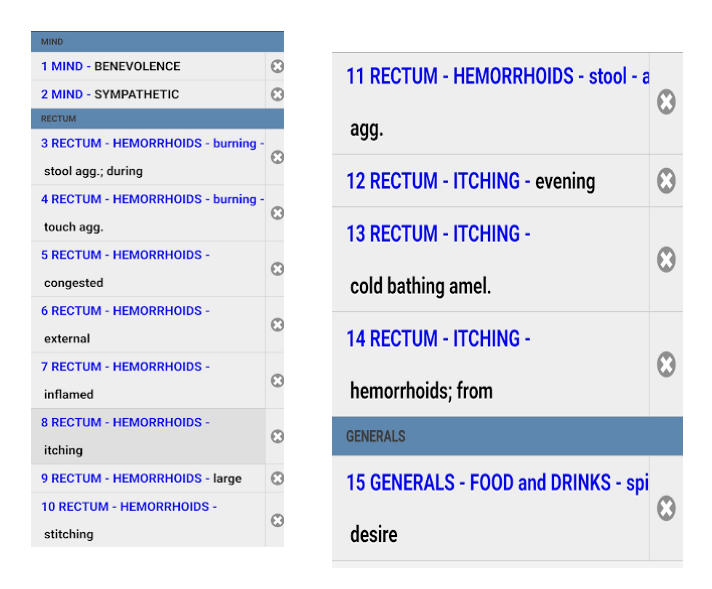
The following totality was derived by considering the most characteristic, peculiar, and persistent symptoms at the mental, general, and particular levels:
Mental Symptoms
Sympathetic, caring, and helpful nature; sensitive to the suffering of others.
Anxiety and mental distress aggravated by thinking of his condition.
Irritability and dissatisfaction from continuous discomfort.
General Symptoms
Desires: spicy food, chicken, hot curry.
Aversions: brinjals, fermented foods.
Thermal modality: Relief from washing with cold water.
Sleep: without clothes, on left lateral side.
Urination: frequent, 10–12 times daily.
Perspiration: moderate, non-offensive.
Particular Symptoms
Protruding haemorrhoids (3rd–4th degree) at 3, 7, and 11 o’clock positions.
Associated non-pyogenic anal fistula.
Burning pain in anus, especially after stool.
Violent itching around anus, worse in evening and after stool.
Orgasm-like relief after scratching.
Fear and anxiety regarding his condition.
Aversion to passing stool due to intense pain, goes only once or twice despite urge.
Characteristic Features:
Burning + itching after stool.
Relief from cold water application.
Mental distress from dwelling on his condition.
Sympathetic emotional nature.
Cravings (spicy food, chicken) and aversions (brinjal, fermented foods).
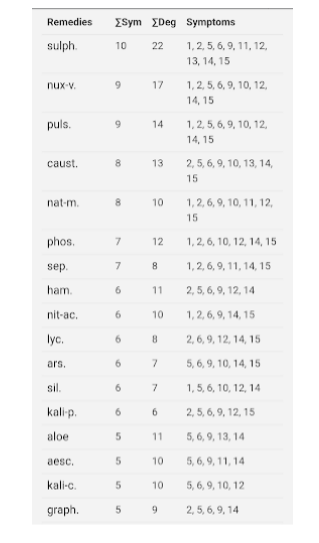
Repertorial totality (synthesis Mobile version)
Homoeopathic Approach
Given the severity of the pathology, the approach was strictly palliative. The goal was symptom control and comfort, not structural reversal. Remedies were chosen on the totality of symptoms, including local, general, and mental characteristics.
Remedies Prescribed
1. Aloes Socotrina (30C)
- Symptoms Treated: Burning, soreness, heaviness in anus; prolapsing haemorrhoids; aggravation after stool.
- Modalities: Aggravation in morning, after eating; relief from washing with cold water.
- Mental: Irritability and dissatisfaction from constant discomfort.
2. Ratanhia Peruviana (200C)
- Symptoms Treated: Violent burning, itching, stitching pain in anus after stool; intense urge to scratch with temporary relief.
- Modalities: Worse at night, after stool, with sitting; better from cold water.
- Mental: Anxious, fearful, helpless.
3. Causticum (200C)
- Symptoms Treated: Burning, rawness in anus; suited to sensitive, sympathetic patients.
- Modalities: Worse from mental stress; better from cold water.
- Mental: Emotional sensitivity, sympathetic, even clairvoyant-like.
4. Kali Carbonicum (200C)
- Symptoms Treated: Severe burning after stool, evening aggravation; oversensitivity to impressions.
- Modalities: Better with warmth and cold applications.
- Mental: Health-anxious, overwhelmed socially.
Treatment Outcome
- By the end of March, the patient reported significant relief in burning, itching, and post-stool discomfort.
- Mental distress and anxiety were reduced.
- Though prolapse persisted, it became manageable.
- The patient successfully delayed surgery, continuing his daily life with better comfort.
- In the last week of March, the patient finally opted for surgery. Thuja 1M (one dose) was prescribed post-surgery for constitutional support.
Discussion
This case shows the palliative role of homoeopathy in advanced haemorrhoids where surgery is often unavoidable. Remedies like Aloes, Ratanhia, Causticum, and Kali Carb helped alleviate distressing local and mental symptoms.
As Hahnemann emphasized in Organon of Medicine, §186:
“Palliation is not against homoeopathy; it is one of its highest duties where cure is impossible.”
Similarly, Kent noted in Lectures on Homoeopathic Philosophy:
“Even in incurable cases, the quality of life can be greatly improved by carefully selected remedies.”
Palliation: Views of Different Stalwarts
- Hahnemann (Organon, §186):
He stated that palliation is a legitimate and moral duty when cure is not possible, as relief from suffering is in itself a form of healing.
- Kent (Lectures on Homoeopathic Philosophy):
Kent emphasized that palliation is not contrary to homoeopathy but a part of its highest mission, provided remedies are chosen on similarity.
- Stuart Close (The Genius of Homoeopathy):
Close wrote:
“Palliation is not suppression. True palliation in homoeopathy relieves suffering, while respecting the laws of cure.”
He clarified the difference between palliation through similars (beneficial) and suppression through contraries (harmful).
- H.A. Roberts (Principles and Art of Cure by Homoeopathy):
Roberts described palliation as relieving without curing, yet still working within the law of similars. He advocated for it especially in advanced, incurable pathology.
- Boericke (Pocket Manual of Materia Medica):
Boericke considered the palliative sphere as noble and legitimate, when the physician’s duty is to ease suffering.
Thus, homoeopathy recognizes palliation as a humane, ethical, and scientific responsibility, especially in advanced pathologies where cure is beyond reach.
Conclusion
This case emphasizes the vital role of homoeopathy in palliation. In advanced haemorrhoids with fistula, where structural reversal is
impossible without surgery, carefully chosen remedies helped alleviate suffering, reduced mental distress, and improved quality of life.
Homoeopathy thus complements modern medicine by offering relief and comfort where surgery is delayed or refused. The successful palliation in this case reflects the humanitarian essence of homoeopathy, aligning with Hahnemann’s principles and the philosophy of later stalwarts.
Consent: Informed consent was taken from the patient for publication.
References
- Boericke, W. Pocket Manual of Homoeopathic Materia Medica.
- Kent, J.T. Lectures on Homoeopathic Materia Medica.
- Clarke, J.H. A Dictionary of Practical Materia Medica.
- Allen, T.F. The Encyclopaedia of Pure Materia Medica.
- Hahnemann, S. Organon of Medicine, 6th Edition.
- Stuart Close, The Genius of Homoeopathy.
- Roberts, H.A. The Principles and Art of Cure by Homoeopathy.
✍️ By: Hiren A. Mahera
(4th Year BHMS)
PHMC