Inflammatory Bowel Disease: An Integrative Homeopathic Perspective on Autoimmunity, Miasmatic Theory, and Constitutional Management
Abstract
Inflammatory Bowel Disease (IBD), comprising Ulcerative Colitis (UC) and Crohn’s Disease (CD), is a group of chronic, relapsing inflammatory disorders affecting the gastrointestinal tract. Although considerable advances have been made in understanding the disease, its exact cause remains uncertain. Current evidence suggests that IBD develops through a complex interaction of genetic susceptibility, environmental influences, alterations in the gut microbiota, and dysregulated immune responses.
Over the past few decades, several therapeutic strategies have been investigated to target different aspects of disease pathogenesis. These include butyrate enemas to improve colonic epithelial metabolism, leukocyte apheresis, anti-CD4 monoclonal antibodies, bone marrow transplantation, and therapies aimed at reducing leukocyte migration through adhesion molecule blockade. Other approaches, such as cyclooxygenase-2 (COX-2) inhibitors, leukotriene B4 inhibitors, thromboxane antagonists like ridogrel, and antioxidant therapies including superoxide dismutase, have shown varying degrees of clinical benefit in selected patients.
Despite these advances, conventional management continues to face important challenges. Long-term use of corticosteroids, immunosuppressants, and biological agents is associated with significant adverse effects, including osteoporosis, opportunistic infections, loss of therapeutic response, and an increased risk of malignancy. Furthermore, patients with refractory disease or those who develop severe complications may ultimately require surgical procedures such as total proctocolectomy.
These limitations have encouraged interest in individualized therapeutic approaches that seek not only to control inflammation but also to improve overall immune regulation and patient well-being. Homeopathy, with its constitutional and patient-centered approach, has been explored as a complementary system of medicine for managing chronic autoimmune disorders. This review discusses the current understanding of IBD, examines its immunopathogenesis from both conventional and homeopathic perspectives, and highlights the role of constitutional prescribing, miasmatic interpretation, repertorial analysis, and selected Materia Medica in the holistic management of the disease.
Comparative Pathophysiology and Biomolecular Mechanics of IBD
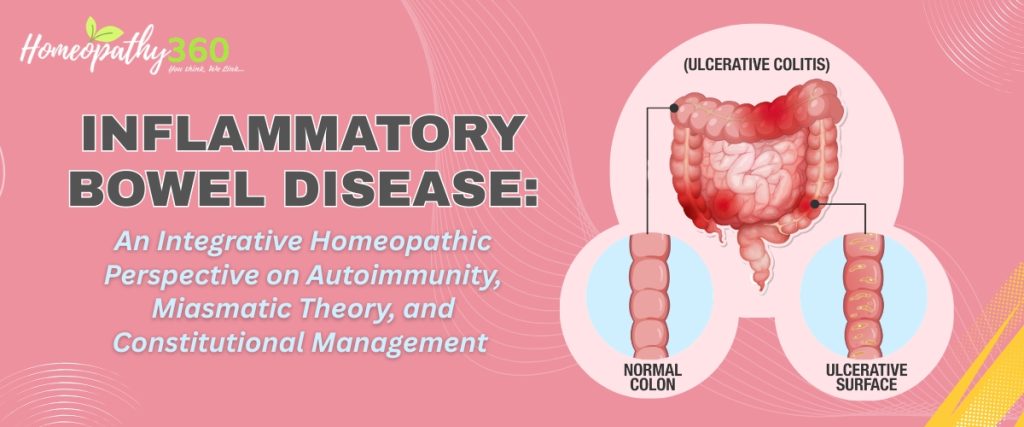
A precise clinical distinction between Ulcerative Colitis and Crohn’s Disease is vital for both conventional diagnosis and homeopathic constitutional matching. The biological differences between these two conditions span clinical presentation, endoscopic findings, and distinct histopathological profiles.
| Diagnostic Parameter | Ulcerative Colitis (UC) | Crohn’s Disease (CD) |
| Anatomical Distribution | Continuous inflammation is limited strictly to the colon and rectum; always originates in the rectum and extends proximally. | Discontinuous, segmental “skip lesions” that can affect any part of the gastrointestinal tract, from the mouth to the anus. |
| Depth of Inflammation | Confined strictly to the mucosal and submucosal layers of the intestinal wall. | Transmural inflammation extends through all layers of the intestinal wall to the serosa. |
| Histopathological Findings | Marked inflammatory infiltration of the lamina propria, crypt distortion, cryptitis, and crypt abscesses. | Transmural inflammatory infiltrates, deep fissuring ulcerations, submucosal fibrosis, and non-caseating epithelioid granulomas. |
| Clinical Presentation | Chronic bloody diarrhea, mucus-laden stools, lower abdominal cramping, severe urgency, and rectal tenesmus. | Recurrent abdominal pain (often right lower quadrant), watery diarrhea (rarely grossly bloody), marked weight loss, and low-grade fever. |
| Common Complications | Toxic megacolon, severe hemorrhage, bowel perforation, and a high risk of colorectal carcinoma in long-standing disease. | Intestinal strictures, mechanical bowel obstruction, fistulae, perianal abscesses, and nutritional malabsorption. |
This genetic susceptibility, when triggered by environmental factors and intestinal dysbiosis, leads to a chronic breach of immune tolerance.
Understanding these molecular mechanisms is highly relevant to classical homeopathy, which views these biochemical changes as physical expressions of an underlying constitutional disturbance of the Vital Force.
The Homeopathic Etiological Paradigm and Psychosomatic Dynamics
In the classical homeopathic paradigm, health is maintained by the harmonious operation of the Vital Force—the dynamic, immaterial self-regulatory principle that coordinates the physiological, metabolic, and psychological functions of the organism. Chronic inflammatory and autoimmune conditions represent a profound, centralized disturbance of this Vital Force.
According to this view, the localized pathological lesions of IBD are not the disease itself, but rather the physical end-products of a deeper constitutional susceptibility.
The human organism is constructed with a highly organized physiological hierarchy. This hierarchical arrangement protects the most vital internal systems by keeping pathological disturbances as superficial as possible. On a physical level, this defensive hierarchy arranges organs from superficial to deep:
Skin⟶Mucous Membranes & Glands⟶Musculoskeletal System⟶Gastrointestinal System⟶Renal, Pulmonary, & Endocrine Systems⟶Cardiovascular & Central Nervous Systems
An energetically robust immune system adapts efficiently to external pathogenic stimuli, resolving acute infections through superficial channels such as cutaneous eruptions or temporary mucosal discharges.
However, when these superficial expressions are suppressed through aggressive external treatments—such as topical steroids, anti-inflammatories, or repeated courses of antibiotics—the Vital Force is compromised. This suppression drives the energetic pathology deeper into the organic hierarchy.
In homeopathic clinical practice, chronic intestinal diseases like Ulcerative Colitis are frequently observed to follow the suppression of skin eruptions (such as eczema or psoriasis), the surgical or pharmacological suppression of hemorrhoids, or the aggressive treatment of acute diarrhea with strong antimotility or antibiotic agents.
This physical progression is closely linked with psychosomatic dynamics. Homeopathy has long recognized the mind-body connection, emphasizing that emotional and psychological states directly modulate immune reactivity. Clinical evidence indicates that a majority of patients suffering from autoimmune disorders have experienced severe psychological stress, particularly during childhood.
Crucially, these individuals often exhibit a compromised capacity to externalize or express this emotional stress, leading to a barrier in emotional catharsis. This internalization of emotional trauma and unresolved conflict mirrors the biological process of autoimmunity.
The failure of the immune system’s surveillance mechanisms to distinguish self from non-self represents an internalized, self-directed destructive process. The immune system becomes functionally paralyzed, turning its defensive capacities inward against the colonic mucosa, reflecting a state of deep psychological and physiological self-antagonism.
Miasmatic Mapping and Temporal Modalities of Autoimmune States
To address these deep-seated constitutional imbalances, classical homeopathic practice relies on the analysis of chronic miasms. Miasms represent inherited or acquired dynamic morbid predispositions that shape the specific pattern of an individual’s physical and psychological pathology.
Autoimmune diseases like IBD are fundamentally multi-miasmatic, involving a progression through functional, inflammatory, and ultimately destructive pathological phases.
The Hahnemannian Miasmatic Framework
In classical Hahnemannian miasmatic theory, the progression of autoimmune pathology is mapped across three primary states:
- Psora: Represents the foundational state of functional disturbance, environmental hypersensitivity, and heightened susceptibility without structural tissue change. In the early stages of IBD, Psora manifests as functional bowel irritability, localized allergic reactions, and dynamic hypersensitivity.
- Sycosis: Represents hyper-reactivity, chronic inflammatory infiltration, tissue proliferation, and autoantibody synthesis. In the gut, this state manifests as chronic mucosal thickening, polypoid changes, and structural hypertrophy.
- Syphilis: Represents destruction, degeneration, necrosis, and structural disorganization. The active, ulcerative phase of IBD—characterized by deep mucosal ulcerations, tissue death, fistulae, and irreversible structural damage—is driven by the syphilitic miasm.
[PSORA] Functional Hypersensitivity (IBS/Allergy)
│
▼ (Suppression / Chronicity)
[SYCOSIS] Chronic Inflammation & Proliferation (Mucosal Thickening)
│
▼ (Tissue Destruction / Ulceration)
[SYPHILIS] Active Necrosis & Organ Disorganization (Ulcerative Colitis)
Rajan Sankaran’s 10-Miasm Taxonomy
Dr. Rajan Sankaran refined this model by expanding the miasmatic spectrum, placing the Cancer miasm as the primary axis of autoimmune disorders. The Cancer miasm is characterized by a prolonged inner struggle to maintain order and control against a threat of total breakdown.
On a psychological level, patients with this miasm exhibit intense perfectionism, self-criticism, and a history of severe emotional suppression. Immunologically, this mirrors the hyper-vigilant, highly coordinated, yet self-directed destructive response of autoimmunity.
As tissue destruction accelerates, the pathology transitions from the Cancer miasm toward the Leprosy miasm—characterized by deep isolation, intense despair, and rapid, necrotic tissue destruction—and ultimately to the Syphilitic miasm, representing irreversible end-stage organ destruction.
Dr. Prafull Vijayakar’s Predictive Homeopathy cellular defense model
Dr. Prafull Vijayakar mapped these miasms directly to cellular defense mechanisms. He classified Psora as functional/irritative, Sycosis as constructive/proliferative, and Syphilis as destructive/suicidal.
In Vijayakar’s framework, autoimmune diseases are fundamentally syphilitic, arising when prolonged clinical suppression weakens normal defense mechanisms, forcing the cells into a destructive, “suicidal” defense pattern where they attack autologous tissues.
He observed that “the more you suppress (sycosis), the more the syphilitic miasm grows,” emphasizing that the overuse of immunosuppressive drugs drives the pathology deeper into the destructive syphilitic layer.
Temporal Aggravation Modalities of Miasms in the Gut
In addition to structural pathology, miasmatic states exhibit distinct temporal aggravation patterns that guide remedy selection:
- Psoric Aggravation: Characterized by symptoms that worsen primarily in the morning and evening, reflecting functional fluctuations of the Vital Force.
- Sycotic Aggravation: Characterized by symptoms that worsen during daylight hours, specifically from morning until 12:00 PM, and in the evening from 4:00 PM to 9:00 PM.
- Syphilitic Aggravation: Characterized by symptoms that worsen at night, specifically after 9:00 PM until 4:00 AM, matching the nighttime pain and diarrhea characteristic of advanced, destructive ulcerative colitis.
Repertorial Methodologies and Posological Science
Achieving a lasting cure in classical homeopathic practice requires a precise interface between symptom evaluation, repertorial analysis, and posological science. The selection of the simillimum is guided by systematic repertorial analysis, which has evolved through several historical stages.
Samuel Hahnemann compiled the first formal index in 1805 within his Fragmenta de viribus medicamentorum positivis, followed by his 1829 direction to Ernst Ferdinand Rückert to arrange a comprehensive index of remedies. Dr. Clemens von Bönninghausen introduced the systematic gradation of remedies, allowing clinicians to compare the relative clinical weight of different medicines for a specific symptom.
Dr. James Tyler Kent developed a highly systematic repertory based on deductive logic, proceeding from general symptoms (mental-emotional states and physical generals) to particulars (localized organ symptoms).
Kent emphasized that “man is prior to his organs,” asserting that constitutional expressions at the level of the whole person must guide remedy selection, as localized pathology is always preceded by a general disturbance of the Vital Force.
In modern practice, Robin Murphy’s Homeopathic Medical Repertory updated this framework, integrating clinical terminology (such as “colitis,” “Crohn’s disease,” and “celiac disease”) alongside traditional symptomatology, making it a highly practical index for complex pathologies.
Once the correct remedy is selected, posological science determines the appropriate potency and dosing frequency, which must be carefully matched to the strength of the patient’s Vital Force. The clinical evaluation of the Vital Force is based on physical energy, mental-emotional responsiveness, sleep quality, and digestive capacity.
- Strong Vital Force: Patients with high reactivity can safely tolerate high-potency remedies (such as 200c, 1M, or 10M) administered in infrequent, single doses.
- Moderate Vital Force: Patients benefit from medium potencies (such as 30c), which provide a balanced stimulation to the immune system.
- Weak or Suppressed Vital Force: In patients with advanced chronic pathology and extensive tissue destruction, the Vital Force is severely depleted. In these cases, administering high potencies can trigger a severe, potentially dangerous homeopathic aggravation of the bowel.
Therefore, these compromised patients require low potencies (such as 6c) or organ-support remedies administered in frequent, repeated doses to gently stimulate the healing response and rebuild cellular resilience.
Materia Medica and Comparative Therapeutics of Primary Gastrointestinal Remedies
Selecting the simillimum for IBD requires a detailed comparison of the primary gastrointestinal remedies in the homeopathic Materia Medica. Each remedy presents a distinct clinical profile, mental-emotional state, and physical modality.
1. Mercurius corrosivus
This is a primary remedy for severe, acute hemorrhagic colitis. It is indicated when there is intense, constant rectal tenesmus, where the patient experiences a continuous, ineffectual urge to defecate, with the passage of small quantities of blood, pus, and dark mucus.
The stool is extremely offensive and putrid. Clinically, it features severe cutting and burning pains in the hypogastric region before, during, and after stool, often accompanied by tenesmus of the bladder.
The patient is highly irritable, physically restless, and experiences extreme weakness and trembling after passing a stool.
Symptoms are characteristically worse at night, with temperature changes, and during cold autumn nights.
2. Arsenicum album
Indicated in patients presenting with marked physical restlessness, profound exhaustion, and intense burning pains in the abdomen that are temporarily relieved by local heat. Stools are small, frequent, watery, dark, and highly offensive.
The patient exhibits severe anxiety, an acute fear of death, and fastidiousness in their surroundings.
Symptoms are characteristically aggravated after midnight (especially between 1:00 AM and 3:00 AM), from cold food or drinks, and are ameliorated by warm drinks and warm applications.
3. Sulphur
An important anti-psoric remedy, often required to address the constitutional foundation of chronic colitis or cases characterized by skin-gut alternations. Stools are highly offensive, causing severe burning and redness around the anus.
A key indication is a sudden, urgent diarrhea that drives the patient out of bed in the early morning (typically around 5:00 AM).
The patient is characteristically warm-blooded, experiences burning heat in the soles of the feet at night, and has a strong intellectual or philosophical temperament.
Symptoms are aggravated by the warmth of the bed, standing for long periods, and are improved by cool, open air.
4. Phosphorus
Indicated in hemorrhagic states characterized by profuse, painless, gushing rectal bleeding of bright red blood, leading to rapid exhaustion and anemia. Stools are watery and often accompanied by a sensation as if the anus were remaining constantly open.
The patient is highly sensitive, empathetic, artistic, and craves cold drinks, ice cream, and salt.
Symptoms are aggravated by lying on the left side and by warm food or drinks, and are improved by cold water, sleep, and physical massage.
5. Nux vomica
Indicated when colitis is triggered or exacerbated by high stress, a sedentary lifestyle, or the abuse of stimulants and medications. The clinical picture features frequent, ineffectual urging to stool, with small, incomplete passages, where the abdominal pain and tenesmus are temporarily relieved immediately after defecation.
The patient is highly irritable, competitive, easily angered, and extremely sensitive to noise and light.
Symptoms are aggravated in the early morning, after eating, and by cold air, and are improved by warmth and rest.
6. Aloe socotrina
Indicated when there is extreme fecal urgency, with a marked loss of confidence in the rectal sphincter. The patient experiences an insecure sensation in the anus, as if stool would escape when passing flatus or urinating. Stools are watery, contain jelly-like mucus, and are preceded by severe rumbling and cramping in the abdomen.
Symptoms are aggravated after eating or drinking and in warm weather, and are improved by cold local applications and passing flatus.
7. Podophyllum peltatum
Indicated for profuse, gushing, painless, highly offensive watery stools, often containing yellow mucus. The diarrhea is characteristically worse in the early morning and is accompanied by severe abdominal rumbling and a tendency toward rectal prolapse during stool.
The patient experiences profound weakness and dehydration out of proportion to the stool volume.
8. Argentum nitricum
Indicated when diarrhea and colitis are directly triggered by anticipatory anxiety, apprehension, or emotional excitement. Stools are green, resembling shredded spinach, and contain large amounts of mucus and gas. The abdomen is severely bloated and distended.
The patient is highly hurried, impulsive, and craves sugar, which consistently aggravates their diarrhea.
Symptoms are aggravated by warmth and are improved by cool air and hard physical pressure.
9. Carcinosin
A deep-acting nosode utilized when there is a strong family history of cancer, tuberculosis, or severe autoimmune disorders. It is indicated when the patient exhibits an obsessive, perfectionistic, highly sympathetic, and over-responsible nature, often with a history of severe emotional suppression or childhood neglect.
10. Kali bichromatum
Indicated when the colitis features severe, localized, “punched-out” mucosal ulcerations. Stools are jelly-like, extremely stringy, and contain tough, tenacious mucus and blood.
The abdominal pain is characteristically described as burning or constricting, worsening immediately after eating.
11. Natrum muriaticum
Indicated when chronic colitis is linked with deep, unexpressed grief, emotional disappointment, or childhood trauma. The patient is introverted, socially withdrawn, avoids crowds, and rejects consolation.
They exhibit a strong craving for salt, experience chronic dry mucous membranes, and are highly sensitive to the sun.
REFERENCES
- Ng SC, Tang W, Ching JY, Wong M, Chow CM, Hui AJ, et al. Incidence and phenotype of inflammatory bowel disease based on results from the Asia-pacific Crohn’s and colitis epidemiology study. Gastroenterology. 2013;145(1):158-165.
- Hendrickson BA, Gokhale R, Cho JH. Clinical aspects and pathophysiology of inflammatory bowel disease. Clin Microbiol Rev. 2002;15(1):79-94.
- Vithoulkas G. An innovative proposal for scientific alternative medical journals. J Med Life. 2017;10(3):197-199.
- Vithoulkas G. An integrated perspective on transmutation of acute inflammation into chronic and the role of the microbiome. J Med Life. 2021;14(6):730-737.
- Ward A. Case Study: Ulcerative colitis/proctitis. Simile. 2021 May;16-20.
- Rai GK, Chattopadhyay A, Jaiswal AK, Yadav A. A Comprehensive Review on Inflammatory Bowel Disease with Homoeopathic Insight. J ReAttach Ther Dev Divers. 2023;6(1):2299-2305.
- Alstead EM, Newer medical treatments for inflammatory bowel disease. Postgrad Med J. 1996;72(845):132-136.
- Triantafyllidi A, Baldwin T, Papadimitriou CA, Liveri A, Koniari C, Gerasimidis K, et al. Herbal and plant therapy in patients with inflammatory bowel disease. Ann Gastroenterol. 2015;28(2):210-220.
- Tripathy T, Das S, Singh DP, Dwivedi R, Mishra A, Tripathy S, et al. Inflammatory Bowel Conditions & Homoeopathy. Saudi J Hum Soc Sci. 2023;8(6):119-122.
- Ponnam HB, Chirravuri SS, Konduru SP, Jammalamadaka S. Homeopathic Intervention in Post-COVID Functional Gastrointestinal Disorders: A Case Series. Homeopathy. 2024;113(2):85-92.
- Rai GK, Chattopadhyay A, Jaiswal AK, Yadav A. A Comprehensive Review on Inflammatory Bowel Disease with Homoeopathic Insight. J ReAttach Ther Dev Divers. 2023;6(1):2299-2305.
- Autoimmunity: A Miasmatic Philosophy and Homeopathic Perspective. Int J Innov Res Technol. 2024;11(2):2445-2448.
- Homoeopathic Miasmatic Interpretation of Autoimmune Disorders. J Homeop Surv Med. 2023;12:100953.
- Sura D, Shaw N, Bashir R, Rao R, Ghosh R. Individualised homoeopathic treatment in alopecia areata: An evidence-based case series. Indian J Res Homoeopathy. 2026;20(2):167-179.
- A Comprehensive Review on Homoeopathic Miasmatic Interpretation of Autoimmune Disorders. ResearchGate; 2024.
- The Role of Homeopathy in Autoimmune Disorders: Immunopathophysiology, Therapeutic Perspectives, and Research Evidence. IJARSCT. 2026;6(2):447-455.
- Mathew A. The role of homeopathy in autoimmune disorders: Immunopathophysiology, therapeutic perspectives, and research evidence. Int J AYUSH. 2025;14(10):208-215.
- Exploring Homeopathy for Colitis Symptoms: A Natural Approach to Ulcerative Colitis. Apollo Homeopathy. 2024. Available from: https://www.apollohomeopathy.ca/post/exploring-homeopathy-for-colitis-symptoms-a-natural-approach-to-ulcerative-colitis.
- Bahrami M, Hassanshahi A, et al. Herbal approaches for treating ulcerative colitis. J Herb Med. 2022;31:100512.
- Homeopathic Treatment of Ulcerative Colitis. J Biol Innov. 2020;9(6):45-52.
- Ward A. A case of ulcerative colitis/proctitis treated with classical homeopathy. Simile. 2021;16-20.
- Vijayakar P. Predictive Homoeopathy. Homeopathy USA. 2023. Available from: https://homeopathyusa.org/wp-content/uploads/2023/06/Vijayakar.pdf.
- Vijayakar P. Redefining Miasms: Predictive Homoeopathy and Autoimmunity. IJIRT. 2024;11(2):2446-2448.
- Complete Homeopathy Journal. Posology and Homoeopathy. Complete HH. 2021;47(5):30-35.