Abstract :-
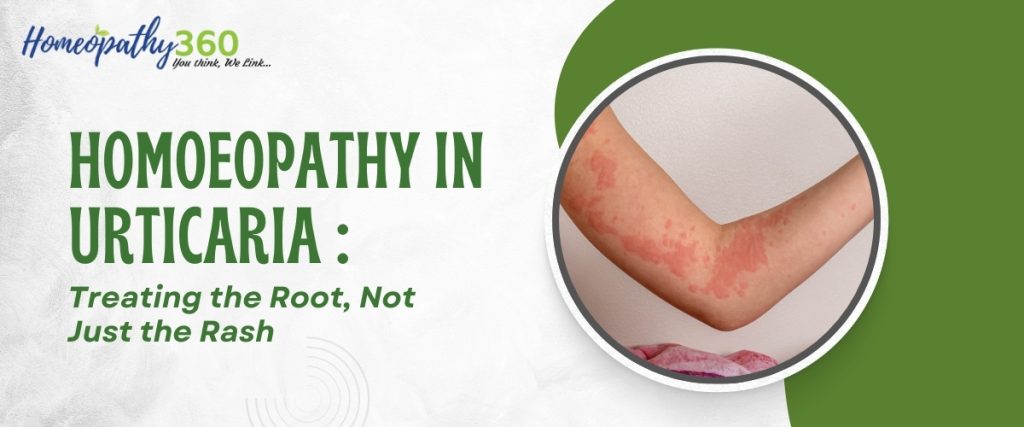
Urticaria, often referred to as hives, is a skin condition marked by itchy, red swellings or wheals, and in some cases, angioedema. It’s usually caused by an allergic reaction, but other factors like stress or temperature changes can also activate it. Homoeopathy is considered one of the best alternative system for the treatment of urticaria which can provide permanent results.
Keywords :-
Urticaria,Nettle rash, Hives, Allergic skin disease,Angioedema,Homoeopathy
Epidemiology :-
Studies indicate that between 8.8 – 20 % of individuals in the community are experiencing urticaria once in their lifetime . Its epidemiology varies by age , gender , and geography . Chronic form of urticaria are more common in adults especially in women’s .
Introduction :-
Urticaria develops when certain antigens activates local hypersensitivity reactions in the skin. It is a hypersensitivity reaction involving the release of histamines from mast cells in response to various triggers like allergens, infections, or stress. Symptoms of urticaria can appear on any part of the skin and may vary in severity.
Classification of urticaria :-
Urticaria can be classified in various ways :
1. Based on Duration
- Acute Urticaria :
Duration : Less than 6 weeks.
It is commonly triggered by allergens (foods, drugs, infections, insect bites).
- Chronic Urticaria :
Duration : More than 6 weeks.
It is further classified into spontaneous or inducible types..
2. Based on Underlying Cause / Trigger :-
A. Chronic Spontaneous Urticaria (CSU) :-
- It lasts for 6 weeks or more.
- Occurs without a clear external cause
- Also known as idiopathic urticaria.
B. Acute Spontaneous Urticaria (ASU) :-
- It lasts for less than 6 weeks.
- It is often triggered by allergic reactions, infections, or physical stimuli
C. Chronic Inducible Urticaria (CIndU)
- Triggered by specific stimuli:
| Type | Trigger |
| Dermographism | Stroking or scratching the skin |
| Heat Urticaria | Exposure to local heat |
| Cold Urticaria | Exposure to cold air or water |
| Delayed Pressure Urticaria | Prolonged pressure on skin |
| Solar Urticaria | Sunlight (UV/visible spectrum) exposure |
| Vibratory Urticaria | Vibration from tools, devices |
| Aquagenic Urticaria | Contact with water |
| Cholinergic Urticaria | Exercise, stress, or heat (sweating) |
3. Special Forms of Urticaria :-
- Autoimmune Urticaria :- Due to autoantibodies (anti-FcεRI or anti-IgE).
- Urticarial Vasculitis :- Involves inflammation of blood vessels, lesions last longer than 24 hours and may be painful.
- Contact Urticaria :- Triggered by direct contact with substances (e.g., latex).
- Angioedema with or without wheals :- Involves deeper tissue swelling
Etiology :-
Exact cause of urticaria is unknown. several contributing factors have been identified, such as.
- Immunologic causes : IgE-mediated allergy, autoimmune activity
- Infections : Hepatitis , Parasitic
- Physical triggers : Heat , Cold , Pressure , Water
- Foods : Eggs , Peanuts , Strawberries
Pathophysiology :-
- Allergen (etiological factor) : Exposure to a triggering substance (e.g., food, drug )
- Body reaction to allergen : The immune system identifies the allergen as harmful and then initiates a response.
- Then ecposure to allergens leads to histamine release from mast cells
- It causes small blood vessels to leak fluid
- Accumulation of fluid in skin : This fluid collects in the dermis, leading to swelling.
- Formation of rashes or wheals
- Urticaria
Signs and Symptoms of urticaria :-
You can manage urticaria effectively by :
- Intense itching is the hallmark symptom
- Redness due to vasodilation around wheals
- Angioedema may cause difficulty in breathing
- Burning or stinging sensation at the site of the rash
- Swelling of various body parts, such as lips or eyelids
Investigations :-
- Complete Blood Count (CBC) : It helps to identify infections or systemic inflammation.
- Thyroid Function Tests : It helps to rule out autoimmune thyroid disease.
- Antinuclear Antibodies (ANA) : It helps to rule out autoimmune disorders
- Skin prick test : It helps to determine specific allergens responsible for symptoms.
- Detailed history : Essential for identifying individual susceptibility
Lifestyle Management :-
- Wear loose cotton clothing
- Keep the skin cool and avoid the overheating
- Avoid hot baths or showers
- Maintain a symptom diary
- Stay away from spicy foods
Homoeopathic Approach :-
Homoeopathy plays a significant role in treatment of urticaria by considering the individual’s unique symptoms.. Homoeopathy considers the totality of symptoms. By addressing the root cause and constitution of the patient, homoeopathic remedies can provide long-term relief without side effects . Homoeopathy not only relieves the itching but also helps prevent recurrence by strengthening the immune system
Conclusion:-
Homoeopathy provides a holistic option and gentle approach for individuals suffering from urticaria. By understanding the unique symptom patterns and overall constitution of the patient, remedies can be selected which not only relieve the itching but also work towards preventing future episodes.
Homoeopathic Remedies :-
- Sulphur – Useful in Chronic urticaria with intense burning and itching; worse by heat and bathing. Here the skin becomes dry and scaly were itching with a great burning sensation .
- Rhus toxicodendron – Recommended with Itchy, burning urticaria with restlessness; worse at night and better from warm applications and the person is usually quite restless.Here the skin is red,swollen along with extreme itching.
- Apis mellifica – Red, swollen, edematous hives with burning and stinging pain; worse from heat and better by cold applications. There is a great burning sensation after itching and the affected area is often very sensitive to touch . Symptoms generally worse with heat and improve with cold application.
- Natrum muriaticum – Urticaria after emotional stress or suppressed grief . The itching often becomes worse with physical activity or exposure to heat.
- Lycopodium – It is helpful in cases of urticaria that occur in digestive issues such as gas, bloating, or acidity.
Reference Book :-
- Allen’s Keynotes and Characteristics – by H.C. Allen
- . Boericke’s New Manual of Homoeopathic Materia Medica – by William Boericke
- Therapeutics of Skin Diseases – by Lilienthal
- Handbook of Urticaria: An Initiative of GA²LEN Urticaria Centers of Reference and Excellence (UCARE) – by Kiran V. Godse, Abhishek De, and Anant Patil
- Kent’s Repertory of the Homoeopathic Materia Medica – by Dr. James Tyler Kent
- Skin Diseases and Their Homoeopathic Treatment– by Dr. Y.R. Agarwal