Homoeopathic Approach In Restoring The Hair Growth In Alopecia Areata By Using Synthesis Repertory: A Case Report.
Abstract:
Introduction: Alopecia areata (AA) is a chronic autoimmune disorder characterized by non-scarring hair loss involving hair-bearing areas such as the scalp, face, and body. The scalp is the most frequently affected site, although facial hair involvement is also common. Alopecia areata can occur at any age and typically presents as well-defined round or oval patches of hair loss. The precise pathogenesis remains unclear; however, genetic predisposition, environmental triggers, and immunological mechanisms are considered contributory factors. Case Summary: A 27-year-old male presented with progressive hair loss involving the eyebrows, moustache, and beard for one year. Based on detailed case history, symptom totality, repertorial analysis using the Essential Synthesis Repertory, and correlation with Materia Medica, Natrium muriaticum 200C was prescribed. Subsequent individualized remedy adjustments were made during follow-up. Gradual hair regrowth was observed, culminating in complete resolution of bald patches without recurrence. Conclusion: This case demonstrates the potential role of individualized homoeopathic treatment in the management of alopecia areata. Homoeopathy emphasizes a holistic approach by considering mental, physical, and general symptoms along with individual susceptibility.
Keywords: Alopecia areata, Autoimmune disorder, Homoeopathy, Natrium muriaticum
Introduction:
Alopecia areata is a chronic, immune-mediated autoimmune disorder primarily affecting hair follicles and, less commonly, nails and retinal pigment epithelium. The disease selectively targets anagen hair follicles, resulting in hair loss without permanent follicular destruction. Clinically, alopecia areata presents as sudden, well-circumscribed, non-scarring patches of hair loss, most commonly on the scalp. ¹
Although spontaneous regrowth may occur within one year in some patients, alopecia areata often follows a relapsing course and can cause significant psychological distress, necessitating long-term therapeutic intervention and emotional support.
Identified risk factors include family history, associated autoimmune conditions such as thyroid disorders and vitiligo, chromosomal abnormalities such as Down syndrome, vitamin D deficiency, psychological stress, and poor nutritional status. Conventional management options include topical or intralesional corticosteroids, immunotherapy, and systemic immunosuppressive agents, all of which require close monitoring due to potential adverse effects. ²
Homoeopathy offers an individualized and holistic therapeutic approach, focusing on the totality of symptoms and underlying susceptibility.
Etiology And Pathophysiology:
The hair growth cycle consists of three phases: anagen (growth), catagen (regression), and telogen (resting). In alopecia areata, hair follicles prematurely shift from the anagen phase to the catagen or telogen phase due to immune-mediated mechanisms. Arrest of follicular development typically occurs in stages III or IV of anagen, leading to abrupt hair shedding and impaired regrowth.
Epidemiology:
The lifetime risk of alopecia areata is approximately 2%, with a prevalence of about 1 in 1000 individuals. The condition affects both sexes equally and occurs across all age groups, with a mean age of onset of 32 years in males and 36 years in females. Increased prevalence has been observed among Asian, Black, and Hispanic populations.
Case Report:
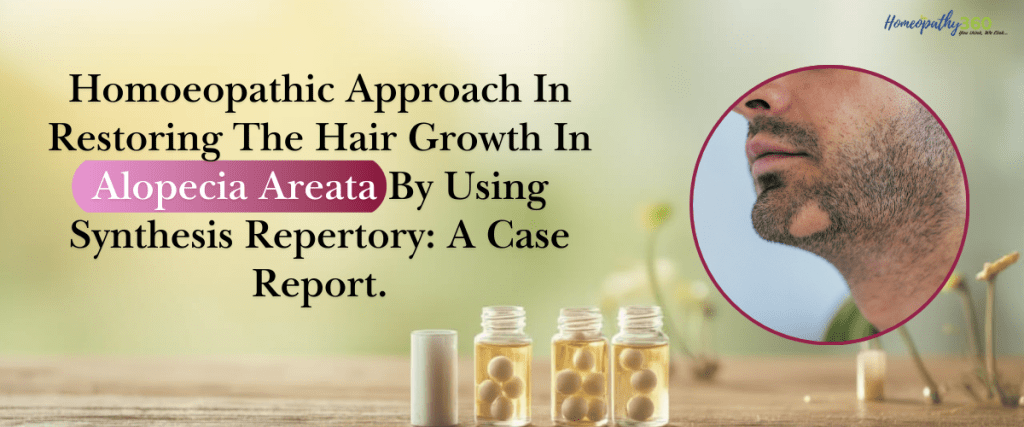
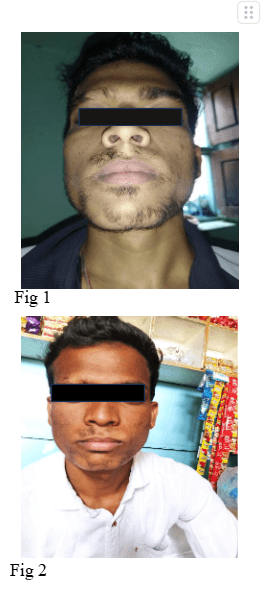
A 27-year-old male came to the clinic with concerns regarding hair loss affecting his eyebrows, mustache, and beard that has persisted for the past 1 year. Initially, he experienced itching on his scalp accompanied by dandruff, which eventually led to patchy hair loss in the areas of his eyebrows, mustache, and beard, causing him significant distress. He often feels the need to cover his mustache and beard whenever he goes out in public. Describing himself as a reserved individual, he prefers the company of his close friends and is reluctant to engage with others outside of his established social circle. Additionally, he exhibits a tendency to be frugal, often hesitating to spend or share money when out with friends. He appears physically weak and debilitated, although his appetite remains normal, and he tends to have a hot thermal reaction. Despite trying Ayurvedic treatments for three Months, he has not noticed any improvement in his condition. There is no reported family history of Alopecia Areata or any autoimmune disorders within his family.
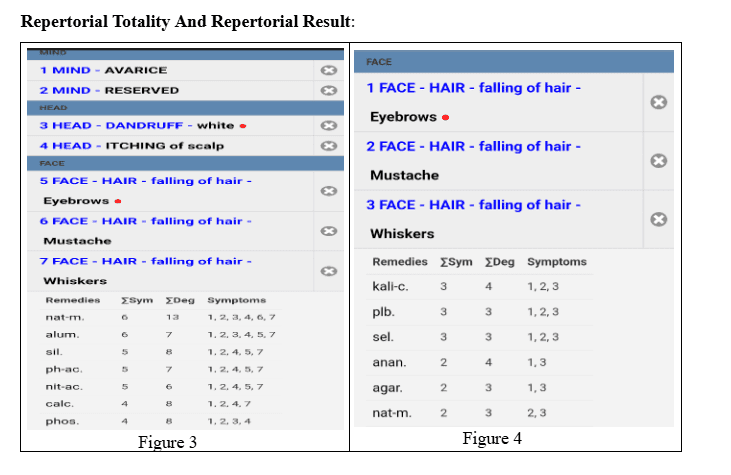
The following characteristic symptoms were selected for repertorisation:
- Avarice
- Reserved Person
- Scalp itching
- Dandruff with itching
- Hair loss on eyebrows
- Hair loss on beard
- Hair loss on moustache
Repertorisation was performed using Synthesis Repertory, chosen for its expanded clinical rubrics, emphasis on mental symptoms, and integration of contemporary clinical confirmations. The repertorial result guided remedy selection.
Prescription And Follow-Up:
- Natrium muriaticum 200C – single dose (06/01/2024)
- Phosphorus 200C – single dose (15/06/2024)
- Selenium 200C – single dose (20/08/2024) Follow-ups were conducted monthly, and outcomes were documented systematically.
AFTER TRETMENT
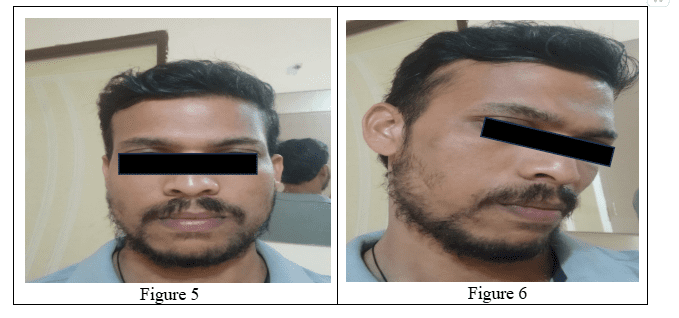
Table 1: Timeline including follow-up
| DATE | CONDITION DURING FOLLOW UP | PRESCRIPTION |
| 08/02/2024 | Slight itching of scalp improved. No change in dandruff and bald patches. | SLX 1 Month |
| 05/03/2024 | Itching of scalp improved with no change in dandruff and bald patches. | SLX 1 Month |
| 10/05/2024 | Itching of scalp recurred with dandruff. No change in bald patches. | NAT.MUR/2001 DOSE |
| 15/06/2024 | Complaints of severe dandruff with intense itching of scalp along with bald patches. | PHOS/ 2001 DOSE |
| 10/07/2024 | Itching of scalp and d0andruff improved. No change in bald patches. | SLX 1 Month |
| 20/08/2024 | Itching of scalp and dandruff improved. No change in bald patches. | SEL/ 2001 DOSE |
| 01/10/2024 | Regrowth of hair seen only on eyebrows. | SLX 1 Month |
| 28/12/2024 | Complete regrowth of hair seen on eyebrows, mustaches, and beard. | SLX 1 Month |
Results:
On the basis of the complete case history, totality of symptoms, repertorial analysis, and reference to Materia Medica, Natrum muriaticum 200 (single dose) was prescribed initially. The patient showed noticeable improvement for the first two Months. Subsequently, there was a recurrence of symptoms, and repetition of Natrum muriaticum yielded no further relief.
During the next follow-up, the patient presented with increased intensity of scalp itching and dandruff. The case was re-taken and re-analysed, Repertorised with synthesis repertory leading to the prescription of Phosphorus 200 (single dose) After two Months of treatment, improvement in the dandruff and scalp itching was observed, though the bald patches remained unchanged. On further analysis and repertorisation, Selenium was prescribed. After two Months of continued treatment, hair growth seen only on eyebrows. After two months complete regrowth of hair was observed on the eyebrows, moustache, and beard. This case exemplifies the effectiveness of Homoeopathic remedies in managing alopecia areata when applied with a personalized and holistic approach.
Discussion:
This case highlights the effectiveness of individualized homoeopathic treatment in managing alopecia areata. The absence of familial predisposition suggests an acquired immune dysregulation. Sequential remedy changes based on evolving symptomatology underscore the importance of dynamic case analysis. Complete hair regrowth without recurrence supports the potential role of homoeopathy in chronic autoimmune conditions when prescribed according to classical principles.
Conclusion:
This case report demonstrates successful management of alopecia areata with individualized homoeopathic treatment over a period of ten months, resulting in complete hair regrowth. Comprehensive case taking, repertorial analysis, and Materia Medica correlation were pivotal in remedy selection. Homoeopathy, by treating the individual as a whole, may offer a safe and effective complementary approach in alopecia areata management.
Declaration Of Patient Consent:
The authors certify that they have obtained all appropriate patient consent forms. In the form, the patient has given his consent for his images and other clinical information to be reported in the journal. The patient understands that his name and initial will not be published, and due efforts will be made to conceal his identity, but anonymity cannot be guaranteed.
Financial Support And Sponsorship:
Nil.
Conflicts Of Interest:
None declared.
Reference:
- Lepe K, Syed HA, Zito PM. Alopecia Areata. [Updated 2024 Feb 8]. In: StatPearls [Internet]. Treasure Island (FL): StatPearls Publishing; 2025 Jan-. Available from: https://www.ncbi.nlm.nih.gov/books/NBK537000/
- Shivadikar AP. Evidence- based homoeopathy: Case report of alopecia areata in an 11 year old boy. Indian J Res Homoeopathy 2019;13:251-5
https://www.ijrh.org/cgi/viewcontent.cgi?article=1429&context=journal
- Dr. Fredrik Schroyens. Essential Synthesis Repertory.
- Phatak SR. MateriaMedicaHomoeopathicmedicines. 2nd ed. NewDelhi:B.JainPublishers(P)Ltd.1999.577p.