Gem of Materia Medica: Agraphis Nutans in Action – Managing Adenoids with a Rare Homoeopathic Remedy – A Case Report
Abstract
Rare and small remedies, in Homoeopathy, are those which had a few symptoms recorded through drug proving. These medicines are proved to be specific remedy in specific disease condition. Many of our fraternity are not aware of these rare and small medicines due to lack in literature and less clinical use. In this one important and very rare homoeopathic medicine was enumerated with its symptomatology, so that this can be used in day-to-day practice to increase the literature of such medicines by conducting clinical researches at our outdoor patients’ departments or in clinics. In my 29 years of practice in children’s suffering from Adenoids can be best utilized Agraphis Nutans to treat the same.
Keywords
Adenoids, Nasopharyngeal Tonsils, Sympathetic, Lymphoid Tissue, Hypertrophy, Bluebell, Angiosperms.
Introduction
Homoeopathic Remedy: Any drug may be considered to be a homoeopathic medicine if it is recorded in “homoeopathic proving” or has known physiological effect as causing the symptom syndromes which it is administered to cure, if it is used in a dose insufficient to cause active physiological effects.
Homoeopathic remedies work by the principles of harmonic resonance. The original name for Homoeopathic remedies before Hahnemann’s time was sympathetic or sympathic medicines because of these resonance factors. Sympathy reflects the principle of likes cure likes. There is a sympathetic relationship between the action of the remedy on healthy person, the proving and the therapeutic action of disease and indicated medicine is called remedy.
Rare and small remedies in the Materia medica have their importance, because these remedies had few symptoms found through drug proving. These medicines had too few symptomatology, thus, can be very useful in treating one-sided diseases (diseases having too few symptoms).
Uses of Rare and Small Remedies of Homoeopathic Materia Medica Are –
- Useful in one-sided diseases.
- Used as organ remedy.
- Used as pathological remedies.
- Used as rescue remedy.
- In palliative cases.
ADENOIDS OR NASOPHARYNGEAL TONSILS
Definition – Adenoids are the pathologically enlarged Nasopharyngeal tonsils are called as adenoids.
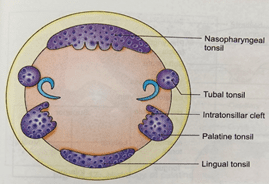
There is a large collection of lymphoid tissue in the mucous coverings the roof of the nasopharynx. Enlargement of this pharyngeal tonsil, known than as adenoids, can occlude the nasopharynx so that breathing is only possible through the oral cavity. Adenoids when enlarged, is in the midline on the roof of the nasopharynx.
Hypertrophy or enlargement of the nasopharyngeal tonsil or adenoids may obstruct the posterior nasal aperture and may interfere with nasal respiration and speech leading to mouth breathing. These tonsils usually regress by puberty.
Hypertrophy of the tubal tonsil may occlude the auditory or pharyngotympanic tube leading to middle ear problem.
Waldeyer’s Lymphatic Ring
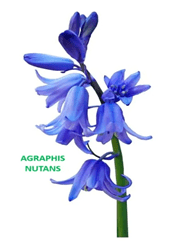
AGRAPHIS NUTANS (Bluebell)
Agraphis nutans, commonly known as Bluebell or Wild Hyacinth or Drooping Leucothoe, is a remedy derived from the vegetable kingdom in Homoeopathy with certain historical uses and is known for its distinctive drooping flower clusters. The sphere of action of this remedy is on respiratory system and mucous membrane.
- Kingdom: Plantae
- Phylum: Angiosperms
- Class: Eudicots
- Order: Ericales
- Family: Ericaceae
- Genus: Agraphis
- Species: Agraphis nutans
Agraphis nutans is a deciduous shrub that typically grow in dense, mounded form, it is characterized by its elongated, drooping clusters of small, bell shape flower
GUIDING SYMPTOMS
- Catarrhal Conditions
Agraphis nutans has obstruction of the nostrils, especially from adenoids and throat deafness. Enlarged tonsils, adenoids. The action of it is felt towards the root of the nose.
2. Ear and Throat Troubles
The remedy is associated with throat and ear troubles, particularly when there is tendency to free discharge from mucous membranes.
- Adenoids and Enlarged Tonsils
Agraphis nutans is related to conditions involving adenoids and enlarged tonsils. This can contribute to symptoms like deafness and mutism in childhood.
- Mucous Diarrhoea from Cold
In the cases of mucous diarrhoea trigged by exposer to cold.
- Chill from Cold Wind
Susceptibility to catching cold on exposure to cold wind.
HOMOEOPATHIC GEM: AGRAPHIS NUTANS IN ACTION- MANAGING ADENOIDS WITH A RARE HOMOEOPATHIC REMEDY –
A CASE REPORT
PRELIMINARY DATA
Name : Mr. A.S.S.
Age : 6 yrs.
Sex : Male
Address : Malgaon
Occupation : Student
Religion : Hindu
Marital status : Unmarried
Date of interview : 11/04/2025 OPD No. : 5779
CHIEF COMPLAINTS
– Recurrent Coryza since childhood. – Blockage of nose with mouth breathing with snoring at night during sleep.
– Frequent urination in the last 1 year.
HISTORY OF CHIEF COMPLAINTS
– Recurrent Coryza since childhood.
– Discharge from nose during day
– But nose blocking at night.
– Nostrils blocked, difficulty in breathing.
– Fever due to that.
– < Cold drink, cold air and at night, during sleep.
– Frequent urination in the last 1 year.
– Pass little quantity and has to go after every 10 mins.
PAST HISTORY
No H/o any major illness in the past.
FAMILY HISTORY
4 members in family. No any major illness in family.
PERSONAL HISTORY
Thermally – Chilly patient.
Diet – Mixed
Appetite – Reduced
Desire – Sweet, meat
Aversion – Milk, pungent, eggs
Bowel – Satisfactory
Urine – 3-4/2-3, D/N
Perspiration – Profuse on forehead, esp. during sleep
Sleep – Disturbed, screams in sleep occasionally
Dreams – Not remembered
CONSTITUTION
Fat, fair complexion with black hairs. Well, built.
MIND
– Obstinate
– Irritable
– Throws things in hands
– Naughty, hits even his younger brother
GENERAL PHYSICAL EXAMINATION
Built – Fat
Nourishment – Average
Eyes – Conjunctiva- Pink
Sclera – White
Tongue – White coated
Throat – Rawness
Ear – No discharge
Nose – Watery discharge
Extremities – NAD
Cyanosis, clubbing, oedema, pallor- Absent
VITAL DATA
Temp. – 99°F
Pulse – 94 beats/ min
RR – 20 cycles/min
BP – 120/80 mm of Hg
SYSTEMIC EXAMINATION
Respiratory System
INSPECTION – Bilaterally symmetrical chest. No scar swelling present.
PALPAT1ON – Trachea centrally placed
PERCUSSION – Resonant note except cardiac dullness
AUSCULTATION- Slight wheeze heard
CVS –NAD
GIT – NAD CNS – Patient is co-operative and conscious.
– All superficial and deep reflexes are well oriented.
ANALYSIS OF SYMPTOMS
1]GENERAL SYMPTOMS
a) MENTAL GENERALS
– Obstinate
– Irritable
– Throws things in hands
– Naughty, hits even his younger brother
b) PHYSICAL GENERALS
– Thermally chilly
– Desire sweet, meat
2] PARTICULAR CHARACTERISTICS
– Recurrent coryza – Blockage of nose
– Pain in chest while coughing
– < Cold, winter, night, sleep
– > Summer
EVALUATION OF SYMPTOMS
1] GENERAL SYMPTOMS
GRADE I – Obstinate
– Irritable
– Throws things in hands
– Naughty, hits even his younger brother
GRADE II – Thermally chilly
– Desire sweet, meat
2] PARTICULAR SYMPTOMS
GRADE I – Recurrent coryza, blockage of nose.
– Pain in chest while coughing
GRADE II– < Cold, winter and night
– > Summer
DIFFERENTIAL DIAGNOSIS
– Adenoids – Acute Rhinitis
– Common Cold
– Sinusitis
INVESTIGATIONS
CBC Hb – l1.6 gm%
WBC – 7400/cmm
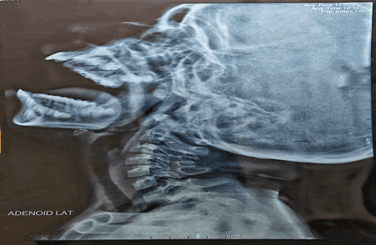
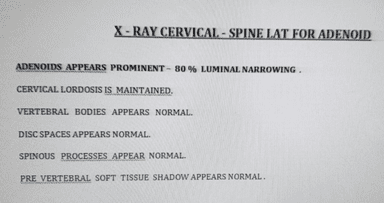
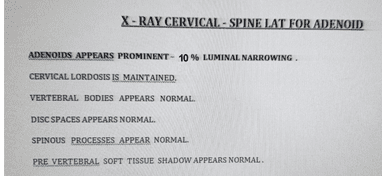
ESR – 30 mm after 1 hr. Increased X – ray – Head-lateral view for Adenoid X – ray report – Adenoid appears prominent with 80 % luminal narrowing
Before Treatment
FINAL DIAGNOSIS – Adenoids
DIFFERENTIAL REMEDIAL DIAGNOSIS
– Calc carb
– Sulphur – Agraphis Nutans
– Mercurius
FINAL REMEDY- Agraphis Nutans
PRESCRIPTION
Name : Mr. A.S.S.
Age : 6 yrs.
Sex : Male Date : 11/04/2025
Rx Agraphis Nutans 30 3 Pills BID for 6 Days.
PL 3 —0— 3 For 1 month Follow up After 1 month.
FOLLOW UP
| Date | Follow up | Prescription |
| 10/05/2025 | – Blocking of nose reduced but mouth breathing during sleep present. – Watery discharge from nose. – Urination only at night. | Rx Agraphis Nutans 30 3 Pills BID for 6 Days. PL 3 —0—3 For 1 month |
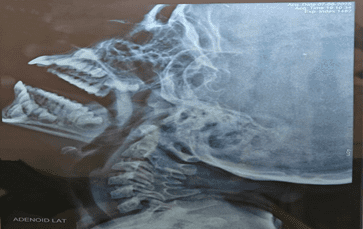
| 07/06/2025 | – Coryza and mouth breathing reduced 60% – Cough at night reduced completely – Frequency of urination reduced. – Sticking of eyelids – Sleep sound | Rx PL 3 —0—-3 For 1 month |
After Treatment
CONCLUSION
Agraphis Nutans is a valuable homoeopathic remedy for treating adenoids, particularly in children. It’s effective in alleviating nasal congestion, throat discomfort, and enlarged tonsils associated with adenoid issues. This remedy is often recommended for individuals prone to catching colds and experiencing catarrhal conditions. Adenoid hypertrophy can be considered for adenoidectomy. Rare and small homoeopathic medicine Agraphis nutans mainly used to treat the cases of adenoids. Clinical verification studies of such medicines will help to increase the symptomatology of these rare medicines and also develop a firm belief on clinical effectiveness of the same in our fraternity.
1) Mandal PP, Mandal B. A Textbook of Homoeopathic Pharmacy. Reprint 3rd Kolkata: New Central Book Agency (P) LTD.; 2015.
2) Murphy R. Lotus, Materia Medica. 3rd ed. New Delhi: B. Jain Publishers (P) LTD.; 2014.
3) Banerjee NK, Sinha N, Banerjee SK. A Treatise on Homoeopathic Pharmacy. Reprint ed. B. Jain Publishers (P) LTD.; 2006.
4) Boericke W. Boericke’s, New Manual of Homoeopathic Materia Medica with Repertory. 3rd revised & augmented edition. New Delhi: B. Jain Publishers (P) LTD.; 2010.
Authors –
Dr. Jineshwar Annasaheb Yaligouda
C.C.H., C.G.O., C.C.M.P., M.D. Professor & H.O.D Department of Human Anatomy, Gulabrao Patil Homoeopathic Medical College & Hospital, Miraj. Maharashtra. India. President of Malgaon Medical Association Malgaon. Sanjivani Clinic, Malgaon, Miraj, Sangli. Maharashtra. India.
Mr. Padmraj Jineshwar Yaligouda B.H.M.S. Final Year. Bharatesh Homoeopathic Medical College & Hospital, Belagavi, Karnataka. India.