About the Book
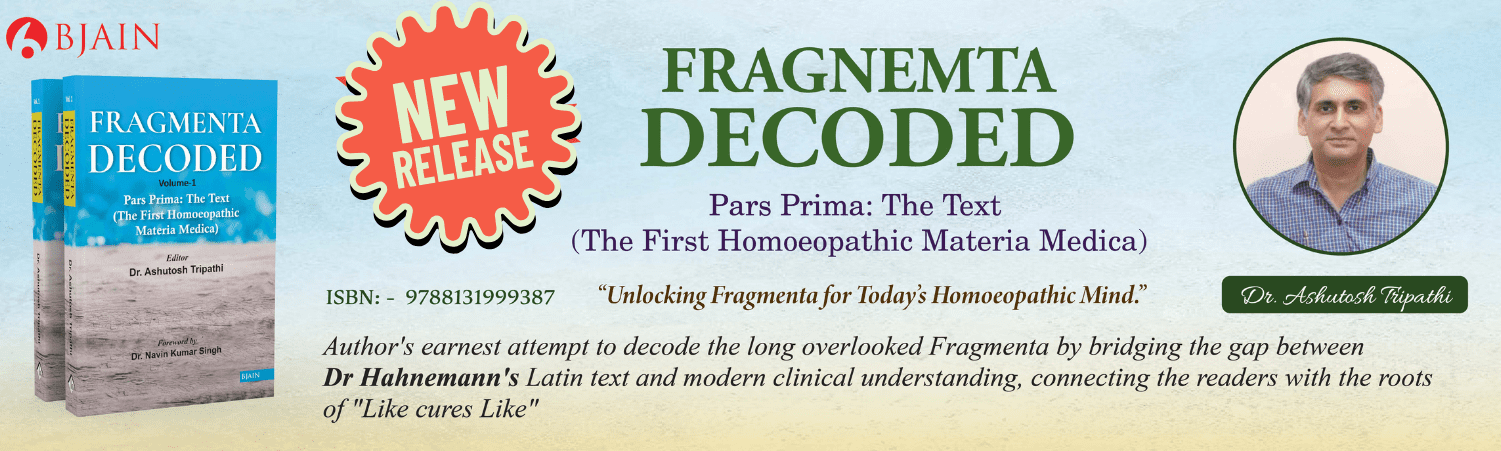
Fragmenta Decoded offers a landmark interpretation of Dr. Samuel Hahnemann’s pioneering work Fragmenta de Viribus Medicamentorum Positivis, recognized as the first homeopathic materia medica. Edited by Dr. Ashutosh Tripathy, a homeopathic medical officer with over a decade of clinical, academic, and research experience, and with a foreword by Dr. Navin Kumar Singh, this edition is a thoughtful and accessible exploration—not a translation—of Hahnemann’s original insights.
The original work, composed in Latin across two volumes (Pars Prima Textus and Pars Secunda Index), details Hahnemann’s drug provings on healthy humans—the foundational methodology of homeopathy. Although several translations exist, none are in English with contemporary relevance. Fragmenta Decoded bridges this gap by presenting Hahnemann’s ideas in a modern, relatable format that illuminates his thought process and methodology.
Harnessing the productive use of artificial intelligence, this edition brings clarity and depth to Hahnemann’s work for today’s learners and practitioners. Highly recommended for BHMS and postgraduate students, Fragmenta Decoded is an essential resource for understanding the original principles that shaped homeopathic practice.
In my study of Homoeopathic history, I was repeatedly confronted by the striking absence of a readily accessible English translation of Dr. Samuel Hahnemann’s Fragmenta de Viribus Medicamentorum Positivis (1805). This work, which represents his first systematic effort to document remedy provings and forms the earliest foundation of the principle of similia similibus curentur, has remained largely inaccessible to English-speaking homoeopaths, confined to dense anatomical and medical Latin. Recognizing this gap in our collective understanding became the starting point for Fragmenta Decoded.
This book does not claim to be a conventional Latin translation. I approach the task with humility, fully aware that I am not a classical Latin scholar. Rather, this work is an attempt to carefully unfold ideas that have remained out of reach for more than two centuries. With the support of modern tools, including AI, and through meticulous symptomatic and repertorial comparison with later texts such as Materia Medica Pura and Chronic Diseases, I have attempted to bridge both the linguistic and conceptual distance between Fragmenta and contemporary Homoeopathic practice. To preserve historical integrity, I consistently cross-referenced the original Leipzig edition of 1805 with the later Naples (1824) and London (1834) editions, ensuring that interpretative clarity never came at the cost of fidelity to the source.
Within these pages lies the essence of Hahnemann’s earliest experimental work, based on 27 medicinal substances commonly known in his time. Fragmenta may be understood as a pilot study, marking the first clear articulation of the concept of positivis—absolute symptoms observed in healthy individuals—distinct from the relative and often unreliable symptoms encountered in disease. The structure of the original work is examined in detail, including its two principal divisions, Pars Prima (Materia Medica) and Pars Secunda (Repertory), along with historically revealing features such as catchwords (custodes) and signature marks used by printers in the 1805 edition.
Writing this book became a deeply absorbing and personal process. I immersed myself in the nuances of Hahnemann’s early methodology, including his careful grading of 4330 symptoms using bold, italic, and Roman types, as well as his early attention to pharmacy and duration of action—concepts that would later evolve but are already clearly visible in this foundational text. Throughout, my intention has been to present these early provings in a way that remains meaningful for the modern practitioner, while preserving their original context and spirit.
Equally important was honoring Hahnemann’s intellectual honesty. He himself acknowledged the “imperfect and insufficient” nature of these early observations, and it is precisely this openness to revision and self-critique that gives Fragmenta its enduring value. Far from diminishing the work, this humility reveals the living, experimental nature of Homoeopathy at its very beginning.
Ultimately, Fragmenta Decoded stands as a tribute to a pivotal yet often overlooked chapter in Homoeopathic history. It is my hope that this work helps students and practitioners trace the gradual evolution of Hahnemann’s thought—how careful observation, reflection, and correction shaped the system we inherit today. To attempt an understanding of Homoeopathy without engaging with Fragmenta is much like admiring a mature oak tree without ever considering the acorn from which it first emerged.

Title: Fragmenta Decoded
Author: Dr. Ashutosh Tripathi
ISBN: 9788131999387
Imprint: B Jain Regular
Pages: Printing
Format: Paperback
Language: English
Provings of 27 remedies from Fragmenta are presented, illustrating the roots of the principle of Similia Similibus Curentur.
Each remedy includes a detailed introduction, along with the editor’s commentary explaining how the medicine appears in the original text.
Footnotes from both Dr. Hahnemann and the editor are included for deeper understanding and context.
Accurate page references to the original work are provided throughout.
Symptoms are arranged in the same order as in the original text, along with their documented sources.
An annexure provides information on previous translations of Fragmenta.
Dr. Ashutosh Tripathi
He is a senior Homoeopathic physician currently serving as Medical Officer (Homoeopathy) at the Department of Homoeopathy, AIIMS Raipur (C.G.) Read More…