Abstract
Human relationships are among the most profound experiences of life. They give meaning, belonging, and emotional grounding. Yet the same relationships—when strained by jealousy, mistrust, unmet expectations, or separation—can shake a person from within. Emotional suffering does not remain confined to the heart; it ripples through sleep, appetite, hormones,
and immunity, slowly reducing the individual’s inner vitality. From a homoeopathic viewpoint, such emotional upheavals signal a disturbance of the vital force, the dynamic energy that weaves balance between mind and body (1). Homoeopathy
recognizes that grief, insecurity, and jealousy are not isolated events but interconnected disturbances revealing deeper internal disharmony. Healing must therefore embrace the entire emotional landscape, not just fragments of symptoms. This paper offers a compassionate and integrative view of relationship-induced emotional distress. By uniting modern psychological insights with homoeopathic principles—rubrics, miasms, and remedy profiles—it explores how individualized homoeopathic care can help people move from emotional chaos toward clarity, resilience, and renewed self-understanding.
Introduction
Relationships shape the rhythm of human life. They touch our sense of identity, safety, and purpose. When love flows easily, it strengthens confidence and emotional stability. But when trust is shaken or expectations collapse, the same relationship can become a source of intense psychological pain.
In today’s fast-moving world, people often carry emotional burdens silently—sleepless nights, racing thoughts, loss of appetite, and physical symptoms arising from heartbreak or conflict (2). These disturbances are not “just emotions.” They reflect a deeper disruption in the psycho-neuro-endocrine-immune (PNEI) network. In homoeopathy, emotional imbalance is seen as one of the earliest and most important markers of internal disharmony (1). The mind speaks before the body breaks. Understanding
this language is central to healing. This paper explores the emotional patterns commonly triggered by relationship stress, their
underlying miasmatic expressions, and the homoeopathic remedies that resonate with these states. The aim is to illuminate how homoeopathy restores harmony—not by numbing the pain, but by helping individuals transform it.
The Emotional Spectrum of Relationship Challenges-
1.Jealousy and Insecurity
Jealousy often hides deeper fears—fear of not being enough, fear of comparison, fear of being replaced. It may show itself as:
- warmth turning cold without warning
- restless thoughts spiraling late into the night
- emotional outbursts followed by guilt
- constant checking, seeking reassurance, yet feeling unsatisfied (3)
Even the strongest individuals can be shaken by the thought of losing someone they love.
Key Rubrics
- Mind; jealousy; with rage
- Mind; anxiety; relationship, about
- Mind; fear; losing beloved
- Mind; suspicion; unfounded
- Here, remedies like Lachesis, Hyoscyamus, Pulsatilla, and Natrum muriaticum help soften emotional agitation and restore inner security.
2. Suspicion and Possessiveness
Suspicion often begins quietly—with a doubt, a small question, a moment of insecurity—until it grows into internal turmoil.
The mind becomes a battlefield:
- imagining scenarios
- replaying conversations
- searching for hidden meanings
- needing control to feel safe (4)
This emotional tightening drains energy, creating more fear than reality ever did.
Rubrics
- Mind; suspicion; everything seems wrong
- Mind; delusions; neglected, thinks he is
- Mind; control, desire to
Such patterns often belong to the sycotic miasm, where emotions magnify and overshadowreason (7).
3. Emotional Dependency and Fear of Abandonment
At its core, emotional dependency is not weakness—it is fear of losing the person who feels
like home.
The moments of emotional distance feel like:
- breath becoming shallow
- panic rising from the chest
- sadness settling in the stomach
- an urge to hold on tightly (5)
Rubrics
- Mind; forsaken feeling
- Mind; clinging; desire to be held
- Mind; fear; being alone
- Mind; dependence; emotional
- Remedies such as Pulsatilla, Ignatia, Natrum muriaticum, and Calcarea carbonica gently support emotional grounding.
4. Grief and Post-Breakup Despair
A breakup is not just an event—it is a psychological and spiritual rupture. It may bring:
- heaviness in the ches
- mind wandering to old memories
- loss of motivation
- sleepless nights and exhausted mornings (6)
- Grief does not move in a straight line. It pulls in waves—some soft, some overwhelming.
Rubrics
- Mind; grief; ailments from
- Mind; despair; love, disappointed from
- Mind; sadness; chronic
- Mind; apathy; grief after
- Ignatia, Natrum muriaticum, Phosphoric acid, and Aurum metallicum offer profound support in such deeply wounded states.
Homoeopathic Interpretation of Emotional Disturbance
Hahnemann emphasized that the emotional plane reflects the deepest layer of the vital force
(1). When a person’s emotional world collapses, the body soon follows.
Miasmatic Interpretation
i. Psoric – anxiety, overthinking, hypersensitivity, fear of inadequacy
ii. Sycotic – possessiveness, jealousy, emotional exaggeration
iii. Syphilitic – despair, hopelessness, self-destructive impulses (7)
Understanding the miasm gives direction: it reveals not just “what hurts,” but “how theperson suffers.”
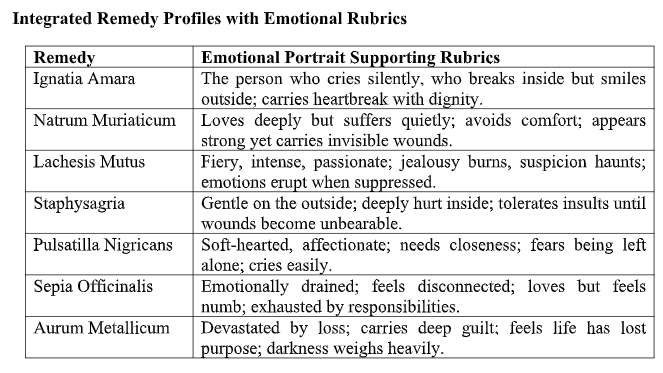
These profiles reveal what textbooks cannot: the emotional essence that connects remedy and
patient.
Mind–Body Integration: A Unified Scientific and Homoeopathic View
Modern psychoneuroimmunology confirms what homoeopathy understood centuries ago: the
mind speaks through the body.
Chronic emotional turbulence alters:
i. cortisol rhythms
ii. serotonin pathways
iii. immune defense (9)
iv. reproductive and thyroid hormones
v. autonomic balance
This is why heartbreak can cause:
i. palpitations
ii. headaches
iii. digestive issues
iv. hormonal imbalance
v. skin flare-ups
vi. menstrual irregularities
Homoeopathic remedies do not suppress these emotions—they help the organism process
them, restoring balance through gentle modulation of internal pathways.
Conclusion
Relationship-induced emotional suffering is one of the most profound human experiences. It
can shake foundations, open old wounds, and blur one’s sense of self. Yet, within this pain
lies the possibility of transformation.
Homoeopathy offers a compassionate, individualized path toward healing. By honoring a
person’s emotional narrative—jealousy, grief, insecurity, fear, or despair—it helps restore
balance not only to the mind but to the entire psycho-neuro-endocrine-immune system.
In a world where people feel more emotionally overwhelmed than ever, homoeopathy serves
as a reminder that healing is not the suppression of pain but the rediscovery of inner
harmony. Every emotional wound carries the potential for growth, clarity, and renewed
strength.
REFERENCES:
- Hahnemann S. Organon of Medicine. 6th ed. New Delhi: B Jain Publishers; 1994.
- American Psychological Association. Relationship and Mental Health Report 2023.
Washington (DC): APA; 2023. - Kent JT. Lectures on Homoeopathic Philosophy. New Delhi: B Jain Publishers; 2012.
- Clarke JH. A Dictionary of Practical Materia Medica. London: The Homeopathic
Publishing Co.; 1902. - Boericke W. Pocket Manual of Homoeopathic Materia Medica. New Delhi: B Jain
Publishers; 2008. - Brian R, Walker BR, Colledge NR, Ralston SH, Penman ID. Davidson’s Principles
and Practice of Medicine. 24th ed. London: Elsevier; 2023. - Banerjea SK. Miasmatic Prescribing. New Delhi: B Jain Publishers; 2003.
- Sherr J. The Dynamics and Methodology of Homoeopathic Provings. Malvern:
Dynamis Books; 1994. - Ader R. Psychoneuroimmunology. 4th ed. San Diego: Academic Press; 2007.
Co-Author – Dr. Mansi Saini, MD scholar, Department of Practice of Medicine, Dr. M.P.K. Homoeopathic Medical College, Hospital & Research Centre, Homoeopathy University, Jaipur, Rajasthan, India