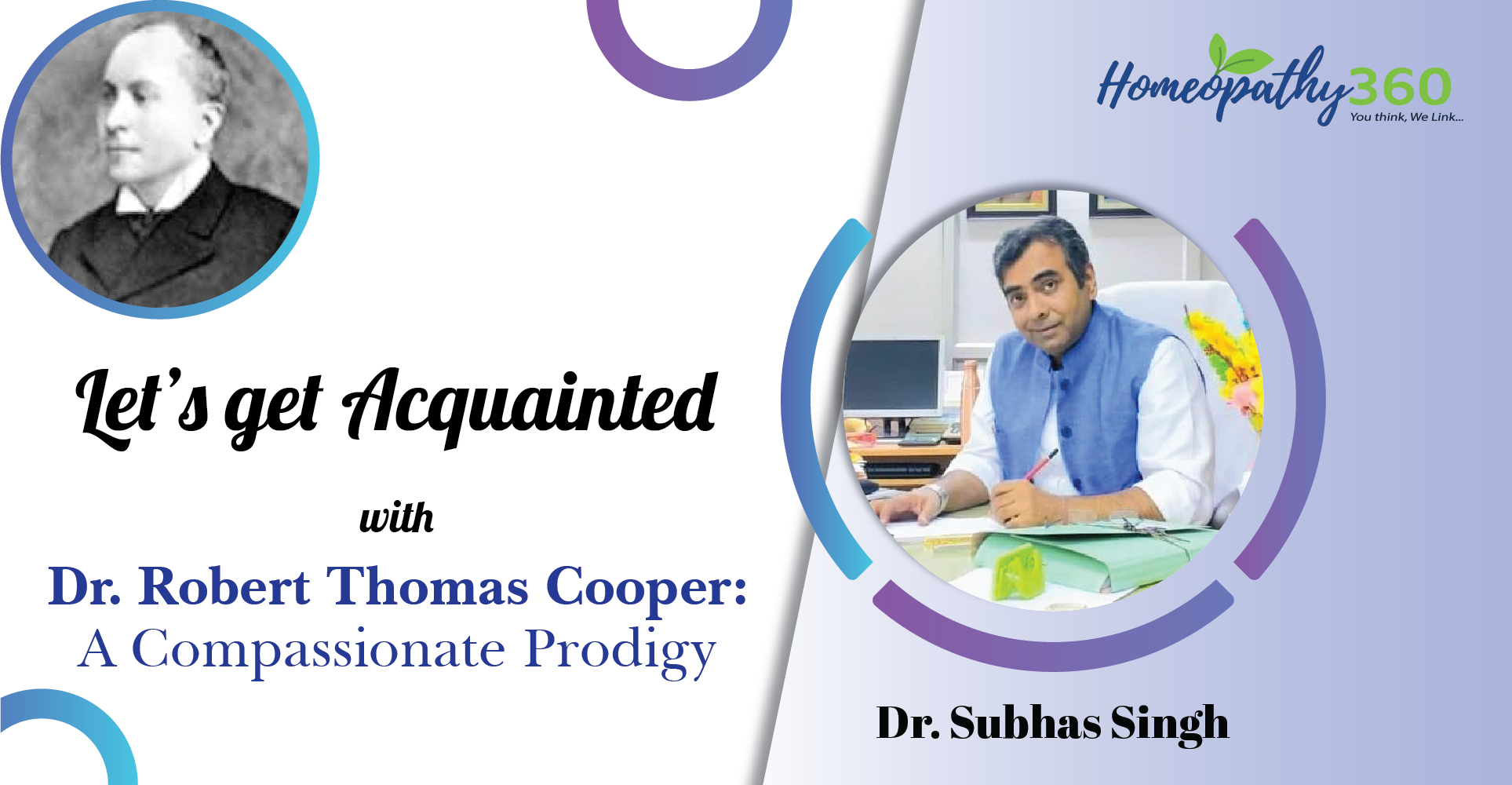
Dr. Robert Thomas Cooper was an Irish orthodox physician turned Homoeopath. He was also a keen botanist, thinker and founder of ‘Arborivital’ medicine.
Early Life and Education
Dr. R. T. Cooper was born on 2nd June 1844, at Cooper’s Hill, County Carlow, Ireland. A precocious student, he entered Trinity College Dublin at the age of 16 years, beginning what would become one of the most distinguished academic records of any Irish physician of the period. He took up academics with great interest and accomplished notable degrees such as B.A. (1864), L.M. (1864), M.Ch. and M.B. (1865), M.D. (1870) and M.A. (1883).
These qualifications reflected not only Cooper’s intellectual prowess but also his strong foundation in classical medicine before turning to Homoeopathy.
Conservationism and the Irish Forestry Society
Dr. Cooper’s love for trees extended beyond the medical sphere. He was the founder and first president of the Irish Forestry Society, which he saw as crucial to restoring Ireland’s natural landscape and addressing rural poverty. He traced the country’s agricultural decline to centuries of deforestation, and reportedly embraced the label of a “tree-worshipper”.
To him, vegetation was a sacred medium for protecting humanity from both illness and social calamity—a belief that deeply connected his conservationism with his medical philosophy.
Medical Career
In 1866, Dr. Cooper began his private practice in Southampton before relocating to London in 1874, where he maintained two thriving clinics, in Notting Hill and Hanover Square. He specialised in ear, nose and throat disorders and served for many years as an Assistant Physician and Surgeon for Ear Diseases at the London Homeopathic Hospital between 1880 and 1894.
He became a member of the British Homeopathic Society (MBHS) and was recognized for his clinical precision and tireless work in both mainstream and alternative medical circles. Dr. Cooper emphasised on low potencies and mother tinctures, the tangible, material doses.
Arborvital Medicine
Dr. Cooper’s innovative contribution to medicine was the creation of Arborivital Medicine, a system of botanical therapy rooted in vitalist philosophy. Although not very different from Master Hahnemann’s idea, he also drew inspiration from Paracelsus, ancient herbalism, and possibly Goethean science or Steiner’s anthroposophy. Dr. Cooper believed that the vital force inherent in living plants could be harnessed to correct growth disorders, especially, cancer in the human body.
His remedies were made from living plants, often while still attached to the stem, immersed in proof spirit to preserve their vitality, exposed to sunlight, a process Cooper termed “heliosthening” and administered in single-drop doses, on the tongue, with long intervals before repetition.
In 1900, he wrote, “By allowing the spirit to come into contact with the living plant, the branch, while still attached, being kept plunged in the spirit and exposed to sunlight while thus immersed—heliosthened, as I term it.”
Dr. Cooper believed these tinctures worked through a plant’s inherent germinating force, mirroring the “growth force” that caused diseases like cancer: “In the living plants we get a force which, if applied… to disease, will arrest its progress and even cause its dispersal.”
This methodology had much similarity to later figures such as Dr. Edward Bach, creator of the Bach Flower Remedies.
The Cooper Club
Dr. Cooper was the namesake and a founding member of the Cooper Club, an informal group of four Homoeopaths who met weekly in London from 1880–1900 to discuss philosophy, materia medica, and clinical experiences. The members were:
Dr. Thomas Skinner (1825–1906) – A converted high-potency Homoeopath and inventor of the Skinner Fluxion Machine, Dr. James Compton Burnett (1840–1901) – Advocate of organotherapy, tinctures, and cancer remedies and Dr. John Henry Clarke (1853–1931) – Editor, writer and compiler of the Dictionary of Practical Materia Medica.
These four doctors pushed forward their clinical ideas in remedy preparation and application. Among them, Cooper was considered the most conservative, due to his strict reliance on low potencies and scepticism toward nosodes, high dilutions and unproven remedies.
Nonetheless, his arborivital concept was highly original and placed him in a lineage of vitalist thinkers tracing back to pre-Hahnemannian herbal traditions.
Published Works and Botanical Interests
Dr. Cooper was a prolific writer and botanist. His major publications include:
“Lectures on Diseases of the Ears” (2nd ed. 1880)
“Cancer and Cancer Symptoms” (1899)
Numerous articles in the Homeopathic World, Dublin Medical Review, and pamphlets between 1897 and 1899.
He introduced or promoted numerous plant-based remedies, including Ornithogalum umbellatum, Scrophularia nodosa, Hydrastis canadensis, Lemna minor, Silphium perfoliatum, Caltha palustris, Spiraea ulmaria, Matthiola annua, and many others.
His therapeutic focus lay in using plants with strong signatures of growth regulation, and he often analysed botanical families such as the Rosaceae, Solanaceae, Labiatae, Compositae, and Cruciferae to identify patterns in healing. Dr. Margaret Tyler wrote, “Dr. Cooper had an uncanny genius for discovering unusual remedies; some of these he got, no doubt, from old herbals; but it has been said that he used to lie down before a flowering plant by the hour, dragging from it its virtues of healing. He made an extraordinary play, in cancer, with some of his flowers, and one heard him called the man who can cure cancer”.
Death and Final Years
In the summer of 1903, while on holiday with his family in Switzerland, Dr. Cooper overexerted himself playing tennis, caught a chill, and subsequently developed influenza, which progressed into congestion of the lungs. He passed away in London on September 14, 1903, at the age of 59. His death was mourned by both the Homoeopathic and botanical communities.
About the Author:
Prof. (Dr.) Subhas Singh1, Dr. Rumsha Tamkeen2, Dr. Vignesh S2, Dr. Jyotidarshanee2, Dr. Jasna Moideen V M2, Dr. Binay P. Singh2
1 HOD, Department of Organon of Medicine, National Institute of Homoeopathy, Kolkata.
2 Postgraduate scholar, National Institute of Homoeopathy, Kolkata.