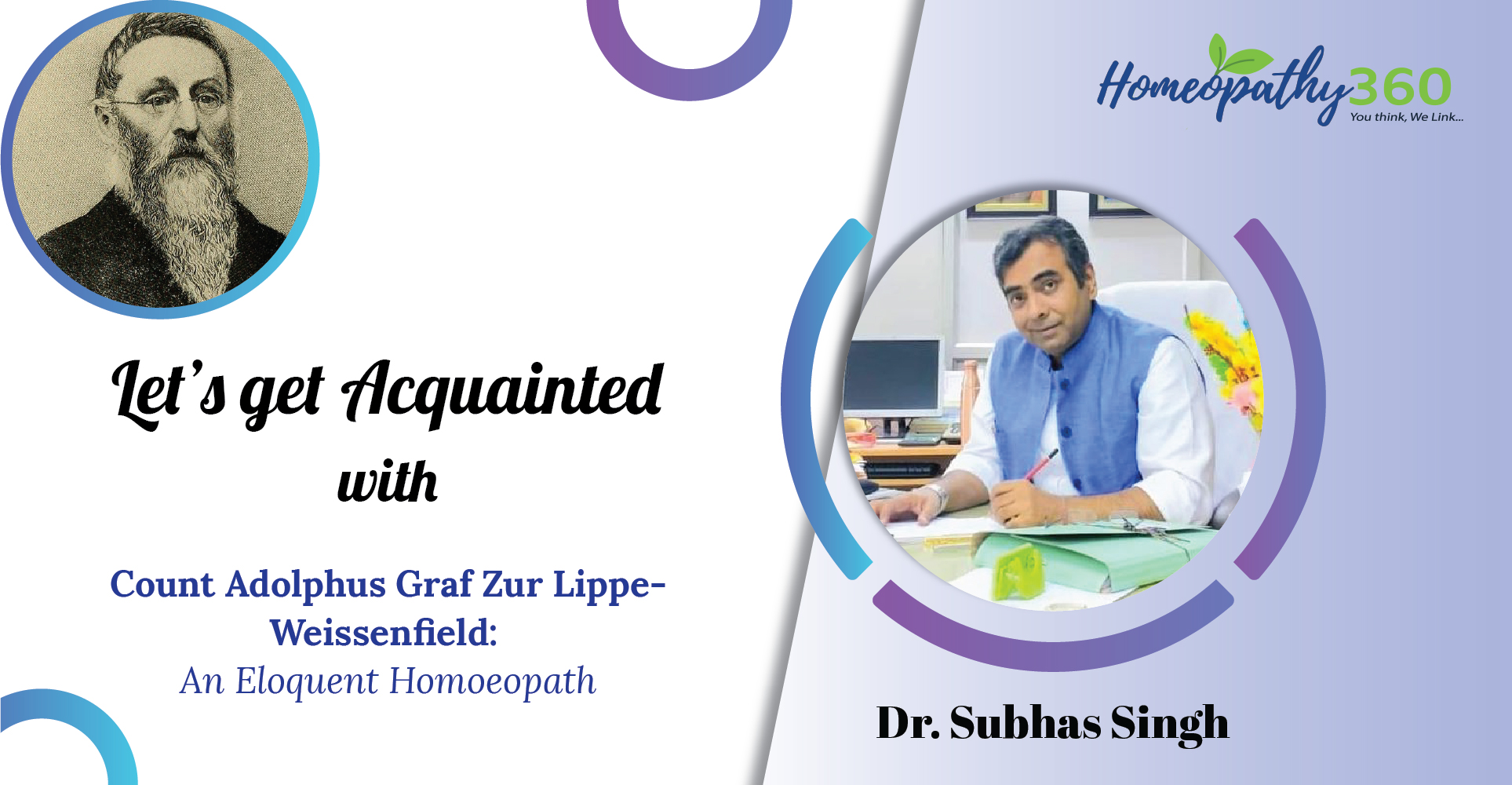
Dr. Adolph Lippe was a resolute and unwavering advocate of Hahnemannian principles and practice of homoeopathy based on it. He regarded Organon of Medicine as the final word in the science and art of healing the sick. In his view, Homoeopathy, as Hahnemann taught it, was the only true method of cure, effective for both acute and chronic illness. He believed all other treatment approaches were merely palliative, harmful and misguided.
Early Life and Education
Dr. A. Lippe was born on 11th May, 1812, on the family estate of ‘See’ near the town of Goerlitz in Prussia, to Count Ludwig and Countess Augusta zur Lippe, members of a distinguished and long-established noble family. He was educated in Berlin and his parents encouraged him to pursue a career in Law, but Dr. Lippe was determined to study Medicine. He came to America in 1837 and enrolled at the Hering’s Allentown Academy to study Homoeopathy, which at the time was the only Homoeopathic Medical school available. On July 27, 1841, he received his Diploma from the hand of Dr. Constantine Hering.
Medical Profession
Dr. A. Lippe initially settled in Pottsville, where he practiced for a while before moving to Carlisle, where he spent 6 years. During his time in the Cumberland valley, he gained recognition for his successful treatment of the epidemic which was prevalent at that time. This led him to Philadelphia, where he began a distinguished career as a Homoeopathic practitioner and educator. Dr. Lippe was highly successful in his medical practice, suited naturally for the profession. Few physicians have achieved the level of success that Dr. Lippe did, with his remarkable cures over a 46- year career earning him a stellar reputation and providing relief to countless patients whom other, less skilled doctors had given up on. From 1863 to 1868, Dr. Lippe served as the Chair of Materia Medica at the Homoeopathic Medical College of Pennsylvania, a position he excelled in due to his exceptional knowledge of the subject. He made significant contributions to the literature of Homoeopathy. He played a key role in founding several Homoeopathic journals, including Organon, The Hahnemannian Monthly and The Homeopathic Physician. He was an active and honorary member of numerous foreign and domestic societies.
Contributions
Although Dr. Lippe authored only a single book, he was a major contributer to various journals of his time. The volume of his contributions to Homoeopathic Literature is unmatched by any writer in the field, except perhaps Dr. Hering. Many of his writings focus on clarifying Homoeopathic Philosophy, while others explore the principles and techniques of proper Homoeopathic practice. Additionally, he wrote extensively on the more intricate aspects of the Materia Medica and provided detailed reports of clinical cases.
- He regularly wrote articles and translated works from German, French and Italian making them accessible to a wider audience.
- He helped in launching several of the best Homoeopathic journals ever to be published including The Organon, The Hahnemannian Monthly, The Homoeopathic Physician. He edited The Organon Journal with Thomas Skinner, Samuel Swan and Edward William Berridge in 1878-1881.
- He wrote a long series entitled The Fatal Errors in American Homoeopathic Observer which strongly criticized the views and practices that Dr. Lippe felt were harming and diminishing Homoeopathy.
- He was the founding member of the International Hahnemannian Association (IHA) and also was a colleague of James Tyler Kent, Henry Newell Guernsey, Caroll Dunham.
Other Major works:
1. Key to the Materia Medica or Comparative Pharmacodynamic: It was published by Henry Duffield in 1854. This book is for facilitating the study of Materia Medica specially comparison with similar medicines. The plan of this Materia Medica was to give only the characteristic and most prominent symptoms of each remedy and to compare them with all other medicines already proved.
2. Textbook of Materia Medica: Published in 1866. It is a seminal work in Homoeopathic literature. This comprehensive text was originally prepared for students attending Dr. Lippe’s Lectures at Homoeopathic Medical College of Pennsylvania.
3. Keynote and Redline Symptoms of Materia medica: It is a text in Homoeopathy renowned for its concise and clinically verified description of approximately 300 remedies. This work emphasizes ‘Keynotes’- the most characteristic symptoms of each remedy and ‘red line symptoms’- gleaned from the author’s writings, appeared in several old foreign journals together with other important ones, collected from the great homoeopaths of those days. It is an edited compilation of his earlier works, hence each sterling symptom in the context other than that of Dr. Lippe has the name of its author indicated against it in abbreviatory form.
Last days of his Life and Demise Dr. Lippe suffered a devastating blow when, on 1st January, 1885, he lost his eldest son Dr. Constantine Lippe due to pneumonia which developed as a consequence of injuries he had sustained during his service in the Civil War, just 2 weeks after the death of his only daughter in December 1884. The profound grief from these two tragedies deeply affected him and he never fully recovered. After days of exposure to harsh weather, Dr. Lippe caught a cold that quickly turned into fatal Typhoid Pneumonia. Though fully conscious until the end, he saw no hope in the medicines, saying they only offered temporary relief. Even in his final days, he suggested remedies like Nux moschata and Natrum muriaticum, based on his symptoms. He fell ill early Saturday and died on Monday morning, 9.45am, 23rd January, 1888. The funeral took place on Thursday, 26th January from his residence, 1204, Walnut Street. Dr. Adolph Lippe, was a guiding light to Homoeopathy and he died within a few years of the founding of IHA. The Association remained strong and many of its members guided Homoeopathy into the next century.
About the Authors
Prof. (Dr.) Subhas Singh1, Dr. Jasna Moideen V. M.2, Dr. Vignesh S.2, Dr. Jyotidarshanee2, Dr. Rumsha Tamkeen2
1. HOD, Department of Organon of Medicine, National Institute of Homoeopathy, Kolkata.
2. Postgraduate Scholars, National Institute of Homoeopathy, Kolkata.