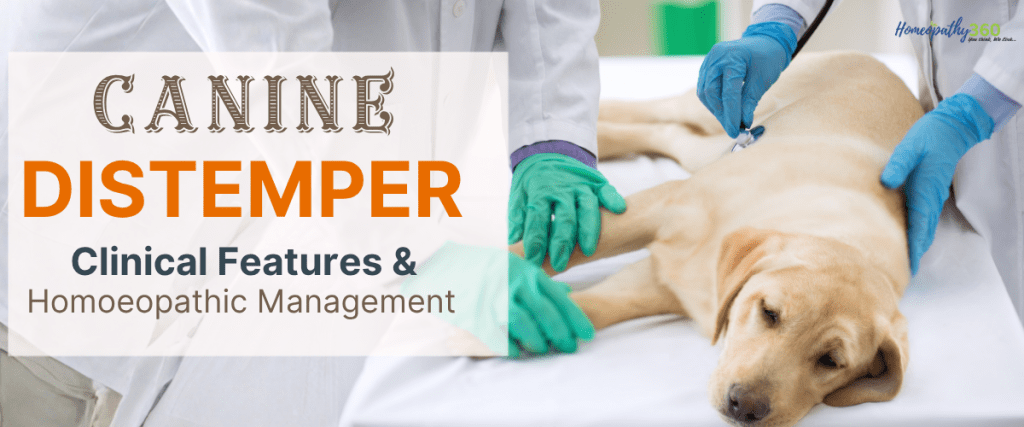
Canine Distemper – Clinical Features And Homoeopathic Management
Abstract
Veterinary is a branch that is concerned with prevention, diagnosis , managment and treatment of disease and injury conditions in animals. Now it includes all species of animals , but the first animal one would think of will be dogs , specifically because they are the most closest to humans. They are easy to understand and they as well have different personalities which individualise them, once you really start spending time with them. With homoeopathy , their individualising character helps with a remdy meant for their particular diseased state. In recent years , many individuals are coming forward for helping homeless Indie dogs. Being unvaccinated they are at a very higher risk , and many of them die due to lack of treatment.Also the treatment becomes quite costly for disease like Canine distemper, Parvovirus, Tick fever (babeniosis). As the treatment often includes regular IV drips with medication for 7 -15 days, sometimes even more for Canine Distemper, which is probably the most heartbreaking one as eventually without or sometimes with treatment we lose our furry freinds. Canine distemper is a highly contagious life threatning viral diesease for canines. Homoeopathy acts as a ray of hope to save them by supporting their vital force. In vetenary world, one would call them distemper survivors , which says quite a lot about the ratio of dogs that survive distemper.
Keywords
veterinarian, cannine distmper, homoeopathy.
Signs And Symptoms
Canine distemper is a highly contagious and life threatning viral disease. It is caused by a single-stranded RNA virus that belongs to the Morbillivirus genus under the family Paramyxoviridae. It attacks the nervous, respiratory and gastrointestinal systems and weakens the immune system of a dog. It can further spread to healthy dogs by airborne exposure through the aerosol droplet secretions from the nose of the infected dog while sneezing or coughing , sharing same water bowls or licking one another. All unvaccinated puppies and young adult dogs are at a higher risk but sometimes even the vaccinated ones with low immunity or under stress are at high risk as well.
Clinical signs of distemper :
• Diphasic Fever
• Coughing
• Change in appetite
• Lethargy
• Discharge from eyes or nose or both.
• Hardenning of the paw pads and dryness of nose.
As the disease progresses it attacks the nervous system , producing more set of symtoms : • Twitching of muscles
• Lock jaw
• Lack of co-ordination
• Head tilt
• More serious symptoms include seizures and paralysis, eventually leading to death.
Canine distemper is diagnosed by the above symtpoms and is confirmed by veterinarian by taking a nose swab of the dog. Their is no specific treatment for Canine distemper , but often includes supportive care with IV fluids to maintain electrolyte balance, analgesics and antibiotics to prevent secondary infections. “Canine distemper is much more painful to the dog that is suffering than one can ever imagine”.
Cases Of Distemper Treated With Homoeopathy ( Alongwith Supportive Care)
Case 1
Name : A 9 months old female puppy named “Rosie”
Symptoms :
• 103 degree celsius fever.
• No appetite.
• Complete thirstlessness.
• greenish agglutination in corners of both eyes with dry nose.
• Short and a visibly seen hurried breathing with rattling of cough clearly being heard.
• Lock jaw – ( because of which the veterinarian was compelled to say that she will not survive)
• Mild twitching of back limbs.
• Hiding herself.
It is said that once a dog stops eating at all it gets almost meaningless to try to save them. She was given IV drips for 3 days and was prescribed “Bryonia 200 “ in water potency, repeated 3 times a day using a dropper. Her fever subsided by night and hurried breathing went down moderately but was still present. After 2 days her breathing was back to normal but still her jaw was locked and most importantly she started showing interest 1st to water and by next 12 hours to food. She was not able to open her jaw much but was able to open it just little by which she started having liquid diet in small quantities, 4-5 times/ day. She was still on Bryonia 200, now only for 2 times/a day. After 3-4 days , her eyes were no longer agglutinated, with no coughing. Bryonia 200 OD was continued for 5 days and then was stopped. Today she lives a happy life as a distemper survivor even on the streets. She has persistent mild twitching of jaw, but lives as a completely healthy active dog.
Case 2
Name : A 7 months old puppy named Bholu
When diagnosed with distemper by the veterinarian , he had:
• Regular meals with no change in thirst and no fever
• He had green crusts blocking his both nostrils completely which didn’t alow him to breathe from nose and had to respire from mouth instead.
• It was because of keratinised paws, nose crusts and mild twitching of jaw that confirmed canine distemper. He was given Nat sulph 200 4 pills – 3 times a day with no supportive care. He recovered very well with the crusts eventually stopped forming and was breathing easily from his nose. He still has twitching of jaw for which conium maculatum 30 OD is given but remains a strong distemper survivor.
NOTE : Distemper survivors often live on with life long twitching of either jaw , body , or just their limbs.