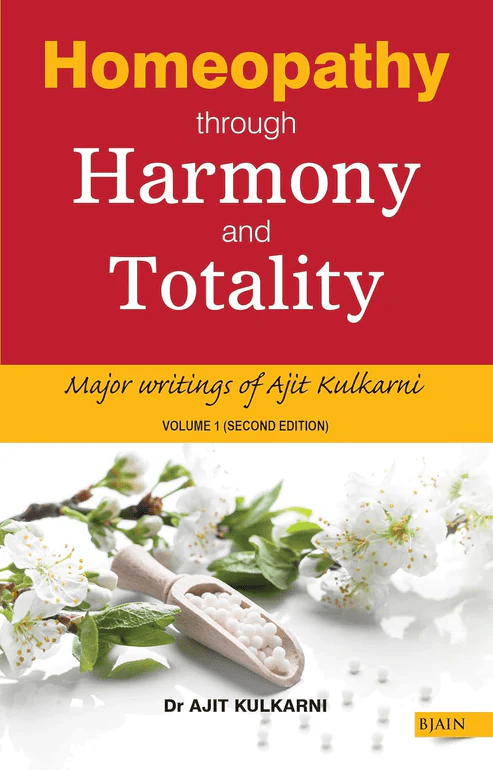
Volumes I–IV
Dr. Ajit Kulkarni, M.D. (Hom.)
Published by B. Jain Publishers
Approx. 87 chapters; hardbound multi-volume academic work.
Dr. Ajit Kulkarni’s Homeopathy Through Harmony and Totality is a monumental four-volume contribution to modern homoeopathic literature. Known internationally for his earlier works such as Absolute Homeopathic Materia Medica, Body Language and Homeopathy and Homeopathic Posology, Dr. Kulkarni once again demonstrates remarkable scholarship, clinical maturity and philosophical depth through this extensive series.
The work reflects more than three decades of dedicated clinical experience, teaching and international academic engagement. Across 87 chapters, the author explores philosophy, human constitution, miasmatic understanding, repertory, materia medica and therapeutics in an integrated and clinically meaningful manner.
One of the greatest strengths of this series is its ability to harmonize classical homoeopathic philosophy with contemporary medical understanding. The books are not limited to theoretical exposition; they consistently emphasize practical applicability in daily clinical practice. This balance between philosophy and bedside utility makes the series especially valuable for both students and experienced practitioners.
Limitations
Certain philosophical discussions may appear intellectually dense for beginners unfamiliar with advanced homoeopathic terminology. Some interpretative approaches may also invite discussion among practitioners from differing schools of homoeopathic thought. Nevertheless, such debate reflects the scholarly richness of the work rather than a weakness.
Conclusion
Homeopathy Through Harmony and Totality is a major contemporary contribution to homoeopathic literature. Rich in philosophy, materia medica, repertory and clinical insight, the series represents a valuable educational and professional resource for serious students and practitioners seeking a broader and clinically integrated understanding of classical homoeopathy.
Dr. Ajit Kulkarni deserves appreciation for producing a work that successfully integrates classical principles with modern clinical realities while preserving the holistic spirit of homoeopathy.
Overall, Homeopathy Through Harmony and Totality is an ambitious and intellectually stimulating contribution to modern homoeopathic literature.
Reviewer’s Notes
- Strong integration of philosophy and clinical practice
- Particularly valuable for postgraduate homoeopathic education
- Useful discussions on repertory interpretation and constitutional analysis
- Encourages holistic and individualized case understanding
- Suitable for institutional and personal academic libraries
Highly recommended for:
- Undergraduate and postgraduate students
- Teachers of homoeopathic philosophy and repertory
- Practicing physicians
- Researchers in clinical homoeopathy
- Advanced learners interested in constitutional and miasmatic understanding
Volume I
Philosophy and Holistic Understanding
The first volume establishes the philosophical foundation of the series. Dr. Kulkarni discusses constitution, susceptibility, human evolution and environmental influences with impressive clarity. The chapter discussing the Law of Similars in Medical Science is especially noteworthy for its attempt to correlate homoeopathic principles with broader medical disciplines.
The philosophical discussions remain clinically oriented and avoid becoming abstract or dogmatic. Readers are encouraged to perceive disease dynamically and holistically rather than diagnostically alone.
Notes
- Excellent conceptual clarity
- Strong integration of philosophy with clinical understanding
- Useful for Organon and philosophy teaching
- Encourages deeper understanding of individuality and totality
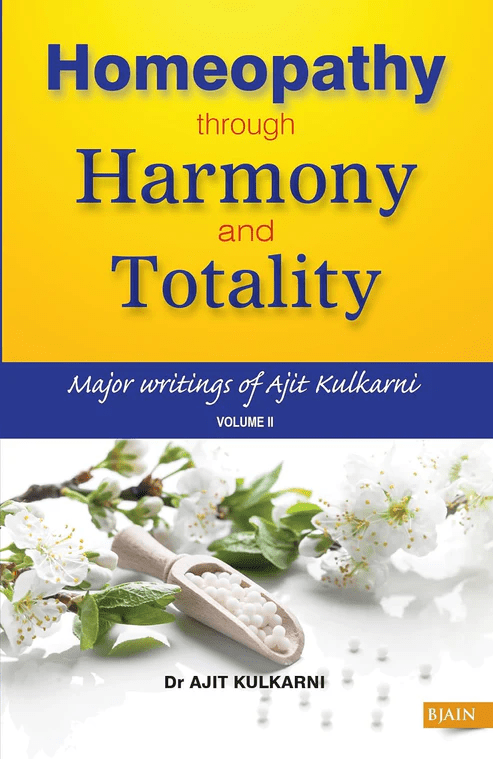
Volume II
Data Processing and Materia Medica
This volume is among the most practically valuable sections of the series. The discussions on case processing, objective analysis, acute prescribing and intercurrent prescribing are highly applicable to daily practice.
The concept of the Monogram represents one of the author’s original contributions to remedy understanding. Through characteristic remedy patterns and dynamic tendencies, Dr. Kulkarni presents a memorable and clinically useful method of studying materia medica.
The incorporation of body language and defense mechanisms into remedy selection further enriches the practitioner’s observational skills.
Notes
- Highly practice-oriented
- Innovative interpretation of materia medica
- Strong emphasis on observation and analysis
- Particularly useful for postgraduate students and young practitioners
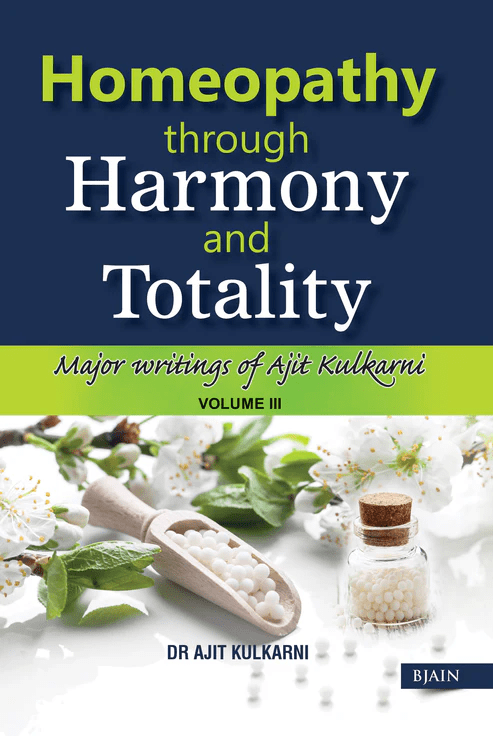
Volume III
Repertory and Therapeutics
Volume III explores repertorial philosophy and therapeutic application with considerable depth. Dr. Kulkarni interprets rubrics dynamically rather than mechanically, especially in the discussion of mental rubrics and Kentian philosophy.
The therapeutic chapters covering respiratory, dermatological and chronic diseases demonstrate the author’s clinical maturity and systematic thinking. Miasmatic interpretation and constitutional understanding are consistently integrated into clinical discussions.
Notes
- Advanced repertorial interpretation
- Clinically relevant therapeutic discussions
- Encourages meaningful rubric analysis
- Bridges repertory with constitutional prescribing
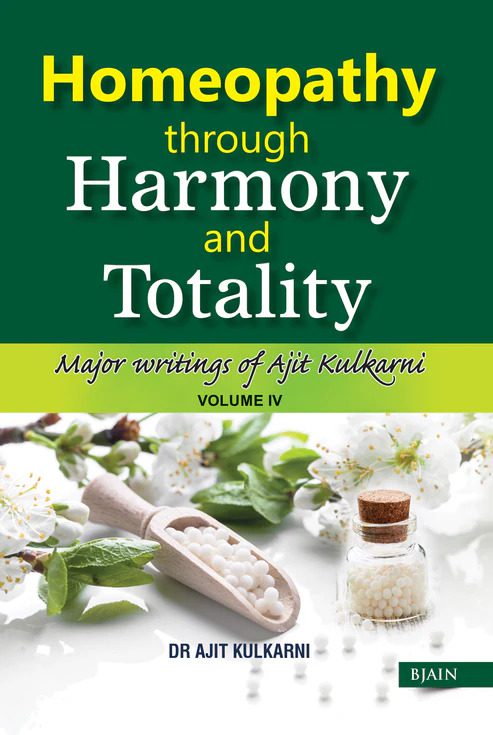
Volume IV
Psychiatry and Advanced Clinical Practice
The fourth volume highlights advanced clinical application in psychiatry, neurology and chronic disease management. The author integrates modern medical classifications with individualized homoeopathic understanding in a balanced and responsible manner.
Particularly impressive are the sections dealing with panic disorders, COPD, neurological conditions and bedside clinical observations. The discussions reflect practical wisdom acquired through long clinical experience.
The chapter Even a Single Hair Casts Its Shadow beautifully illustrates the importance of subtle observations in constitutional prescribing.
Notes
- Strong psychiatric and psychosomatic understanding
- Excellent bedside clinical insights
- Advanced level clinical applicability
- Valuable for experienced practitioners
Critical Appreciation
The series succeeds in presenting homoeopathy not merely as a therapeutic system but as a multidimensional science of human individuality. The author repeatedly emphasizes observation, constitution, susceptibility and harmony as central pillars of clinical practice.
The editorial philosophy of Homoeopathic Links emphasizes integration between practical therapeutics and philosophical reflection. This series aligns remarkably well with that tradition by combining clinical applicability with conceptual depth.
Another notable aspect is the inspirational quality of the work. The books stimulate curiosity, encourage deeper study and revive enthusiasm for classical homoeopathy among readers.
Dr Ajit Kulkarni M.D. (Hom.) is Director, Homeopathic Research Institute, Pune, A veteran homoeopath, an academician and a famed international teacher. A classical Homeopathic physician, he has been practising for 35 years. He has given over 100 international seminars and workshops in different parts of the world. Dr. Kulkarni is co-author: Absolute Homoeopathic Matera Medica, Five Regional Repertories: AIDS, DM, Thyroid, HTN and Trauma . Also, author of Body Language and Homeopathy, Homeopathy through Harmony and Totality (Three volumes), Law of Similars in Medical Science, Homeopathic Posology, Kali Family and Its Relations, Homeopathic Covidoscope (published by Amazon)