Asking people a simple question, “What brings you to homeopathy?” can teach us firsthand that no matter what path someone has followed in the prior phase of one’s life, once they realize the simplicity and potential of homeopathy, they become avid users, home prescribers, or serious homeopathy professionals. Homeopathy becomes quite the center of their lives.
I had encountered Dr. Richard Moskowitz, MD, over the past several years while attending Joint American Homeopathy Conferences, and from his lectures, writings, and work, known him to be a medical doctor who had embraced homeopathy as the center of his life. But I had never asked him, “What brings you to homeopathy?” I am glad I never did, because now he has a book that says it all, “Conscientious Objector: Why I became a Homeopath,” and I get the pleasure of reading this autobiographical book. Dr. Moskowitz’s medical career has been outstanding. He practiced family medicine for 53 years and attended 600 home births in Colorado and New Mexico.
He also studied homeopathy, and practiced it for 46 years. How did he manage to practice homeopathy as a medical doctor, and what made him the prolific writer, and a larger-than-life personality in the homeopathy circle? The title of his latest book gives a clue, “Conscientious Objector,” and lets us read the book to find out what he was objecting to.
This book begins with anecdotal storytelling about his premed years and medical training, when the unbearable torment of questions that could not be answered by orthodox medicine inspired him to study philosophy, hoping to make sense of it all. Then his experience with vaccine-injured children led him to ponder the role of vaccines in the causation of chronic disease.
In an autobiographical voice, he takes us on a hike through his pre-med, medical school, clinical rotation at Bellevue, and internship years when he saw the system up close and felt deep in his heart that he could not practice medicine the way he was trained All along, he had felt a moral outrage at the medical school mentality and practices but had not objected or protested in any way other than leaving the room and staying away from participating in what he could not bring himself to perform or witness. A silent protest, let us say.
But then life intervened just at the right moment, in 1969, when a woman he had met recently asked him if he would help her give birth at home. “Helping a woman do what her body was already doing is indeed a useful, important, and life affirming service” that he could perform as a physician, “without telling people what to do, how to live, or force their bodies into compliance,” he thought. Surely the very first home birth he attended taught him life lessons that served him well for 50+ years.
Back in the days when Dr. Moskowitz was morphing into a home birth doctor, he had a telephone, but no office, no nurse, or appointments. He did his rounds of prenatal visits and taught mothers and family the basics of emergency childbirth.
Many times, during such visits he would do the medical routine as necessary, but he was treated like a member of the family, offered a hot meal, good company, and a warm bed for the night. By integrating himself into the community of expectant mothers, Dr. Moskowitz could give a shape and structure to his medical school protests and objections.
In medical school, treatments and procedures were done by the book. In being with the mothers during childbirth, he could simply be present and let nature do her work through women’s bodies. This life lesson, learned at the bedside of birthing women, is so parallel to homeopathy!
Our vital force governs the body in sickness and in health. The role of the homeopath is to just offer a healing suggestion by way of a remedy, and let nature do her work. Now, our silent protestor / objector, Dr. Moskowitz, finds himself attracted to the philosophy of homeopathy and joins the course taught by Dr Harris Coulter of the National Center for Homeopathy. Integrating homeopathy into his practice, he found it mostly working miraculously.
Another thing Dr. Moskowitz objected to was malpractice insurance because he hardly used hospital admissions for his patients, and he never used surgical procedures at the hospital, or prescribed the toxic pharmaceuticals. Obviously, he had all the right reasons for his objection, and besides, he was fully a homeopathy practitioner now, working in Boston, and mingling with folks who had used homeopathy all their lives.
He was getting deeper into “Vital Force”, the life principle itself that enables the living organism to function as an integrated energy system. In Chapters 4 and 5, you can read about Dr. Moskowitz’s take on homeopathy philosophy, the laws that form its very foundation, the cases and remedies used to obtain a satisfactory outcome.
Though he started his silent objections protesting the medical system during his early years, in Part III we get to read about what exactly he was objecting to. He finds allopathic or orthodox medicine to be a bewildering profusion of techniques and procedures without any philosophical stance.
It is an experimental and empirical science that relies on diagnosis, deals with many diseases without illness (idiopathic hypertension, for example), preventive screenings, and a pill for every known and unknown disease. He also finds that polypharmacy, orthodox medicine’s handling of chronic diseases, drug dependency, surgeries, and side effects do not sit well with him, and his innately philosophical way of looking at health and disease.
In this scenario, malpractice insurance is totally necessary for the orthodox medicine practitioners as their system – while intending to heal, does considerable harm along the way. Chapters 8, 9, and 10 are devoted to vaccination process, the safety and efficacy of vaccines, and how they elicit a chronic state in the long run, subjects worthy of a full book by themselves, but here summarized in Dr. Moskowitz’s lifelong observation, experience, and study of this highly controversial and divisive subject.
Though you can generally relate to the harsh realities of orthodox medicine, Dr. Moskowitz does not leave you objecting and protesting orthodox medicine without offering tips on how to fix the ailing system. He suggests universal health education starting in elementary school, simplified health insurance, healing the doctor – patient relationship, and finally, asks that the government agencies serve the public. In summing up this book, or rather, his life-experience, Dr. Moskowitz calls for good old plain doctoring that enables the practitioner to see all healing as self-healing, something that our Vital Force engages in while complying with the laws of nature so beautifully recognized in homeopathic philosophy.
In summary this book offers great, fun, and engaging reading material, and helps us understand all the reasons for which we simply love homeopathy.
Dr. Moskowitz, Thank You for writing this book.
Vatsala Sperling
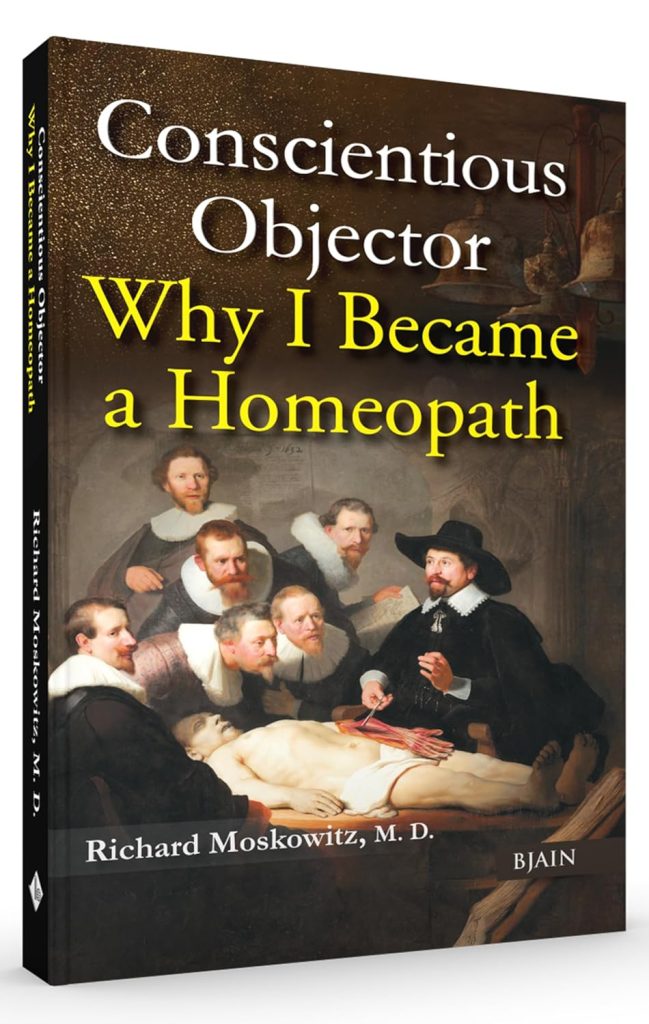
Title: Conscientious Objector – Why I Became A Homeopath
Author: MOSKOWITZ RICHARD
ISBN: 9788131967997
Imprint: B Jain Regular
Pages: 294
Format: Paperback
Language: English