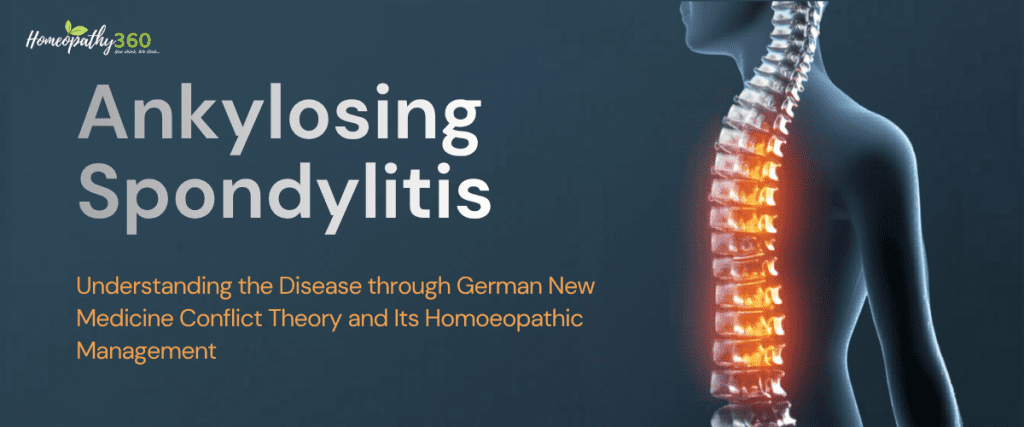
Ankylosing Spondylitis: Understanding the Disease Through German New Medicine Conflict Theory and Its Homoeopathic Management
Abstract:
Background;
Ankylosing Spondylitis (AS) is a chronic inflammatory autoimmune disorder primarily affecting the axial skeleton, resulting in pain, stiffness, and progressive restriction of spinal mobility. Conventional medicine attributes the disease to genetic, immunological, and environmental factors, particularly its association with HLA-B27 positivity. German New Medicine (GNM), proposed by Dr. Ryke Geerd Hamer, offers an alternative perspective, suggesting that diseases may originate from unresolved biological conflicts affecting the psyche, brain, and organs simultaneously.
Objective
To explore Ankylosing Spondylitis through the lens of German New Medicine conflict theory and discuss its relevance in individualized Homoeopathic management.
Methods
A narrative review of the concepts of Ankylosing Spondylitis, German New Medicine conflict theory, and Homoeopathic principles was undertaken. Theoretical correlations between self-devaluation conflicts and Homoeopathic case analysis were examined.
Results/Observations
GNM proposes that unresolved self-devaluation conflicts may contribute to musculoskeletal disorders. Homoeopathic case-taking frequently reveals emotional stressors, grief, humiliation, loss of self-worth, and chronic psychological burdens that may influence disease expression. Integration of conflict analysis may enrich understanding of the patient’s mental and emotional state during individualized Homoeopathic prescribing.
Conclusion
Although GNM remains scientifically unverified, exploration of emotional conflicts may complement holistic Homoeopathic case-taking. Individualized Homoeopathic management focusing on the totality of symptoms may contribute to improved quality of life in patients with Ankylosing Spondylitis.
Keywords: Ankylosing Spondylitis, Homoeopathy, German New Medicine, Biological Conflict, Self-Devaluation Conflict, Quality of Life
1. Introduction
Ankylosing Spondylitis (AS) is a chronic inflammatory rheumatic disease characterized by inflammation of the sacroiliac joints and spine. It commonly affects young adults and can significantly impair mobility, functional capacity, and quality of life.
The prevalence of AS varies across populations and is strongly associated with HLA-B27 positivity. The disease is characterized by chronic low back pain, morning stiffness, reduced spinal flexibility, sacroiliitis, and various extra-articular manifestations.
Conventional medicine attributes AS to a complex interaction of genetic susceptibility, immune dysregulation, and environmental influences. Management typically includes NSAIDs, physiotherapy, biologics, and lifestyle modifications.
Despite advances in treatment, many patients continue to experience physical limitations and psychosocial distress, highlighting the need for holistic and individualized approaches to patient care.
2. German New Medicine Perspective
German New Medicine (GNM) was developed by Dr. Ryke Geerd Hamer and is based on the concept that diseases arise following unexpected biological conflicts.
GNM is founded upon five biological laws, which propose a relationship between emotional shock, specific brain changes, and organ manifestations.
According to GNM, musculoskeletal disorders are frequently associated with a self-devaluation conflict, characterized by:
1) Feelings of inadequacy
2) Loss of self-worth
3) Perceived failure
4) Inability to meet expectations
5) Long-standing emotional burdens
In Ankylosing Spondylitis, unresolved self-devaluation conflicts are theorized to influence musculoskeletal structures, resulting in chronic symptoms. Although this concept lacks
scientific validation, it may encourage clinicians to explore psychological stressors contributing to patient suffering.
3. Homoeopathic Concept Of Disease
Homoeopathy views disease as a dynamic disturbance of the vital force affecting the individual on mental, emotional, and physical planes.
The fundamental principles include:
1) Individualization
2) Totality of symptoms
3) Miasmatic understanding
4) Constitutional treatment
Mental and emotional symptoms hold particular importance in Homoeopathic prescribing. Emotional conflicts, grief, humiliation, anxiety, and stress may serve as maintaining causes and assist in remedy selection.
The self-devaluation conflict described in GNM may correspond to significant mental-emotional factors frequently identified during detailed Homoeopathic case-taking.
4. Ankylosing Spondylitis: Conflict Analysis
Many patients with chronic inflammatory disorders report persistent emotional stressors preceding or accompanying disease progression.
Common themes include:
1) Reduced self-esteem
2) Feelings of inadequacy
3) Chronic occupational stress
4) Family-related conflicts
5) Social isolation
6) Fear regarding future disability
Such observations may correlate with the self-devaluation conflict concept described in GNM.
In Homoeopathic practice, these emotional experiences are explored as part of comprehensive case-taking and may contribute significantly to remedy selection and overall management.
5. Homoeopathic Management
Homoeopathic management of Ankylosing Spondylitis is based on individualized assessment rather than diagnosis alone.
Case-Taking Approach
1) Detailed history taking
2) Mental and emotional assessment
3) Physical generals
4) Modalities
5) Family history
6) Miasmatic evaluation
Totality of Symptoms
The complete symptom picture is constructed using mental, emotional, and physical characteristics unique to each patient.
Repertorization
Appropriate rubrics are selected and analyzed to identify the most suitable constitutional remedy.
Constitutional Prescribing
Remedies are prescribed according to the individualized symptom totality and constitutional characteristics.
Commonly Indicated Remedies
1) Rhus toxicodendron
2) Bryonia alba
3) Thuja occidentalis
4) Natrum muriaticum
5) Staphysagria
6) Sulphur
7) Lycopodium clavatum
8) Calcarea carbonica
9) Aurum metallicum
10) Causticum
The final prescription should always be based on the complete individual symptom picture.
6. Discussion
Both Homoeopathy and GNM emphasize the importance of the individual rather than merely the disease diagnosis.
Similarities
1) Holistic patient assessment
2) Importance of emotional experiences
3) Individualized understanding of illness
Differences
1) Homoeopathy is based on the Law of Similars and individualized remedy selection. 2) GNM proposes biological conflict theories as the origin of disease.
Potential Role of Conflict Identification
Identification of emotional conflicts may assist clinicians in understanding:
1) Disease perception
2) Psychological stressors
3) Coping mechanisms
4) Maintaining causes
Clinical Implications
Exploration of emotional experiences may improve patient communication, therapeutic relationships, and individualized management strategies.
Limitations of Current Evidence
GNM remains controversial and lacks robust scientific validation. Current evidence does not establish biological conflicts as a proven cause of Ankylosing Spondylitis.
Critical Appraisal of the German New Medicine Hypothesis
While GNM highlights the possible influence of emotional experiences on health, its theories have not been adequately supported by rigorous scientific research. Current understanding of Ankylosing Spondylitis recognizes genetic, immunological, and environmental mechanisms as primary contributors to disease development.
Nevertheless, the emphasis on emotional stressors may encourage a more comprehensive patient assessment consistent with Homoeopathic philosophy. GNM conflict analysis should therefore be regarded as a complementary interpretative framework rather than an established etiological explanation.
Future Research Directions
Future studies should investigate:
1) Emotional stress and disease activity in AS
2) Quality of life outcomes following individualized Homoeopathic treatment 3) Psychosocial determinants of disease progression
4) Larger controlled clinical studies integrating psychological assessment and Homoeopathic management
7. Conclusion
Ankylosing Spondylitis is a complex chronic inflammatory disease involving physical, emotional, and social dimensions.
German New Medicine proposes that unresolved self-devaluation conflicts may contribute to disease manifestation, whereas Homoeopathy focuses on individualized treatment of the patient as a whole. Integrating careful exploration of emotional stressors with constitutional Homoeopathic prescribing may provide a broader understanding of patient experiences and support holistic management.
Further scientific research is necessary to clarify the relationship between emotional conflicts, disease activity, and therapeutic outcomes in Ankylosing Spondylitis.
References
1. Braun J, Sieper J. Ankylosing spondylitis. Lancet. 2007;369(9570):1379–1390. 2. Hahnemann S. Organon of Medicine. 6th ed.
3. Kent JT. Lectures on Homoeopathic Philosophy.
4. Hamer RG. German New Medicine Literature.
5. Sieper J, Poddubnyy D. Axial spondyloarthritis. Lancet. 2017;390:73–84. 6. Davidson’s Principles and Practice of Medicine. Latest Edition.
7. Relevant peer-reviewed literature on Homoeopathy and Ankylosing Spondylitis.
Acknowledgement
The author acknowledges the guidance of colleagues, students and patients who contributed to the understanding of Ankylosing Spondylitis and its holistic management.