
A Review on Effectiveness of Natrum Mur in Case of Migraine- A Case Report
Abstract (1)
Migraine is a common and disabling neurological disorder, typically characterized by unilateral headaches that are often accompanied by other symptoms such as nausea, photophobia, and phonophobia. It is more common in women (2 to 3:1) and family history is often present (60% of cases) Despite significant advancements in the understanding and treatment of migraines, the complexity of their pathophysiology and the variability in their presentation challenge effective management.
Key Word
Migraine; Homoeopathy; Management
Introduction (1, 2, 3)
Migraine is a common and debilitating neurological disorder, often characterized by severe, recurring headaches, which can significantly impair an individual’s quality of life. It is more common in women (2 to 3:1) and a family history is often present (60% of cases). A migraine attack has three phases: premonitory (prodrome), headache phase and postdrome; each has distinct and sometimes disabling symptoms, which may overlap. About 20-25% of migraine patients have a fourth, aura phase. Migraine can often be recognized by its activators, referred to as triggers. It is considered to be a multifactorial condition, influenced by genetic, environmental and lifestyle factors.
Case History
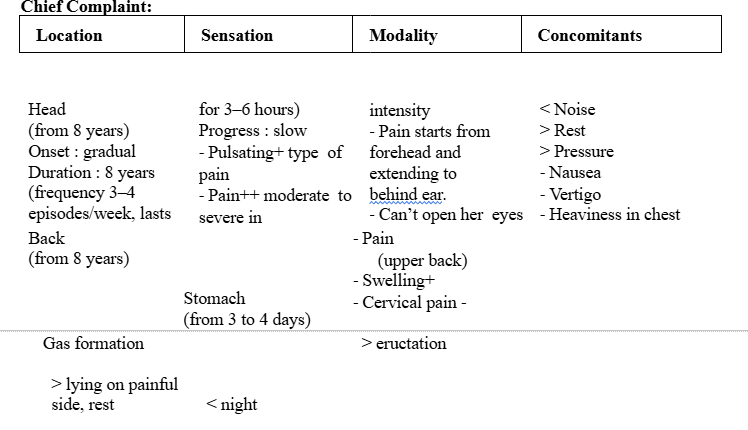
Present History: A 38 year old female patient came in the OPD with the complaint of the headache with pulsating type of pain from 8 years.
Physical Characteristics:
Appetite: 3 Times/ Day, Eats Only When Hungry
Thermals: Hot
Perspiration: More Particular: Scalp, Hand and Back; Staining Linen White on Washing
Thirst: 5-6 Glasses/Day
Menses: Lmp: 26/9/23
Cycle: 28 Days Duration: 2-3 Days Character: Dark Red, No Small Clots Concomitants: BM: Leucorrhoea with Bad Smell
DM: Leg Pains
AM: Leucorrhoea for 2-3 Days
Leucorrhoea– Before and After Menses
Sleep: Disturbed, Unrefreshing Sleep
Dreams: Dogs Fear of; Some Dreams Not Remember
Reactions – Physical Factors:
Thermal: Hot
| Summer | Winter | Monsoon | |
| Fan | Fan +++ | Want but slow | Fan +++ |
| Cover | No | Thick | No |
| Bath | Cold | Cold | Cold |
Systemic Examination:
RS: B/L Airway Clear CVS: S1 S2+
CNS: Conscious & Oriented GIT: Bowel Sound
Family History: –
Father: Alive/Healthy
Mother: Alive/Healthy
Past History: –
Piles (2 times in 2018 & 2022 Taken Allopathic Treatment)
Diagnosis: Migraine
Life Space & Mentals
She is a 38-year-old housewife from Surat who presents with a complex emotional and psychosomatic profile. She is of Hindu background, 9th pass in education, and lives with her husband and children. Her nature is marked by emotional sensitivity, irritability, and
suppressed anger. She tends to stay silent during moments of emotional upset rather than expressing her feelings openly. This tendency to internalize emotions has contributed to deep seated mental stress. She is having strong fear of dogs, particularly the fear of being bitten, and suffers from constant anxiety regarding the future and well-being of her children. These fears seem to reflect a larger insecurity and lack of emotional safety in her personal environment.
Despite her irritability and emotional burden, she is socially pleasant and mixes easily with others. She is emotionally reactive, often crying when scolded or when someone says something hurtful. A major psychological concern is her history of suicidal ideation—just two months prior to her first visit, she attempted suicide by consuming medicine following a conflict with her husband, who has a habit of drinking alcohol. This highlights the depth of her emotional turmoil and the strained marital relationship that contributes to her distress.
Her dreams often involve dogs, which mirrors her waking fears, and she reports that she forgets some of her dreams upon waking. Sandhya’s overall mental state is characterized by fearfulness, anxiety, suppressed emotions, and emotional hypersensitivity. These mental characteristics are strongly connected to her physical complaints, including chronic pulsating headaches, upper back pain, nausea, and disturbed sleep—indicating a strong psychosomatic linkage in her case.
Analysis & Evaluation:
1) Mind fear dog – Mental General – I
2) Mind suicidal disposition – Mental General – I
3) Perspiration staining linen white – Physical General – II
4) Head pain pulsating – Physical Particular – III
5) Head Pain Forehead Extending To Behind Ear – Physical Particular –
Totality Of Symptoms:
1) Fear of dogs
2) Suicidal disposition
3) Weeping when scolded
4) Anxiety about his children
5) Stay silent during emotional upset
6) Head pain pulsating
7) Head pain forehead extending to behind ear/ occiput
8) Perspiration staining the linen white
9) Hot patient
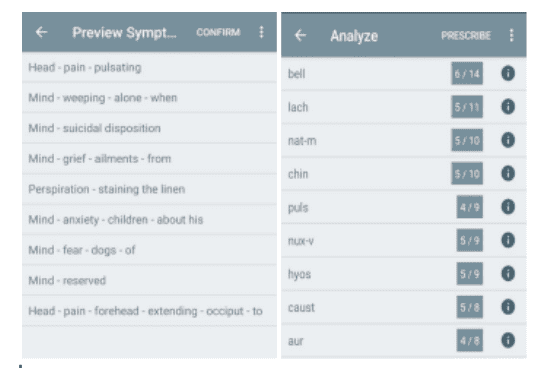
Repertorisation:
1) Mind – Fear – Dogs of
2) Mind – Weeping – alone – when
3) Mind – Grief – ailments – from
4) Mind – Anxiety – children – about his
5) Mind – Suicidal disposition
6) Mind – Reserved
7) Head – Pain – Pulsating
8) Head – Pain – forehead – extending – occiput – to
9) Perspiration – staining the linen – white
D/D: 1) Bell: 6/14
2) Lach: 5/11
3) Nat-M: 5/10
4) Chin: 5/10
5) Puls: 4/9
Prescription:
NATRIUM MURIATICUM 200/ 1 DOSE x STAT
SL 4 PILLS x BD x 15 DAYS
Follow Up:
| STATUS | TREATMENT | |
| After 15 days | Headache intensity and frequency reduced by 40%; back pain reduced; no nausea; feels calmer emotionally. | SL 4 pills TDS × 15 days |
| After 30 days | Headache 80% better; no back pain or cervical swelling; no episodes in the last month; sleep improved; emotional irritability less. | SL 4 pills QDS × 1 month |
| After 30 days | No headache episodes; mental state calmer; no suicidal thoughts. Digestion better; leucorrhoea still mildly before menses. | SL – 4 pills QDS × 1 month |
Conclusion
Homoeopathy offers an effective and holistic approach in the management of migraine by enhancing the body’s natural healing mechanisms, minimizing recurrent tendency of migraine and improving the patient’s overall well-being. Further clinical studies and case based evidence can strengthen the role of homoeopathy in neurological conditions like migraine.
Reference
1) Prakash MA, Dhadwal A, Marco AJ. Headache. In: StatPearls [Internet]. Treasure Island (FL): StatPearls publishing; 2022 Jan– [cited YYYY MM DD]. Available from: https://www.ncbi.nlm.nih.gov/books/NBK560787/
2) AF, Golwalla SA. Golwalla’s medicine for students: a reference book for the family physician. 25th Ed. New Delhi: Jaypee Brothers Medical Publishers; 2017.
3) Davidson S. Davidson’s principles and practice of medicine. 24th ed. London: Elsevier; 2022.