Abstract
Gallbladder stones, or cholelithiasis, are a prevalent condition that can cause significant pain and discomfort. This case report details the successful homoeopathic management of a 30-year-old female patient diagnosed with multiple mobile gallbladder calculi, the largest measuring 12 mm. The patient presented with classical symptoms including pain in the right hypochondriac region, relieved by vomiting, and severe constipation. A detailed case-taking, including a thorough evaluation of her physical and mental spheres, led to the prescription of a constitutional remedy. Over a period of one month, the patient reported significant symptomatic relief. A follow-up ultrasound revealed the disappearance of the calculi, with only gallbladder sludge remaining. This case highlights the potential of an individualized homoeopathic approach in the management of cholelithiasis, offering a non-invasive alternative to conventional treatment.
Keywords
Cholelithiasis, Gallbladder stone, Homoeopathy, Case report, Murphy repertory.
Introduction
Homeopathy, a holistic medical system developed by Dr. Samuel Hahnemann, focuses on treating the individual rather than just the disease. Based on the principle of “Similia Similibus Curentur” (“like cures like”), it uses highly diluted and potentized substances to stimulate the body’s self-healing mechanisms.
Pathophysiology of Cholelithiasis
The formation of gallstones is a complex process driven primarily by an imbalance in the components of bile. The most common type of gallstone, the cholesterol stone, accounts for approximately 80% of cases. The formation of these stones is rooted in a physiological triad:
- Bile Supersaturation: This occurs when the liver secretes an excessive amount of cholesterol, leading to a bile composition that is unable to keep the cholesterol dissolved. Cholesterol, being largely water-insoluble, then precipitates out of the solution.
- Nucleation: The precipitated cholesterol then forms tiny crystals. This process is accelerated by certain proteins in the bile, such as mucin, which can act as a scaffold for the crystals to bind to and grow.
- Gallbladder Hypomotility: If the gallbladder does not contract and empty efficiently, bile can stagnate, providing ample time for the cholesterol crystals to aggregate and grow into larger stones.
Less common are pigment stones, which are composed of bilirubin, a byproduct of red blood cell breakdown. These stones typically form in patients with conditions that cause chronic red blood cell destruction or in those with biliary tract infections.
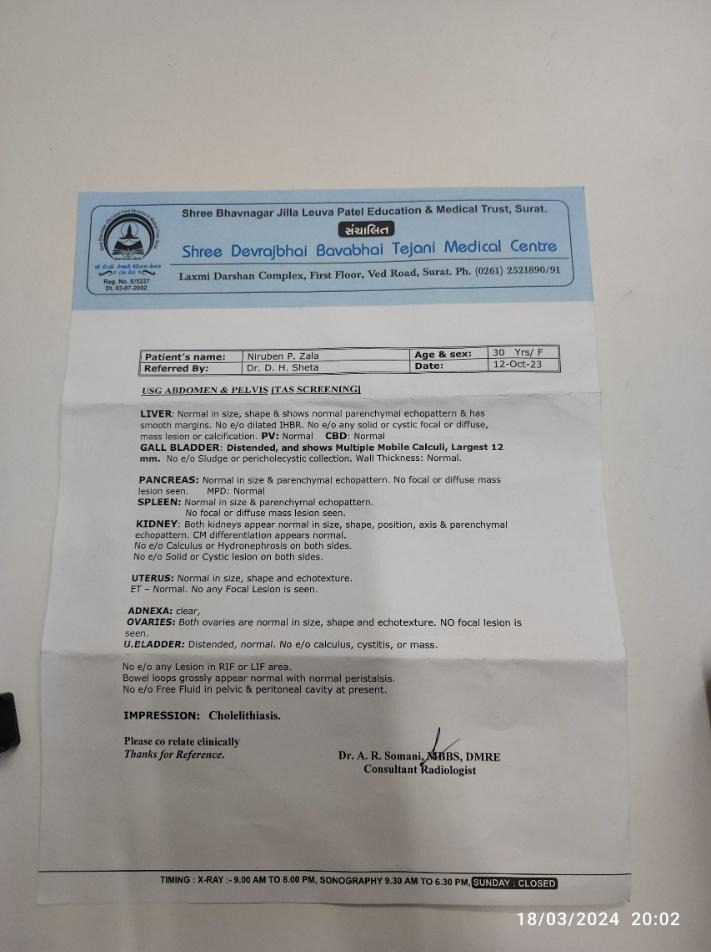
Case History: A 30-year-old female presented on February 12, 2024, with a diagnosis of gallbladder stones since October 2023.
USG Findings: The ultrasound report dated October 2023 indicated a distended gallbladder with multiple mobile calculi, the largest measuring 12 mm. No sludge or pericholecystic collection was noted.
History of Patient’s illness:
- Pain: Dull aching pain in the right hypochondriac region, extending to the back. Aggravated by fasting and ameliorated by vomiting.
- Digestive issues: Burning sensation in the chest with regurgitation, especially when fasting, relieved by drinking cold water.
- Headache: Dull aching pain in the frontal region, aggravated by sunlight and relieved by a cold water bath.
- Constipation: Bowel movements every 3-4 days, requiring purgatives for daily evacuation.
Treatment History: Patient had taken Allopathic medicine for this complains
Past History: :- Recurrent tonsillitis since age 10, with tonsillectomy in 2017.
Family History: Father: No any major illness,
Mother: No any major illness.
- Physical Generals- all the information should be specific, mention character, quantity, modality.
- Thermal reaction- : Chilly
- Appetite: 3 meals per days
- Thirst – 4-5 glasses per day (Thirstless)
- Desire: Strong desire for sweets and bitter things, and a history of pica (eating non-food items).
- Aversion: Alcoholic drinks
- Urine: D – 2-3 N – no , colour: Pale yellow
- Stool: Once , Character : normal – satisfactory
- Sleep: 7 hours , Refreshing
- Dreams: Clairvoyent
- Perspiration: Profuse – on head and chest
- Sensitivities: Intolerant of direct sunlight, which causes tanning and headaches. Intolerant of the smell of alcohol, which causes nausea.
Mental Generals:
From a young age, I had a strong passion for studying, but due to unfavorable family circumstances, I had to stop my education on my own. I started working on diamond polishing at home, setting up a small machine and working daily. My father’s earnings were enough to run the household, and my income was used to educate my two younger sisters. Even now, my husband doesn’t earn much. I go to different buildings and secure contracts for cleaning. When new buildings are being constructed, I take on the contracts for the entire building’s cleaning and manage all the workers. My husband also helps me with the work.
I don’t like it when someone points out my mistakes, especially regarding my work. If that happens, I start working to make my work perfect. My work is always perfect because I believe no one should have a reason to find fault with it. You should make your work perfect before anyone can criticize it.
I absolutely can’t stand the smell of alcohol; it makes me feel nauseous. I can’t even stay in a place where people are drinking. Previously, my father and uncles used to drink, and I would avoid going near them when they were drinking. If they asked for something to eat, my mother would have to go give it to them. I don’t like people who drink, which is why I worked so hard to make everyone stop drinking. Now, no one drinks.
Sometimes, what I see in my dreams comes true. This has happened many times.
Repertorial analysis:
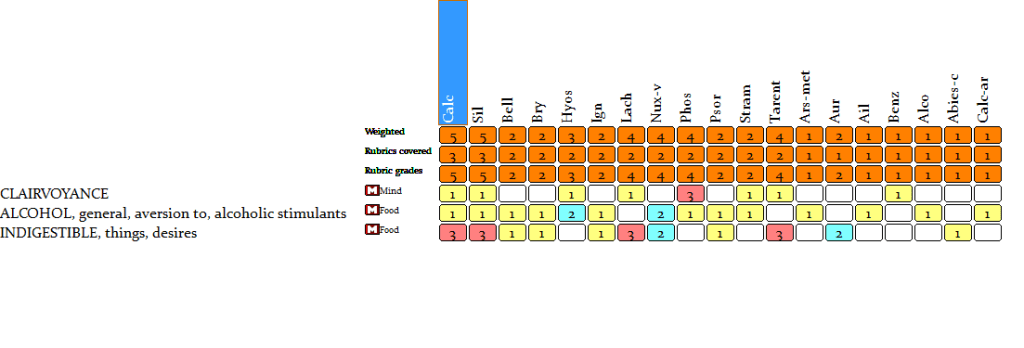
Rx: 12/02/2024
Calcarea Carb 200 1 dose
Sl 200 for 15 days
Follow-up Schedule:
- Date: 26/02/24: The patient reported a complete absence of pain and vomiting. However, the burning and regurgitation were aggravated. No change in the remedy was required as the aggravation indicated a positive action of the remedy on the deeper level. Rx: Calcarea Carb 1M, two doses, followed by Sac lac 3 times a day for 15 days.
- Date: 11/03/24: The patient reported complete relief from all symptoms, including the burning and regurgitation. Rx: Sac lac 3 times a day for 15 days.
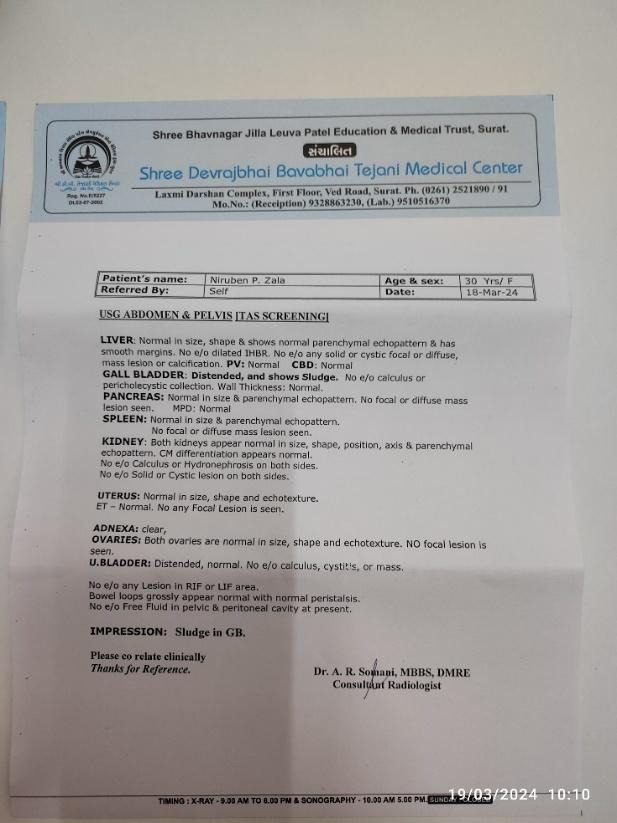
- Date: 18/03/2024: A follow-up ultrasound revealed that the gallbladder stones had completely disappeared. The report now indicated only sludge and a distended gallbladder.
Conclusion
This case demonstrates the remarkable efficacy of individualized homoeopathic treatment in the management of cholelithiasis. The patient’s symptoms, including the prominent mental and peculiar physical characteristics, were meticulously matched to the simillimum remedy, Calcarea Carb. The rapid symptomatic improvement and the subsequent resolution of the gallstones, as confirmed by ultrasound, underscore the potential of homoeopathy to address the underlying disease process rather than just the symptoms. This case provides compelling evidence for homoeopathy as a valid and non-invasive therapeutic option for cholelithiasis and warrants further research.
References
- Boericke, W. (2009). Pocket Manual of Homoeopathic Materia Medica & Repertory. B. Jain Publishers.
- Murphy, R. (2012). Homoeopathic Clinical Repertory. Lotus Health Institute.
- Harrison, T. R., & Fauci, A. S. (2008). Harrison’s Principles of Internal Medicine. McGraw-Hill Medical.
- Lustman, S. (2018). Gallstones and Cholelithiasis. Stat Pearls Publishing.