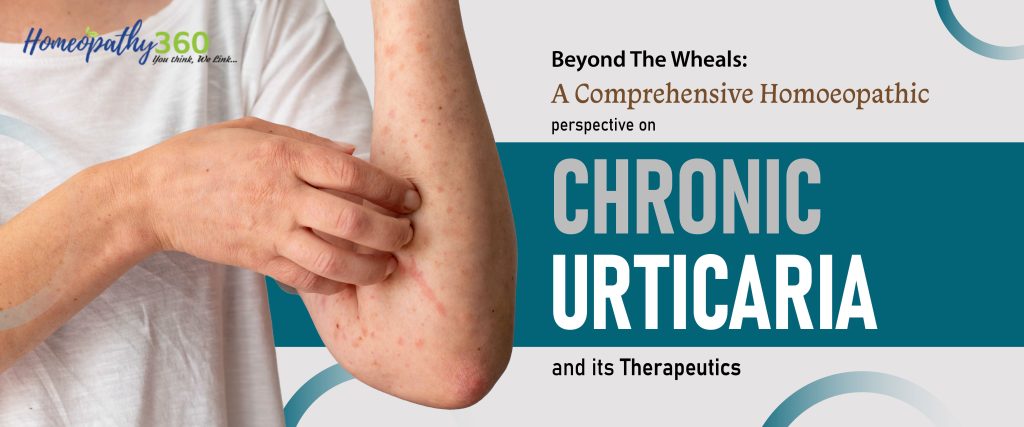
Beyond the Wheals: A Comprehensive Homoeopathic Perspective on Chronic Urticaria and Its Therapeutics
Introduction
Urticaria, commonly known as hives, is a frequently encountered dermatological condition characterized by transient, pruritic wheals. While acute urticaria is often self-limiting, chronic urticaria poses a significant therapeutic challenge due to its recurrent nature and unclear etiology. Integrating modern medical understanding with homoeopathic therapeutics provides a holistic approach to management.
Definition
Urticaria is defined as a vascular reaction of the skin marked by the appearance of wheals (hives), which are transient, edematous, erythematous plaques often associated with itching or burning sensation. Chronic urticaria is diagnosed when the condition persists for more than 6 weeks, with recurrent episodes occurring almost daily.
Types of Urticaria
1. Based on Duration
- Acute Urticaria: Lasts less than 6 weeks; commonly associated with infections, drugs, or food allergens.
- Chronic Urticaria: Persists beyond 6 weeks; often idiopathic or autoimmune in nature.
2. Based on Etiology and Triggers
- Spontaneous (Idiopathic) Urticaria
- Physical Urticaria:
- Dermographism
- Cold urticaria
- Heat urticaria
- Pressure urticaria
- Solar urticaria
- Cholinergic Urticaria (triggered by sweating or exercise)
- Contact Urticaria
- Autoimmune Urticaria
Etiology
According to standard dermatology and medical texts, the etiology of urticaria involves mast cell degranulation, leading to the release of histamine and other inflammatory mediators.
Common Causes Include:
- Allergens: Foods (nuts, shellfish), drugs (penicillin, NSAIDs)
- Infections: Viral, bacterial, parasitic
- Autoimmune mechanisms: Autoantibodies against IgE receptors
- Physical stimuli: Heat, cold, pressure, sunlight
- Psychological stress
- Systemic diseases: Thyroid disorders, lupus
Despite extensive evaluation, many cases of chronic urticaria remain idiopathic, emphasizing the need for individualized treatment.
Pathophysiology
Urticaria results from vasodilation and increased vascular permeability due to histamine release from mast cells. This leads to plasma leakage into the dermis, forming wheals. In chronic cases, autoimmune processes may play a central role.
Homoeopathic Therapeutics in Urticaria
Homoeopathy emphasizes individualization, considering not only the skin manifestations but also the patient’s constitution, modalities, and associated symptoms.
Below are 6–7 important remedies derived from classical Materia Medica:
1. Urtica Urens
- One of the foremost remedies for urticaria
- Intense itching with burning and stinging
- Wheals aggravated by touch, cold air, or water
- Often associated with shellfish allergy
- Useful in acute and chronic cases
2. Apis Mellifica
- Marked edematous swelling with burning and stinging pain
- Skin appears pinkish or pale
- Worse from heat, better from cold applications
- Absence of thirst is characteristic
- Useful in urticaria with angioedema
3. Rhus Toxicodendron
- Intense itching with restlessness
- Eruptions better from warmth and hot bathing
- Urticaria due to exposure to damp cold weather
- Vesicular eruptions may accompany wheals
4. Natrum Muriaticum
- Chronic urticaria with periodic recurrence
- Triggered by sun exposure or emotional stress
- Associated with dry skin and craving for salt
- Reserved, introverted personality
5. Sulphur
- Chronic, relapsing urticaria with intense itching and burning
- Worse from heat, bathing, and at night
- Skin appears dirty, unhealthy
- Useful as an intercurrent remedy to stimulate reaction
6. Pulsatilla Nigricans
- Urticaria associated with rich, fatty food intake
- Symptoms are changeable
- Better in open air, worse in warm rooms
- Mild, emotional temperament
7. Arsenicum Album
- Severe itching with burning sensation
- Marked restlessness and anxiety
- Worse at midnight, better from warmth
- Urticaria with systemic weakness
Comparative Therapeutic Insights
- Apis vs Urtica Urens: Both have burning and stinging, but Apis is better from cold and worse from heat, while Urtica may worsen from cold.
- Rhus Tox vs Sulphur: Rhus Tox improves with warmth; Sulphur worsens with heat.
- Pulsatilla vs Natrum Mur: Pulsatilla seeks company and open air; Natrum Mur prefers solitude and is aggravated by sun.
General Management
- Identification and avoidance of triggers
- Stress management
- Dietary regulation
- Proper case-taking in homoeopathy to individualize treatment
Conclusion
Chronic urticaria is a multifactorial condition requiring a comprehensive approach. While conventional medicine focuses on symptomatic relief through antihistamines and immunomodulators, homoeopathy offers a deeper, individualized therapeutic strategy. By selecting remedies based on totality of symptoms, long-term relief and improved quality of life can be achieved.
References
- Fitzpatrick’s color atlas and synopsis of clinical dermatology
- Harrison’s Principles of Internal Medicine
- Boericke’s Materia Medica
- Clarke’s Dictionary of Practical Materia Medica
- Comparative Materia Medica