Abstract
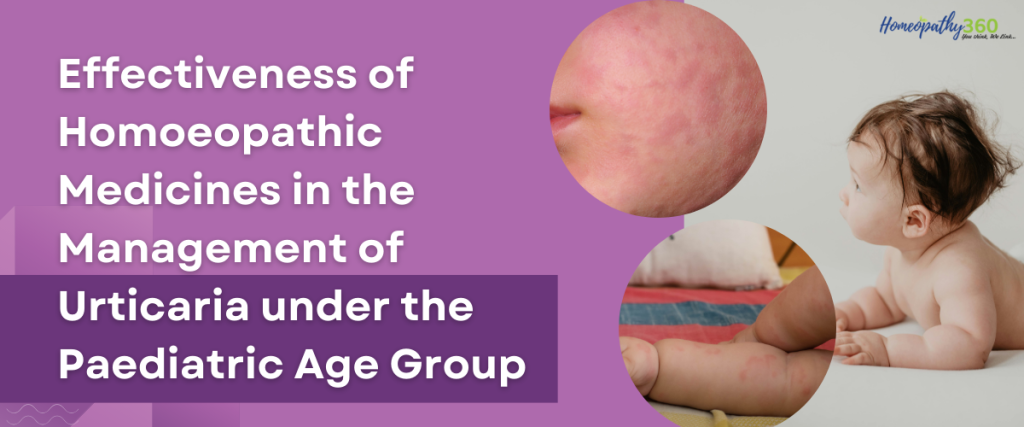
Background: Urticaria is a common skin condition in children, characterized by erythematous, oedematous, and itchy wheals. It significantly affects quality of life of a child. This condition may arise from various infections, allergens, physical stimuli and other idiopathic causes.
Aim: To determine the effectiveness of individualized homoeopathic medicines in the management of Urticaria under the Paediatric Age Group.
Materials and Methods: An open-label, non-randomized, prospective observational study was conducted on 30 children diagnosed with urticaria at the Government Homoeopathic Medical College and Hospital, Bhopal. Individualized homoeopathic medicines were prescribed based on totality of symptoms. For the assessment of the effectiveness of individualized homoeopathic medicine in management of Urticaria, Urticaria activation score was used to assess the before and after symptom outcome.
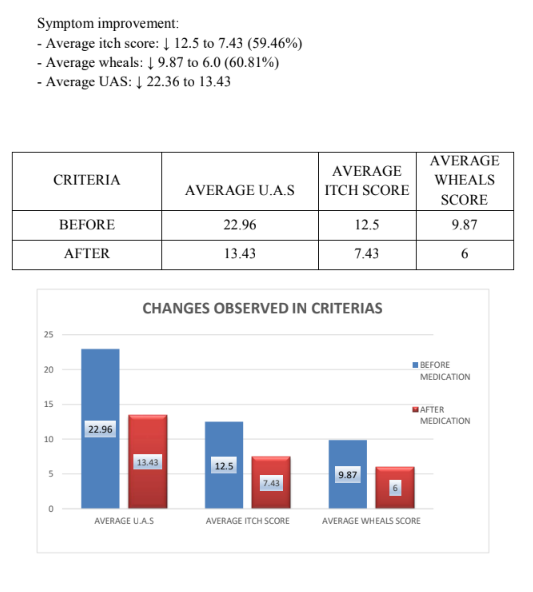
Results: The most affected age group was 4–6 years. Males (67%) were more commonly affected. Acute urticaria was most prevalent. Among the triggering factors, Idiopathic triggers were most frequent followed by Worms and Respiratory complains. Sulphur and Rhus tox were the most frequently prescribed medicines. Homoeopathic treatment showed significant symptom improvement in Urticaria with reductions in Average Urticaria activation score from 22.36 to 13.43. Average itch score and average number of wheal decreased from 12.5 to 7.433 and 9.866 to 6 respectively. Marked improvement was seen in 20% cases.
Conclusion: Homeopathic constitutional medicines, selected on the totality of symptoms and homoeopathic principles, yield significantly positive outcomes for urticaria in children.
Keywords: Urticaria, Homoeopathy, Children, Urticaria Activity Score, Skin disorder.
Introduction
Skin diseases are very common now days. From which Urticaria is one of the most common diseases. In Urticaria, itching and wheal like eruption are the most common manifestations. Urticaria in children is a frequent hypersensitivity reaction affecting the skin and mucosa.
Urticaria affects 8.8-22.5% of individuals at some point in their whole life. [1] Point prevalence of Urticaria is 0.5–1% means at any time.[2] According to a study, total of 1.8% of children were found to be suffering of chronic Urticaria.[5]
Urticaria can induced by any type of infections, insect bites, contact allergy, medications, Transfusion reactions, Physical factors like sun, water, pressure, vibrations, cold, heat etc. can also trigger hypersensitivity reactions in urticaria.[7]
The holistic science of Homoeopathy describes skin diseases external manifestation of internal essence of disease. Dr. Hahnemann, our esteemed Master, provides guidance in the Organon of Medicine (6th edition), aphorisms 5 that a physician should take into account the patients physical constitution, his moral and intellectual character, his age etc. This comprehensive understanding of the person is essential to identify the underlying cause of chronic disease, which is often rooted in a chronic miasm. [3]
In Aphorism 117, Dr. Hahnemann teaches about Idiosyncrasy as a peculiar corporeal constitution which although otherwise healthy possesses a disposition to be brought into more or less morbid state by certain things which seem to produce no impression and no change in many other individuals.
According to Dr. J.T. Kent idiosyncrasy is over sensitiveness to one thing or few things. Hypersensitivity reactions are the indications of psoric and pseudo-psoric miasm. [4]
Homeopathic medicines can help strengthen the body’s resistance to allergens, restore proper immune system function, and revive weakened immunity. They also address emotional imbalances, soothe itching and wheals, and relieve conditions linked to allergies, such as allergic asthma. By promoting internal balance, homeopathy supports overall well-being and helps eliminate allergy symptoms. It contributes to a more comprehensive, patient-centered approach to pediatric health care. This study evaluates the therapeutic effect of individualized homoeopathic remedies in managing paediatric urticaria.
Need for the study-
- Pediatric Urticaria is rising globally causing significant discomfort and distress.
- Urticaria can turn into chronic or recurring forms. Early identification and management can prevent recurrences and complications.
- Prompt and early intervention supports the child’s physical and emotional development which leads to improvement in quality of life.
Objectives:
To determine the effectiveness of individualized homoeopathic medicine in management of Urticaria.
Materials and Methods
- Study Design: Open-label, non-randomized, prospective observational study
- Duration: 1 year, from Dec.2023 to Dec.2024
- Sample size: 30 patients (initially 36 enrolled ; 6 dropped out)
- Age group: 1–18 years
- Location: Govt. Homoeopathic Medical College & Hospital, Bhopal
- Inclusion Criteria –
- Children of aged 1-18 years having symptoms and diagnosed with urticaria.
- Patient of all religions, both sexes and irrespective of socio-
- economic status
- Patients who gave consent to participate their child in the study.
- Patient who are coming for regular follow up.
Exclusion Criteria: –
o Urticaria secondary to any medical illness.
o Any critical cases with angioedema.
o Patient taking any other mode of treatment.
1.Intervention: Individualized homoeopathic remedies based on case totality
2. Assessment Tool: Urticaria Activity Score (UAS) to evaluate changes in itch and wheal count
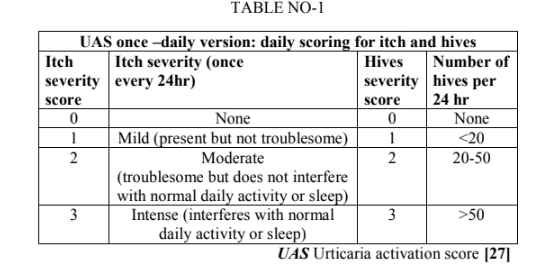
MAXIMUM SCORE per day- 6
MINIMUM SCORE per day -0
It will continue for next 7 day and score will be recorded. Final score
will be in between 42 to 0.
1.Outcome assessment: After using Urticaria activation score (UAS)
score its result before and after treatment was calculated using
percentage of improvement, following formula was used for obtaining
result

2. Statistical Analysis: Paired t-test was used to assess pre- and post-
treatment scores. Significance at p< 0.05.
Results
Age group most affected: 4–6 years (33%)
Gender distribution: 67% males, 33% females
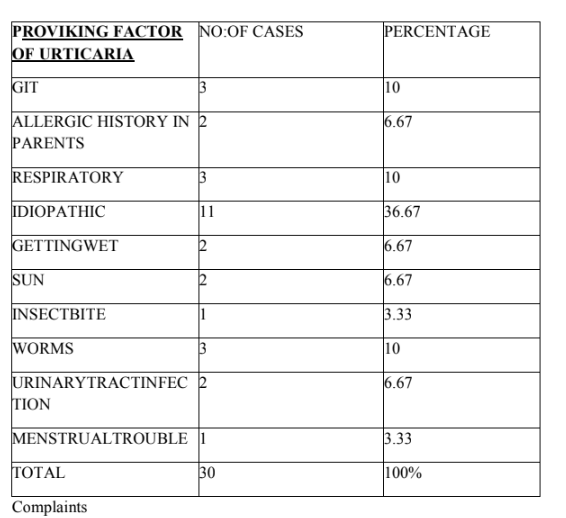
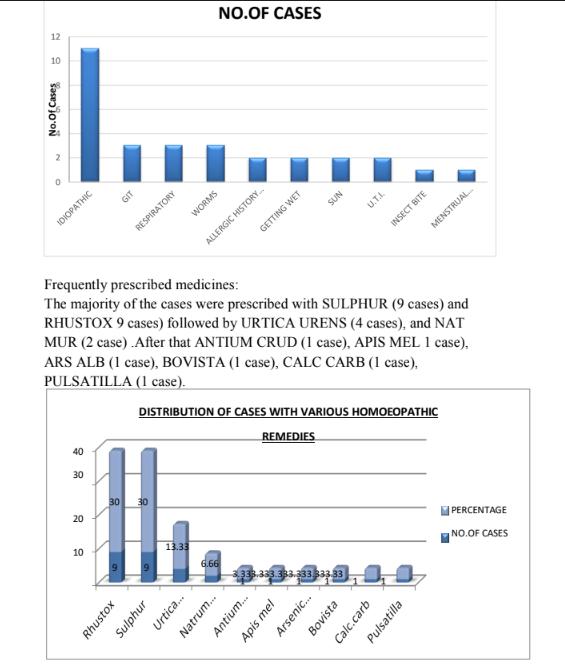
Triggering factors: Idiopathic (36.6%), worms, GIT issues, respiratory
complains.
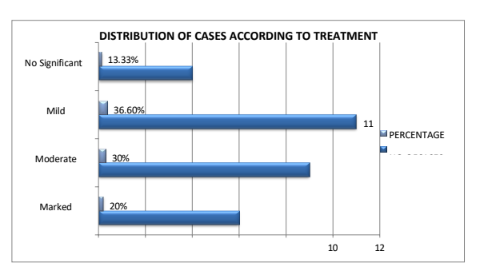
Improvement levels:
Table shows marked improvement (6 cases with 20.0%), moderate improvement (9 cases with 30.0%), mild improvement (11 cases with 36.6%). No significant improvement (4 cases with 13.33%).
Discussion
This study demonstrates that individualized homoeopathic medicines are effective in managing Paediatric urticaria. The findings align with earlier research confirming the potential of homoeopathy in allergy-related conditions. Remedies were chosen based on the patient’s totality and miasmatic understanding, reflecting homoeopathy’s individualized approach.
In this study of 30 pediatric cases, the highest incidence occurred in the 4–6 years age group, with a decline in older age groups. Male children were more affected than females, and the majority of cases were observed in Hindu children. Acute urticaria was the most common subtype, followed by chronic urticaria, cholinergic urticaria, and cold urticaria. Among the triggering or provoking causes of Urticaria, Idiopathic triggers were most frequent followed by Worms, Respiratory Complains etc.
Conclusion
In conclusion, this clinical study underscores the potential benefits of homeopathic treatment in reliving Urticaria in children. Individualized remedies, potency selection, and Miasmatic considerations appear to contribute to positive outcomes, ultimately enhancing the quality of life for these patients.
Acknowledgements
I am deeply grateful to my esteemed guide Dr. Vijay Baraiya for their unwavering support, insightful guidance, and invaluable feedback throughout the course of my research. I also extend my heartfelt thanks to Dr. Ajay Singh Parihar (H.O.D. Department of Pediatrics) and Dr. J.P. Tripathi sir for their expertise, encouragement, and constructive critiques were instrumental in shaping this research work. Also to all the faculty and staff of Govt. Homoeopathic Medical College and Hospital Bhopal. Last but not the least my patients and their parents for having faith in me as a physician and consented to be a part of this study.
Declarations
Funding: None
Conflict of Interest: None declared
Ethical Approval: Approved by Institutional Ethics Committee
Consent: Obtained from parents/guardians
References
2.Kayiran MA, Akdeniz N. Diagnosis and treatment of urticaria in primary care. North
Clin Istanb. 2019;6(1):93-9. doi: 10.14744/nci.2018.75010. PMID: 31180381; PMCID:
PMC6526977.
3.Maurer M, Weller K, Bindslev-Jensen C, Giménez-Arnau A, Bousquet PJ, Bousquet J,
et al. Unmet clinical needs in chronic spontaneous urticaria. A GA2LEN task force report.
Allergy. 2011;66(3):317-30. doi: 10.1111/j.1398-9995.2010.02496.x.
6.Hahnemann S. Organon of Medicine. 6th ed. New Delhi: B. Jain Publishers (P) Ltd; ISBN: 978-8131901410.
7.Kent JT. Lectures on Homoeopathic Philosophy. New Delhi: B. Jain Publishers (P) Ltd; 2013. ISBN: 978-8131901458.
36.Lee SJ, Ha EK, Jee HM, Lee KS, Lee SW, Kim MA, Kim DH, Jung YH, Sheen YH, Sung MS, Han MY. Prevalence and Risk Factors of Urticaria With a Focus on Chronic Urticaria in Children. Allergy Asthma Immunol Res. 2017 May;9(3):212-219.
doi:10.4168/aair.2017.9.3.212. PMID: 28293927; PMCID: PMC5352572.
1.Indian Journal of Research in Homoeopathy. “Assessment of homoeopathic remedies in chronic urticaria”, 2018.
2.Hahnemann S. Organon of Medicine, 6th ed.
3.Kent J.T. Lectures on Homoeopathic Philosophy.
4.BMC Pediatrics 2021; 21:92.
5.Materia Novum, 2019. “The efficacy of Natrum mur in Urticaria”.
6.WHO Global Burden Report 2021.
Author’s- Dr.Surbhi Sharangpure1, Dr.Vijay Baraiya2, Dr.Ajay Singh Parihar3
1.P.G.Scholar , Government Homoeopathic Medical College & Hospital Bhopal.
2. Assistant Professor, Government Homoeopathic Medical College & Hospital Bhopal
3. Professor and H.O.D., Government Homoeopathic Medical College & Hospital Bhopal.