
Dear Dick,
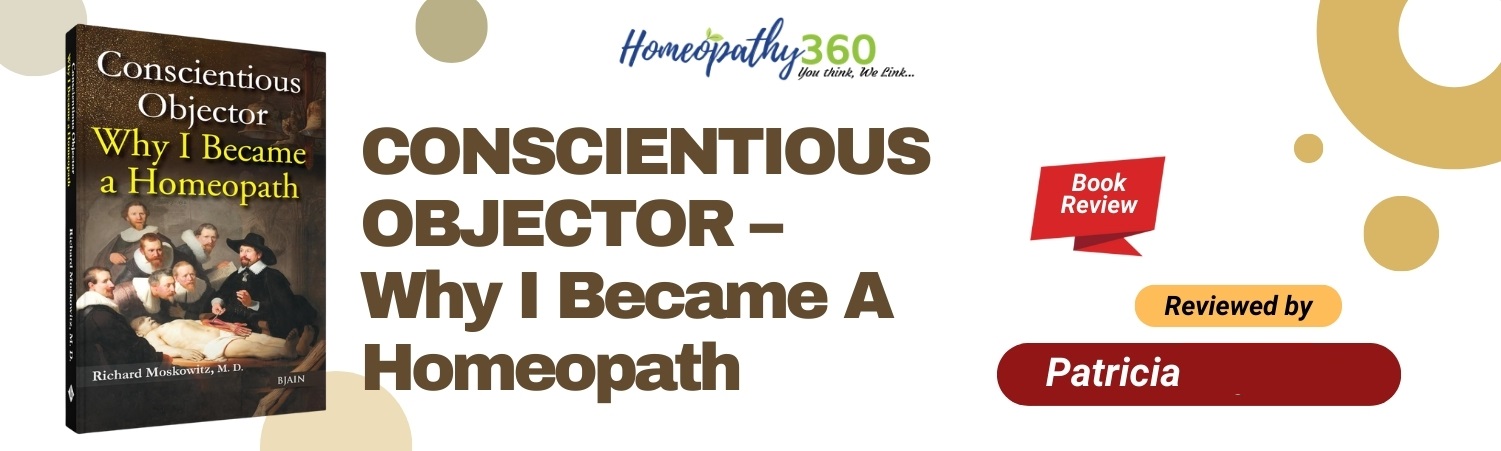
Your book is a masterpiece! You show us what it’s like to follow the thread of what’s important to you from the very beginning. I am struck in reading your story how the “Vital Force” seemed to guide you along the way, throughout your life. You were remarkably in touch with your response to life and had the good sense to seek out advice when appropriate. When your brother, David, said, “study philosophy,” there was a clear “ring of truth” you could identify and follow.
When you delivered hundreds of babies in the early days without complications, you were clearly following some truth you were participating from within. In a way, we talk about “beginner’s luck,” as a phenomenon that seems to nudge us toward the path of our place in the scheme of things. Of course, when the impingement from other levels of reality begins to show up, we are already rooted in something we deeply know, and so the path continues to grow in complexity with the challenges.
When you moved to Boston, again, your path within homeopathy seemed to open up in a lovely way, confirming your move and caring for you while you began to care for others.
And the way you care for others is truly beautiful. Your respect for people’s decisions, understanding of themselves, and ways of living is unusual! You clearly have your own values and grounded intelligence respectfully in place for yourself and your profession(s), but your open-hearted ability to accompany others with such open-heartedness is truly the mark of a “midwife.” (Hear: high compliment!)
Your respect for the deep innate “intelligence” of the body also stands out. I was charmed by your Pulsatilla comment:
Capable of acting in either direction, depending on the sensitivity of the patient, homeopathic medicines can often help a confused or troubled organism clarify or decide which way it really needs to go.
A “troubled organism” decides which way it really needs to go. Beautiful!
I really appreciated your respectful descriptions of the remedies. Choosing 3 remedies from 3 “kingdoms” to highlight their powers, differentiate between the kinds of people who may benefit from the “kingdom” given their own tendencies, was a beautiful way to describe the kind of “pattern recognition” that is behind our work.
But the grand finale of these descriptions comes with your insight into our common remedies:
All are surprisingly profound medicines of broad and deep application, with distinctive features that are useful in a wide range of complaints and revolve around issues of universal scope and importance that are virtually synonymous with the human condition.
I appreciate how you contrasting this with the way “allopathic drugs” work:
Whereas allopathic drugs are celebrated for their power to force the organism to do what it has no natural inclination to do, homeopathic medicines are chosen merely to assist and enhance the innate self-healing capacity that is synonymous with life, continually at work in every patient, and encompasses precisely those same individualizing tendencies, sensitivities, and predispositions which physicians are trained and expected to ignore in our diagnoses, outperform in our research, and override in our treatment.
The description reminds me of the “dominator model,” vs. the respectful listening to something deeper, more mystical, perhaps (I would say that), that is precious and wanting to emerge into life in a way that you clearly see and respect!
Your book helps us see, consider and deepen again and again that what we are caring for is precious and needs to be held in a certain kind of respect that you seem to have natively within yourself, yet you have cultivated it throughout the years into a beautiful insight into the nature of something true and perennial, which you describe so clearly.
Your suggestions for the medical profession show both common sense as well as revealing a clear understanding of the very nature of true scientific inquiry. Your differentiation of one-sided “technical” expertise, reducing people and processes to numbers (quantities) and insisting we bring this to things like “qualities” of being that require a larger way of seeing and holding reality is shown to us throughout your work, convincingly and elegantly. Again, you write very well.
One little tiny question I have as I finish the book, is to ask you to reconsider the chapter on COVID. While your credentials for evaluating and criticizing the current situation of our times are well-established, I fear this chapter could be polarizing in a way that the whole message of your important book can be dismissed. There’s a way this chapter gets too much “weight” given the whole context of your life and work and contributions to medicine. I don’t want you conflated with Fauci, for example. So while your morality, your scientific insights into vaccines, your concern for “the good” in our shared society are all impeccable, the chapter almost needs to be a separate book…
Dick, I felt such relief and wonder and respect as I read your book. It is sane, respectful, inspiring, and deeply wise. I want it to be a best-seller. Just sitting in a kind of “presence” which you transmit in your writing is healing, soothing, fortifying and a true gift. Thanks so much for letting me read it.
With deepening respect,
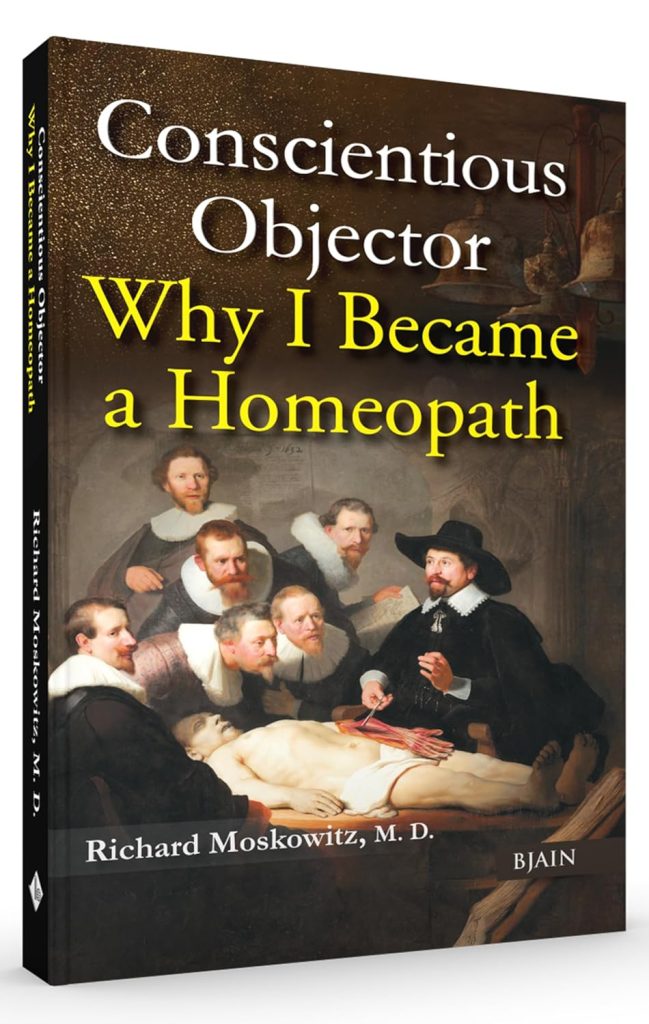
Title: Conscientious Objector – Why I Became A Homeopath
Author: MOSKOWITZ RICHARD
ISBN: 9788131967997
Imprint: B Jain Regular
Pages: 294
Format: Paperback
Language: English