Legacy That Outlived the Mortal Frame
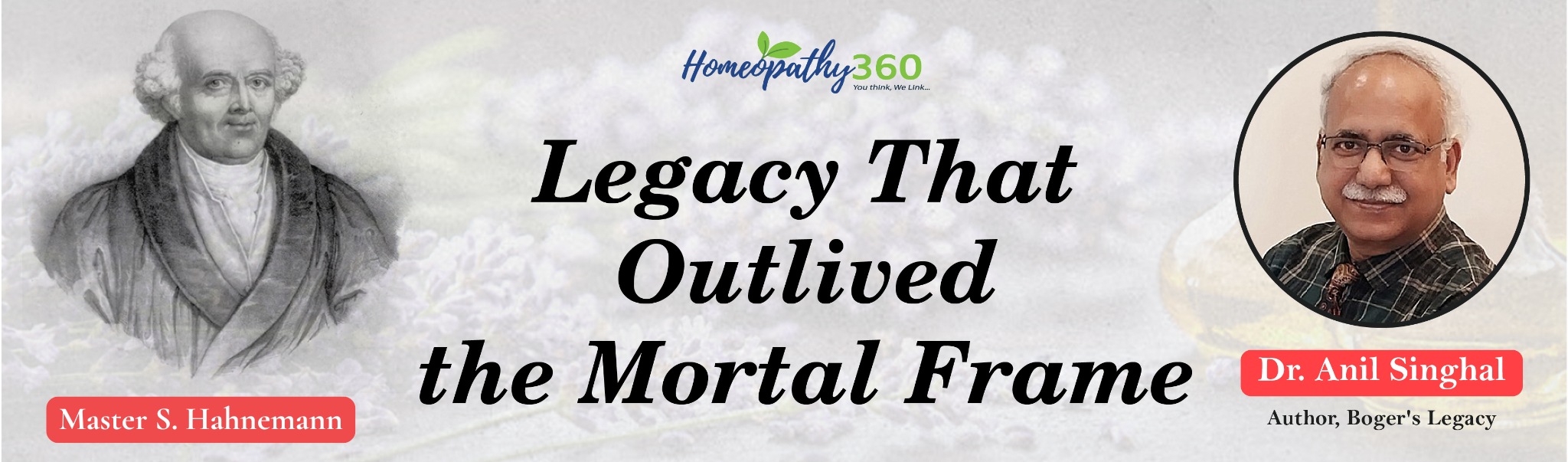
By Dr. Anil Singhal, MD (Hom.)
He died nearly two centuries ago, far from where I was born, in a city I have never seen, surrounded by people who spoke a language I do not speak. And yet, he remains the most present man in my life. More present than many I have met, dined with, or debated. He is there when I open my clinic every morning. He is there when I hesitate before prescribing. He is there when a patient walks out smiling, pain softened, sleep restored, a mother’s worry relieved. Samuel Hahnemann—dead, yes, but absent? Never.
I often wonder: what kind of man leaves behind not just a system, but a spirit? Not merely laws of healing, but a fragrance of presence that lingers in the room long after his mortal voice fell silent? What kind of healer continues to heal, long after the hand is dust and the heart is still?
Whatever I am today, wherever I have reached, whatever I have earned—tangible or intangible—it is because of this one man who had the courage to step away from the medical orthodoxy of his time. He dared to say that the art of healing required more than drugs; it required understanding, observation, humility, and above all, a reverence for the vital force within. And that singular audacity of his gave birth to something that would one day give birth to me—not biologically, but spiritually.
In the early days of my own journey, I did not yet grasp the depth of the road I had chosen. Like many, I entered homeopathy not as a first love, but as a second chance. But slowly, something happened. I began to see. Not just remedies and rubrics, but human beings. Not just symptoms, but stories. And in those quiet, reflective moments at the bedside or the clinic table, I began to feel him—not just as a name on a title page, but as a breathing presence who had once lived, once struggled, once fought to protect a truth that now coursed through my own hands.
Reading the words of J.B. Young, a patient who stood face to face with Hahnemann in Paris in the 1840s, I feel both envy and awe. How it must have felt to be under that gaze, to be touched by those hands, to see healing not as theory but as embodiment! Young wrote, “It is worth more than tongue can express to see and touch the living man, and feel the magnetic thrill from his lustrous eyes… to have his hand in yours and feel the warm impress from a living soul thrilling your own.” What he felt in one moment, I have searched for in many years. And yet, I believe that imprint—that “magnetic thrill”—has not disappeared. It lives in each of us who carry forward his method with sincerity.
J.B. Young recalled that Hahnemann was “preeminently a man first, and then a physician.” That, to me, is the purest compliment a healer can receive. For in being truly human—with all its softness, sensitivity, humility, and unflinching courage—he transformed the practice of medicine from mechanical prescription to soulful participation.
I try, in my own way, to live up to that standard. When I sit across from a patient who has gone from doctor to doctor, diagnosis to diagnosis, and now walks into my small clinic with flickering hope, I remember what Young said: “It is in the presence of disease… that you catch a gleam of the healer and perceive the intense hunger of soul to bring relief to the suffering one.” I recognize that hunger in myself. It is what makes me return to the clinic day after day—not duty, not ambition, but that same hunger.
What continues to astonish me about Hahnemann is not just his scientific insight, but his spiritual steadfastness. J.B. Young wrote: “His greatness comes more into view at this period of his life when he made the decision to follow the light, and, if need be, die for what he believed to be a revelation of eternal truth.” In an age where compromise is often rewarded, how many among us would stand so alone, so sure, for an idea? That singular defiance—that refusal to “travel in the footsteps of others,” as Young put it—is what gave us homeopathy.
And yet, Hahnemann was not a cold revolutionary. He was tender, giving, and profoundly human. Young described him as “gentle and loving as a child, unselfish and helpful… a heart as bold as a lion.” What a rare combination! In my own years of practice, I have learned that the strength of a remedy lies not only in its dilution but in the depth of the physician’s attention, the sincerity of his listening, and the patience of his waiting. These are not technical skills; they are character traits. They are what Hahnemann embodied.
And then comes the moment in J.B. Young’s narrative that moves me beyond words: a sick, frail boy from Scotland, hopeless, discarded by other doctors, carried across lands and seas to Paris. Hahnemann examines him gently but thoroughly—“about one and a half hours,” Young says—then turns to the boy’s guardian and whispers words that feel like an elixir: “I am glad that the lad has come to me in time. I will cure him, but it will take a little while.”
That line feels eternal. It is not just for one boy in Paris. It is for every patient who has come to a homeopath seeking light. It is for every healer who believes that recovery is not instant, but certain. It is for me, every time I feel overwhelmed or inadequate. It is Hahnemann, speaking still.
J.B. Young said, “Out of that presence I shall never find myself, for it is a part of my life and love to be enveloped in it.” I echo that sentiment today. Even though I never met Hahnemann, his presence envelops me. It shapes my language, my silence, my gaze, my questions, and my certainty. It is not a superstition. It is not romanticism. It is, simply, legacy.
What kind of man gives nine months of care to a boy on the brink of death, treats him like a prince, restores his health, and refuses all payment? What kind of physician becomes a myth not because of exaggerated stories, but because of authentic goodness that no story could fully capture? J.B. Young called him “the most divine looking man I ever saw.” I have never seen him, but I know exactly what he means.
To me, Hahnemann is not a figure of the past. He is not even only a founder. He is a companion. A compass. A reminder that medicine is not only about technique but about truth. That the real healer is not the one with the fastest cure, but the one whose presence itself begins to heal.
And so today, on his death anniversary, I do not place flowers at his grave. I place my faith. I place my work. I place my lifelong commitment to never let that legacy fade into abstraction. Because for me, and for countless others like me, his legacy has outlived the mortal frame.
And every time I hold a remedy in my hand, I know I am not alone. I am part of a lineage. I am part of his unfinished story.
And so, I write. Not because he is gone. But because he never truly left.