Abstract-
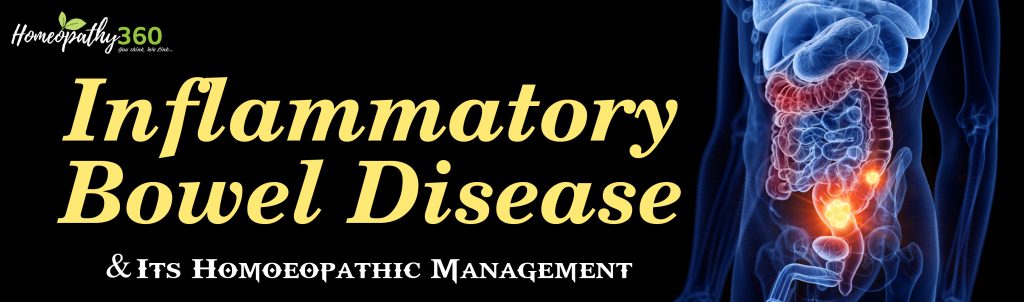
Inflammatory bowel disease is a chronic inflammatory disorder of the gastrointestinal tract that results from environmental, genetic, barrier and microbial components that leads to immune dysregulation. IBD comprises mainly two types of disease-ulcerative colitis and crohn’s disease. clinical features include watery and bloody diarrhea, abdominal pain. Association of microbial dysbiosis and dysfunction in intestinal epithelial barrier was observed in IBD patients. In this article we will discuss homoeopathic management in cases of IBD.
Key words:- inflammatory bowel disease, ulcerative colitis, Crohn’s disease
Clinical features ,rubric’s ,homoeopathic management.
Introduction-
Inflammatory bowel disease includes several condition,most common being
- Ulcerative colitis
- Crohn’s disease
Other uncommon inflammatory bowel disease include
- Microscopic ulcerative colitis
- Microscopic lymphocytic colitis
- Microscopic collagenous colitis
Peak occurrence is between age 15 and 30 and between age 60 and 80.
Ulcerative Colitis
Ulcerative colitis is an inflammatory disease affecting mainly the large intestine( most commonly Rectum) , characterised clinically by recurrent attacks of bloody diarrhoea and pathologically by diffuse inflammation of colonic mucosa.
Disease extent can be broadly divided into distal and more extensive disease.
- Distal disease refers to colitis confined to the rectum (proctitis) or rectum and sigmoid colon (proctosigmoiditis). and pancolitis (affecting the whole colon).
- More extensive disease includes “left-sided colitis” (up to the splenic flexure), “extensive colitis” (up to the hepatic flexure)
Aetiology-
- Familial
- Strong family history
- Occurrence in monozygotic twins
- Genetic-HLADR2
- Infectious– Possible pathogens include:
- Mycobacterium (M. avium paratuberculosis)
- Measles virus
- Listeria monocytogenes
- Yeast
- Endogenous bacteria
- Bacteroides
- E. coli
- Dietary factors– Western diet, Deficiency or excess of certain nutrients (butyric acid, sulphides, L-arginine, glutamine)
- Smoking– There is an increased risk of ulcerative colitis in non-smokers.
- Psychological
- Characteristic personality and major psychological stresses are related to flare-ups and precipitation of symptoms
- Defective immune regulation.
- Many immunological abnormalities have been described that include stimulation of macrophages leading to ex production of cytokines (interleukin-1, interleukin-6 and tumour necrosis factor-a). There is also activation of other cells (eosinophils, mast cells, fibroblasts).Immune complexes may be responsible for extraintestinal manifestations.
Pathology-
Macroscopically- continuous and uniform inflammation of colonic mucosa seen.mucosa looks hyperemic and hemorrhagic and ulcers do not usually extend deeper to sub mucosa.
Microscopically– lamina propria is infiltrated with lymphocyte and plasma cells,loss of goblet cells and crypt abscess are characteristic.
Clinical Features–
- Exacerbation and remission are characteristic.
- Bloody diarrhoea with mucus and pus
- Abdominal pain mainly on left lower quadrant (tenderness on palpation)
- Tenesmus
- Weight loss and fever
Investigation
- Anaemia and raised ESR.
- Electrolyte abnormality
- Abnormal liver function test
- Stool examination exclude infective pathology
- Plain radiography-to exclude toxic megacolon
- Barium enema-loss of haustration (lead pipe appearance),mucosal irregularity,ulceration seen.
- Colonoscopy-is useful in assessing progression of disease.
- Sigmoidoscopy-diffuse mucosal erythema,loss of mucosal vascularity,mucosal friability(diffuse small bleeding point), shallow but small ulcer,and in chronic cases pseudopolyp is seen.
Complications–
Toxic megacolon and risk of cancer
Crohn’s Disease
Crohn’s disease is characterised by patchy, transmural inflammation, which may affect any part of the gastrointestinal tract.
It may be defined by location (terminal ileal, colonic, ileocolic, upper gastrointestinal) or by pattern of disease (inflammatory fistulating or stricturing).
Aetiology-
- Genetic factors-There are mutations in the CARD15 (NOD2) gene on chromosome 16 in patients present with Crohn’s disease.
- Smoking is also one of the maintaining causes.
- Infective organisms– Mycobacterium paratuberculosis is one of the factors responsible for the occurrence of disease
- Diet- Occurrence of crohn’s disease may be due to high intake of refined sugar and low intake of fibre from fruits and vegetables.
- Immune mechanism- In Crohn’s disease, down regulating mucosal immune responses are impaired.
Pathology–
Affects any part of the GI tract but usually terminal ileum and colon. Transmural inflammation of intestinal wall,bowel wall is greatly thickened and submucosal thickening leads to cobble stone appearance.
Mucosal involvement is characteristically patchy.there are skip areas(inflammatory process interrupted with normal mucosa).
Microscopically characteristically non-ceasating granuloma formation.
Clinical Features-
- Clinical courses fall into three broad patterns: (1) inflammatory, (2) stricturing, and (3) fistulizing.
- Right lower quadrant pain, tenderness, guarding and mass.Mass palpable per abdomen and rectally reflects adherent loops of intestine and abscess
- Recurrent episodes of colicky abdominal pain with nausea, vomiting
- Stool usually does not contain frank blood, mucus or pus unless colon is involve
- Anal lesions such as oedematous skin tags, fistulae, fissures, perianal and perirectal abscesses are characteristic of the disease
- Features of malabsorption like weight loss and anaemia (iron, folic acid and B12 malabsorption)
- Sodium, potassium, water, magnesium and zinc deficiency due to chronic diarrhea
Investigation–
- Normocytic normochromic or macrocytic or hypochromic anaemia.
- Raised ESR
- Stool culture to exclude infectious causes of diarrhoea.
- Abnormal liver function test
- Sigmoidoscopy and colonoscopy-segmental involvement seen.
Ulceration and deep longitudinal fissures. cobble stone appearance of mucosa.
Rectal sparing.
- Barium enema –string sign seen due to marked narrowing of bowel,fistulous tract and multiple strictures seen.
- Biopsy of colonic mucosa, ileal mucosa, anal skin tags and perianal inflammatory lesions will show typical granulomatous inflammation Tuberculosis must be excluded by appropriate histological tissues
- Serological marker
Extraintestinal manifestation of UC and Crohn’s disease
- Aphthous ulceration
- Erythema nodosum
- Pyoderma granulosum
- Acute arthritis ,Eye complications: conjunctivitis, episcleritis, uveit
| Comparison of ulcerative colitis and crohns disease |
| Ulcerative colitis | Crohn’s disease | |
| Age group | Any | Any |
| Gender | M+F | Slight female preponderance |
| Incidence | Stable | Increasing |
| Ethnic group | Any | Any |
| Genetic factors | HLADR13:colonic epithelial barrier dysfunction | NOD2 |
| Risk factors | More common in non-smokerAppendectomy ptients | More common in smokers |
| Anatomical distribution | Colon only | Any part of gi tract,skin lesions,perianal disease common |
| Extraintestinal manifestations | Common | Common |
| Presentation | Bloody diarrhea | Pain,diarrhoea,weight loss common |
| Histology | Inflammation limited to mucosa,crypt bscess,loss of gobet cell | Transmurl inflammation,deep fissuring ulcers,fistulaes ,granulomas |
Rubrics For IBD–
- Abdomen-Inflammation-Colon
abrot. achy-a. aethi-a. all-s. aran. arg-n. ars. asaf. asar. atis. aur-m-n. bism. cadm-s. calc-ar. canth. caps. carc. cench. chin. Chloram. colch. coli. coloc. cop. coxs. crot-t. cyn-d. dys. eberth. enteroc. Ferr-i. gaert. Gamb. graph. Grat. guat. ham. hell. hoit. hydr. Ign. influ. ip. kali-bi. kali-c. kali-n. kali-p. kurch. lach. lil-t. lyc. mag-c. mag-m. Mag-s. malar. merc. Merc-c. moni. nat-c. nat-m. nat-s. nit-ac. nux-v. olnd. oxyte-chl. parathyr. petr. ph-ac. phos. podo. pot-e. ptel. puls. raph. rhus-t. Staph. Streptoc. sulph. syph. ter. thuj. tub. tub-d. uncar-tom. vac. verat. x-ray zinc. zinc-val.
- Abdomen-Inflammation-Small Intestine
acon. aloe ant-t. Arg-n. cadm-s. caps. coli. eberth. enteroc. lat-m. levist. moni. mucor nux-v. parathyr. pyrog. santin. tub. yers.
- Stool-Bloody-Streaks- In
agar. aloe am-c. amp. ant-t. apis arg-n. arn. arund. bell. bry. calc. canth. Caps. carb-an. cina colch. Coloc. con. cupr. Cupr-ar. cycl. Elat. erig. euph. Ip. Kali-bi. kali-c. kreos. led. lil-t. mag-c. mag-m. Merc. merc-c. merc-d. mez. nat-c. nat-m. Nat-s. Nit-ac. Nux-v. ox-ac. phos. plb. Podo. Psor. puls. pyrog. rhus-t. sel. squil. streptoc. sul-ac. Sulph. thuj. tril-p. Trom
- Abdomen- Pain –Lower Abdomen
Acon. agar. agn. aloe alum. am-c. Am-m. ambr. anac. ang. ant-t. Apis arg-met. arn. Ars. asaf. asar. aster. aur. bar-c. Bell. bism. borx. bov. Bry. calc. camph. cann-s. canth. caps. carb-an. Carb-v. caust. chel. chin. chlam-tr. cic. cimic. clem. Cocc. colch. Coloc. Con. cupr. cycl. dig. euphr. guaj. hell. hyos. Ign. iod. kali-c. kali-n. Lach. laur. Lyc. m-arct. m-aust. mag-c. mag-m. mang. Meny. merc. mez. Nat-c. nat-m. Nit-ac. nux-m. Nux-v. olnd. par. Ph-ac. Phos. plat. plb. puls. Ran-b. rheum Rhus-t. ruta sabad. sabin. samb. Sec. seneg. Sep. sil. spig. spong. squil. Stann. staph. stront-c. sul-ac. sulph. Tarax. teucr. Thuj. Valer. Verat. Verb. Viol-T. Zinc.
- Generals-Weakness-Diarrhoea From
acet-ac. aeth. agar. Ail. aloe Alum. alum-p. Alumn. ambr. ango. ant-c. ant-t. Apis Arg-n. arn. Ars. bamb-a. bapt. bar-m. bism. Borx. both. bry. calc-i. Camph. carb-v. Chin. chinin-ar. colch. coli. coloc. con. Corn. coto crot-t. cupr. Cupr-ar. dios. Dulc. elaps elat. euph-a. Ferr. gamb. gast. gnaph. Graph. hura hydr. hyos. influ. lod. Ip. iris jatr-c. kali-c. kali-chl. Kali-m. Kali-p. kola lil-t. mag-c. merc. merc-cy. moni. Nat-s. Nit-ac. Nuph. Nux-m. Nux-v. Olnd. op. ox-ac. petr. ph-ac. phel. Phos. phyt. Pic-ac. Podo. Rhus-t. Ric. Sec. senec. sep. serp. Sil. Sul-ac. sul-i. Tab. Tarent. Tart-ac. Ter. tritic-vg. trom. tub. upa. vanil. Verat. Zinc.
- Abdomen Inflammation Colon Ulcerative
carc. Chloram. coloc. Hell. lil-t. Mag-s. merc. Nat-s. nit-ac. nux-v. podo. rhus-t. Streptoc. sulph. ter. zinc.
- Rectum- Diarrhea-Accompanied By Appetite Loss
ars. chin. nux-m. phos. Puls
- Rectum-Inflammation-Aesc. aloe alum. ambr. ant-c. bell. bell-p. bop-sc. borx. calc. calc-p. canth. carb-an. cench. colch. coll. Coloc. Con. cupr. enteroc. ferr-p. gamb. gels. Hep. hydr. ip. kali-bi. kali-c. kali-i. lip-as. lyc. Merc. merc-c. moni. nat-s. Nit-ac. ochn-a. Op. paeon. parathyr. phos. podo. positr. pyrog. rat. rhus-t. ric. ruta sabal sabin. sanic. sclero-c. sil. spermc-n. Sulph. syph. thuj. zing.
Homoeopathic Management For Ibd–
- Mercurius Corrosivus–It is very important remedy in patient who suffering from ulcerative colitis in which stool is bloody and contains shreds of mucus membrane associated with tenesmus.there is violence in character of stool with constant urging to pass stool and cutting pain in abdomen followed by weakness.
- Merc Sol–useful in cases of IBD in which Stools Greenish, bloody and slimy, Worse at night, with pain and tenesmus accompanied by chilliness.
- Podophylinum– FOR CROHNS DISEASE WITH WATERY Diarrhoea
Gurgling through bowel,then profuse putrid stool gush out painlessly.rectum is raw,sore weak before stool.diarrhoea ameliorate lying on abdomen.
- Aloe Socotrina– For Crohn’s disease with jelly like mucus Aloe Socotrina is among the top remedies for Crohn’s Disease in those patients who suffered from loose stool worse immediately after eating or drinking anything. There is a sudden urge to pass stool and the patient has to rush to the toilet to pass the stool. There are cutting pains in the lower abdomen which get worse before and during passing stool and relief after passing the stool. Faintness usually follows stool. This medicine can also be prescribed to control the diarrhoea that gets worse due to the intake of beer.
- Argentum Nitricum- For Crohn’s disease with watery green stool and flatulence
It is useful in patients who are suffering from watery green diarrhoea with flatus. Diarrhea comes on immediately after eating and drinking and any emotional excitement and also from taking sweets.
- Arsenic Album– For ulcerative colitis when patient suffering from bloody dark offensive stool followed by great prostration.and patient is very much restless.diarrhoea worse at night especially midnight at 12-2am and relieved by warmth.
- Colchicum Autumnale– For ulcerative colitis especially proctitis when patient presented with diarrhea which is profuse frequent contains jelly like mucus with pain associated with tenesmus with characteristic nausea especially smell of cooking fish meat ,eggs.Aggravated by mentl exertion,autumn.
- Gambogia– For profuse watery diarrhea with tenesmus after and burning in anus.stool is yellow green mixed with mucus.
- Kali Bichromium–for chronic ulcerative colitis with cutting pain in the abdomen soon after eating.stool is jelly like mucus with great tenesmus.stool is brown, ropy and stringy.aggravated in morning.
- Phosphorus–For Ulcerative Colitis with Stool Containing Blood and Greenish Mucus Phosphorus is indicated to those patients in whom there is blood stained stool with green mucus and contains extreme offensiveness. The complaint gets aggravated in the morning. There is excessive craving for cold drinks, ice cream and juicy things.
- Nux Vomica- Nux Vomica is indicated for Inflammatory Bowel Disease with tenesmus. The patient suffered from ineffectual but constant urge to pass stool. The stool is scanty with satisfaction. There is a current urge to pass stool at very short intervals.
- Sulphur- Sulphur is another remedy for those patients who suffer from IBD with diarrhoea that gets worse in the morning. Patients have to rush out of bed early morning to pass our stool. The soles of feet, palms and head are hot.
Conclusion
IBD is one of the chronic disease in which patient suffers from many years.In modern system of medicine there is no entirely effective ,cheap and safe treatment for such condition.but In homoeopathy there is very effective treatment for IBD.and had shown positive results in cases of ibd.The most useful tool in treatment is proper case taking and key symptom of patient with description of sufferings helps us to determine accurate similimum remedy.proper administration of treatment, along with diet and lifestyle modification with exercise and yoga leads to complete healing and cure.
References :-
| 1. | Longo D, Fauci A. Harrisons Manual of Medicine, 18th Edition. Not Avail; 2012. |
| 2. | Praveen A, Mathew GK. Medicine: Prep manual for undergraduates. 6th ed. New Delhi, India: Elsevier; 2019. |
| 3. | Penman ID, Ralston SH, Strachan MWJ, Hobson R, editors. Davidson’s principles and practice of medicine. 24th ed. London, England: Elsevier Health Sciences; 2022. |
| 4. | Boericke W, Boericke OE. Homoeopathic materia medica with repertory comprising the characteristic and guiding symptoms of the remedies. 2nd ed. Savage RB, editor. Sittingbourne, England: Homoeopathic Book Service; 1990. |
| 5. | Clarke JH. A Dictionary Of Practical Materia Medica. Sittingbourne, England: Homoeopathic Book Service; 1991. |
| 6. | Schroyens F. Synthesis repertorium homeopathicum syntheticum edition 9.1. New Delhi, India: B Jain; 2021. |
Author:
Dr Priyanka Mandloi, Md Scholar, Department of Practice of Medicine, Govt Homoeopathic Medical College and Hospital, Bhopal, Madhya Pradesh
Co – Author:
Dr Praveen Jaiswal, Md (Hom), Ph.D – Head Of Department, Practice Of Medicine
Govt Homoeopathic Medical College And Hospital, Bhopal (Madhya Pradesh)