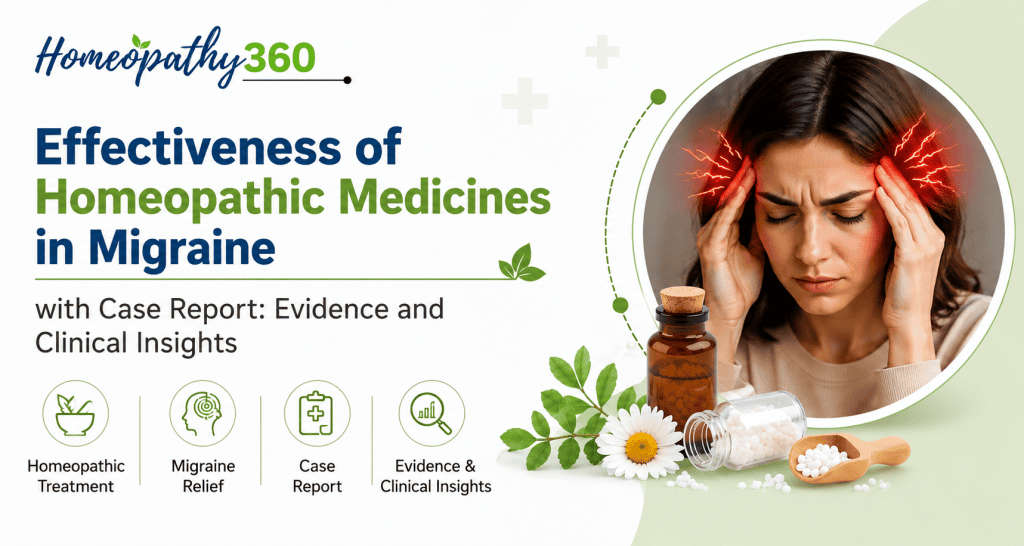
Effectiveness of Homeopathic Medicines in Migraine with case report: Evidence and Clinical Insights
Abstract
Migraine is a common and disabling neurological condition affecting a large proportion of the global population. It significantly impacts quality of life and productivity. While conventional medicine offers symptomatic relief, many patients seek alternative therapies due to side effects or incomplete relief. Homeopathy, a holistic system of medicine, is increasingly explored for migraine management. This article reviews the effectiveness, principles, and clinical applicability of homeopathic medicines in treating migraine.
Case Summary: this article shows a case of migraine, complaining of severe head pain which is associated with nausea along with other physical symptoms. prescribed natrum muririticum medicine in 1m potency, Midas scale was used to assess the severity of migraine.
Keywords: Migraine, Midas Scale Using For Severity Of Migraine, Natrum Muriaticum.
Introduction Migraine is characterized by recurrent episodes of moderate to severe headache, often unilateral and pulsating in nature, associated with nausea, vomiting, and sensitivity to light and sound. It may be triggered by stress, hormonal imbalance, dietary factors, or sleep disturbances.
The chronic and recurrent nature of migraine makes it a challenging condition to manage. This has led to growing interest in complementary and alternative medicine, particularly homeopathy.
Global Burden Of Disease – We obtained information on migraine from the Global Burden of Disease 2021 database, including incidence, prevalence, and DALYs. According to WHO, the Global Health Estimates 2021, migraine headaches are the third biggest cause of disability-adjusted life years (DALYs) around the world, after stroke and neonatal encephalopathy. A headache isn’t just painful; it can also make someone unable to carry out their normal activities. Around the world, about 40% of people, which is around 3.1 billion individuals, experience headache disorders in 2021. These disorders are more common in women than in men. They are among the top three most frequent neurological issues for most age groups, starting from age 5 and staying in the top three until age 80.
Pathophisiology: For some people, migraines are accompanied by aura, which is thought to be caused by widespread cortical inhibition, a wave of neuronal depolarization followed by hyperpolarization. This wave is caused by ion channel dysfunction and constitutes an important element in the pathophysiology of anterior migraine. During the headache phase, extracranial vasodilation occurs, probably under the influence of hypothalamic activity. Additionally, activation of the trigeminal nerve releases vasoactive neuropeptides, particularly CGRP, which also contribute to pain through vasodilation and neurogenic inflammation.
Neurotransmitters such as serotonin (5-HT) and dopamine play important roles in migraine development. Serotonin levels are thought to fluctuate during a migraine attack, and triptans (drugs designed to target serotonin receptors) are effective in treating migraines by causing vasoconstriction and reducing trigeminal nerve activity. Dopamine receptor hypersensitivity is also possible. Symptoms such as nausea and yawning are associated with the effects of dopamine. Dopamine antagonists have been shown to be effective in treating migraines, especially when used in combination with other treatments.
Gut Brain Axis- studies have shown that migraines are associated with inflammatory bowel disease and celiac disease. Recently, the concept of the gut–brain axis has emerged in several medical fields to explain the bidirectional communication between the gastrointestinal system and the central nervous system. Various digestive disorders have been found to be associated with migraine. Migraines are often accompanied by gastrointestinal symptoms such as nausea, vomiting, indigestion, and bowel disturbances. Headaches occur more frequently in patients with gastrointestinal disorders.
Trigger Factors Of Migraine-
causes and risk factors– there are a number of factors that increase your risk of migraines. Individuals who suffer from migraines are particularly sensitive to environmental and sensory stimuli; they struggle to adjust to these stimuli.Women are more sensitive to this during the menstrual cycle. Sound, light, glare, and other forms of afferent stimulation are some of the triggers that can cause or intensify a headache.[22]Here are common migraine triggers-
1) Hormonal fluctuations in women: Many women with documented migraines appear to get headaches in response to changes in estrogen levels. Migraine sufferers frequently describe headaches right before or during their periods, which coincide with a significant reduction in estrogen levels. For others, migraines are more likely to occur during pregnancy or menopause.
2) Hormonal Drug -hormone replacement treatment and oral contraceptives, for example, may exacerbate migraines. However, using these drugs may make migraines less frequent for certain women.
3) Foods- Processed foods, salty foods, and aged cheeses can all cause migraines.
4) Hunger- Attacks can also be triggered by fasting or missing meals. In cases of hypoglycemic migraines, food helps relieve the headache or it gets worse when you’re hungry or thirsty.[28]
5) Food Additives- Migraines may be brought on by the preservative monosodium glutamate and the sweetener aspartame, which are present in many meals.
6) Chemical Stimulation -beverages Drinks heavy in caffeine and alcohol, particularly wine, can cause migraines.
7) Let Down From Stress-Stress at home or at work might trigger migraines. sensations. Loud noises, bright lights, and sun glare can all cause migraines. Some people have headaches when they smell strange things like paint thinner, perfume, or secondhand smoke.
8) Sleep Pattern -Some people may experience migraines as a result of jet lag or sleep deprivation.
9) Phisical Exertion -Sexual activity and other forms of intense physical effort can cause migraines.
10) Enviroment Factors -An alteration in the stormy weather or barometric pressure may cause a migraine.
11) Drugs- Vasodilators like nitroglycerin and oral contraceptives can make migraines worse.[29]
12) Psychological Factors: Because of their higher anxiety levels, women are found to be more susceptible to migraines.Migraine may be considered a psychosomatic disorder, with pain as a somatic expression of psychological distress. Stress and Crying (Depression and Panic Attack),Generalised Anxiety Disorder,Mood Changes,Suppression of anger. Major depressive disorder, bipolar disorder, panic disorder, and social anxiety are all linked to migraines. When migraine occurs along with other mental health conditions, the results for health-related outcomes are worse than when migraine or a psychiatric problem occurs alone.[3] When psychological variables play a role, migraine attacks typically follow stressful times, with Friday nights at the end of the workweek or the start of a holiday being the most common times.
Signs and Symptoms
One-sided suffering and throbbing agony
Light sensitivity, noise sensitivity, and smell sensitivity
nausea, vomiting, upset stomach, and pain in the stomach
Absence of craving
Having unusually chilly or warm chills
Light skin tone exhausted.
Vertigo and blurred eyesight
The scalp of Tendar
Occasionally, the fever and runs
Principles of Homeopathy in Migraine
Homeopathy is based on the principle of “Similia Similibus Curentur” (like cures like). It emphasizes:
- Individualized treatment
- Holistic approach (mind and body)
- Use of minimum dose
- In migraine, treatment is tailored according to:
- Type and location of pain Modalities (aggravating/relieving factors)
- Associated symptoms Mental and emotional state
Common Homeopathic Remedies for Migraine These remedies are prescribed based on symptom similarity rather than disease diagnosis alone.
Belladonna : Violent hyperemia, characterised by throbbing carotid arteries, a flushed face, intolerance to even the smallest jar, noise, or light; hemiopia, retinal blindness, mild tongue paralysis, and even momentary hemiplegia.
Gelsemium Sempervirens- Headache Preceded by blindness>by profuse urination.Headache Beginning in the cervical spine pains extend over the head,causing a bursting sensation in forehead and eye<by mental exertion from smoking heat of sun lying with head low.Sensation of band around the head above eyes,scalp sore to touch.
Glonoinum-Bad effects from having the hair cut.Head troubles,From working under gas-light, when heat falls on head cannot bear heat about the head, heat of stove or walking in the sun Cerebral congestion,or alternate congestion of the head and heart.Head Feels enormously large as if skull were too small for brain sunstroke and sun headache increases and decreases everyday with the sun.Terrific shock in the head, synchronous with the pulse.Throbbing, pulsating headache,holds head with both hands,could not lie down,“the pillow would beat”. Brain feels too large,full, bursting, blood seems to be pumped upwards, throbs at every jar, step, pulse.
Ignatia Amara-Feels hollow, heavy; worse, stooping.Headache as if a nail were driven out through the side.Cramp-like pain over root of nose.Congestive headaches following anger or grief; worse, smoking or smelling tobacco, inclines head forward.
Iris Versicolor-Frontal headache, with nausea.Scalp feels constricted.Right temples especially affected.Sick headache,worse rest, begins with a blur before eyes,after relaxing from a mental strain. Pustular eruption on scalp.
Natrium Muriaticum-Headache: Anemic, of school girls; from sunrise to sunset; left sided clavus; as if bursting; with red face, nausea and vomiting before, during and after menses; as though a thousand little hammers were knocking in the brain during fever;> by perspiration Headache;beginning with blindness with zigzag dazzling,like lightning in eyes, ushering in a throbbing headache; from eye strain.The hair falls out when touched, in nursing women face oily, shiny, as if greased.
Nux Vomica-Headache in occiput or over eyes,with vertigo;brain feels turning in a circle Oversensitiveness.Vertigo with momentary loss of consciousness.Intoxicated feeling;worse, morning, mental exertion, tobacco, alcohol,coffee, open air.Pressing pain on vertex, as if a nail driven in.Vertigo in morning and after dinner.Scalp sensitive.Frontal headache,with desire to press the head against something.Congestive headache, associated with hæmorrhoids.Headache in the sunshine.Feels distended and sore within, after a debauch.
Onosmodium Virginianum-A remedy for migraine.Headaches from eyestrain and sexual weakness.It produces diminution of sexual desire in both sexes.hence its homeopathicity, in sexual neurasthenia .Depressed or lost sexual life in women. Neuralgic pains. General prostration. Acts as if born tired.
Sanguinaria Canadensis-The periodical sick headache begins in morning,increases during the day,lasts until evening. head feels as if it would burst,or as if eyes would be pressed out relieved by sleep.American sick headache >by perfect quiet in a dark room.Headache begins in occiput, spreads upwards and settles over right eye.Headaches return at the climacteric; every seventh day.
Sepia Officinalis-Coldness of the vertex with headache.Headache: In terrific shocks; at menstrual nisus, with scanty flow; in delicate, sensitive, hysterical women; pressing, bursting < motion, stooping, mental labor> by external pressure, continued hard motion.Great falling of the hair, after chronic headaches or at the climacteric.
Sanguinaria Canadensis-The periodical sick headache begins in the morning, increases during the day,and lasts until evening. The head feels as if it would burst,or as if eyes would be pressed out relieved by sleep. American sick headache >by perfect quiet in a dark room.Headache begins in occiput, spreads upwards and settles over right eye. Headaches return to the climacteric; every seventh day.
Sepia Officinalis-Coldness of the vertex with headache.Headache: In terrific shocks; at menstrual nisus, with scanty flow; in delicate, sensitive, hysterical women; pressing, bursting < motion, stooping, mental labor> by external pressure, continued hard motion.Great falling of the hair, after chronic headaches or at the climacteric.
Tuberculinum-Headache Chronic, tubercular; pain intense, sharp, cutting, from above right eye to occiput; as of an iron hoop around head when the best selected remedy only palliates.School girl’s headache: < by study or even slight mental exertion; when using eyes in close work and glasses fail to >; with a tubercular history. Acute cerebral or basilar meningitis, with threatened effusion; nocturnal hallucinations; wakes from sleep frightened.
Veratrum Viride-Nervous or sick headache; congestion from suppressed menses intense, almost apoplectic, with violent nausea and vomiting.Congestive apoplexy, hot head, bloodshot eyes, thick speech, slow full pulse, hard as iron.Sunstroke, head full, throbbing of arteries, sensitive to sound; double or partial vision.
Effectiveness of Homeopathy in Migraine
Clinical Evidence Several observational studies and small clinical trials suggest that homeopathy may help in:
- Reducing frequency of migraine attacks
- Decreasing intensity and duration
- Improving overall well-being
However, large-scale randomized controlled trials often show mixed results, with some findings comparable to placebo.Organizations such as the World Health Organization and National Institute for Health and Care Excellence emphasize the need for more robust scientific evidence before strongly recommending homeopathy as a primary treatment.
Advantages of Homeopathic Treatment
- Safe and minimal side effects
- Suitable for long-term use
- Addresses emotional and psychological factors
- Improves overall quality of life
Limitations
- Lack of strong scientific evidence
- Slow onset of action in some cases
- Not suitable as sole treatment in acute severe migraine attacks
- Requires skilled case-taking and individualized prescription
Integrative Approach in Migraine Management
An integrative approach combining homeopathy with lifestyle modification yields better results:
- Stress management and counselling
- Regular sleep pattern
- Dietary regulation
- Avoidance of known triggers
This approach aligns with modern holistic healthcare practices.
Case Report
6751/04 : A 20 YEAR OLD FEMALE,STUDENT CAME TO OPD ON 22/7/25
1st visit: 22/7/25
Presenting Complaints With Duration:
The patient had been complaining of head pain for 2 years, which started after 12th class during the neet’s prepration. starts on one side of the head above the right eye and radiates to the neck region. throbbing sensation in the head. headache aggravation after fasting, sunlight noise, associated symptoms with photophobia and nausea and vomiting. Headache started suddenly amelioration –sleep in a dark room.at the time of headache use allopathic analgesic medicine for pain. blurred vision before headache.
History of Present Illness, Duration, Mode of Onset, Course of Events, Treatment Taken:
As per patients according – patients were apparently well 2 years ago. the patients suddenly developed severe headaches between 1-2 am in night.she developed headache with gradually increasing duration. intially the headache episode would last 7-12 hours. She has to take lots of pain killers at that time. She has consulted a doctor who dignosed the same as migraine, and prescribed painkillers and antiemetic drug for the acute episode of migraine.
History Of Past Illness:
H/O-typhoid in 2023, B/L pcod diagnosed in 2024
blood infection in 2024
Family History:
Parental side – Father- cholelithiasis, hepatomegally
Maternal side – Mother- thyroid
Childhood History
Birth to milestones: Normal milestone according to age
Obs/Gynae History:
Menstrual History- irregular due to b/l pcod
Obstetric History-not found
Personal History:
Educational Status- student
Occupation – student
Socio-Economic Status- upper middle class
Personality- Good
Habits (Drug addiction, Smoking)- not found
Diet- mixed diet
Appetite- good
Hunger tolerance- not tolerance start weeping
Thirst- normal and increase
Thermal reaction- hot Patient
Micturition-
Bowel – clear
Perspiration- palm, sole
Desire- sweet, chocolate
Aversion-coconut, beetroot, sapodilla
Dreams- ghost
Sleep- normal and disturbed during headache time
Mental General:
Weakness of memory
Depression
Forgets words while speaking
Consolation aggravation
Irritable
Weeping easily
Desire for company
General Examination:
General condition- Stable
Decubitus- Sitting
Build- Proper
General development & Nutrition- Good
Nails- normal
Height-5”1 inch
Tongue- clear
| Face- normal | Cyanosis- Not present |
| Pallor- absent | Jaundice- Not present |
| Clubbing- Not present | Edema- Not present |
| Respiration- 16/min. | Temperature – Afebrile |
| Pulse- 78bpm | B.P.– 110/80 mmhg |
| Lymph node– Not palpable | weight -57kg |
Laboratory Investigation:
Cbp
Hb-13.0
Esr-14
Usg Report On Dtae 07/03/2025
Finging –B/L Pcod
Prescribing Totality (Analysis & Evaluation):
Mental generals:
Weakness of memory
Depression
Forgets words while speaking
Consolation aggravation
Irritable
anger
Weeping mood easily
Desire for company
Fear of ghost and dog
Fear of failure
Physical Generals:
Loss of appetite ,Blurred vision during headache
Perspiration palms and sole
Particular symptom-
Throbbing headache to exposure to sun
Consolation aggravation
Weeping mood
Rubric Selection: As Per Synthesis App
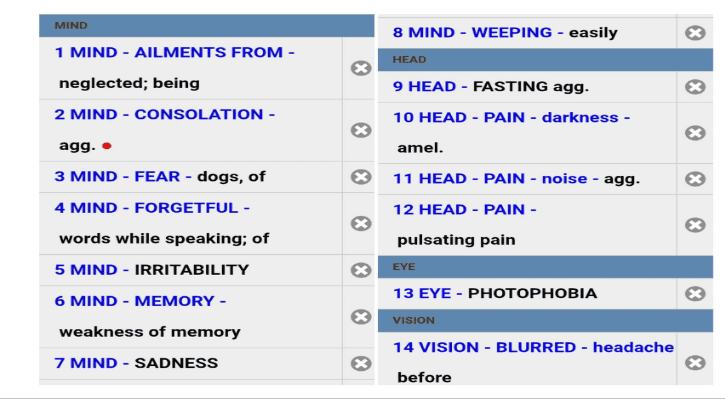
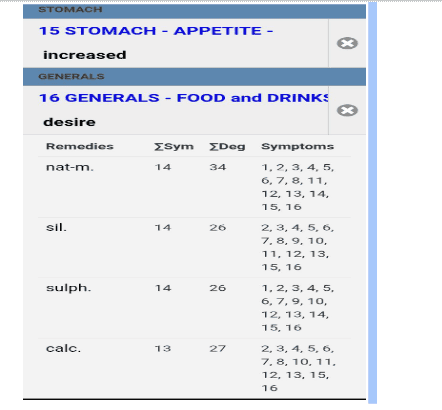
Repetorial Result:-
Nat mur.- 14/34
Sil -14/26
Sulph-14/26
Calc.13/27
Miasmatic Consideration –
Psora Sycotic Misam In The BackGorund
Treatment :- First Preceripation [22/7/25]
Rx –
1) -Natrum Muriaticum 1m Single Dose 4 pills x OD x one day
2) -Sac lac30 4pills x TDS x 15 days
General Management: Avoid fasting for long periods, have short and regular meals at 4-6 hours.Avoid stress And trigger factor,Drink plenty of water to hydrated.
FOLLOWUP(s): Follow up will be taken after every15 days or as per requirement of patient
| DATE | SIGN AND SYMPTOMS | PRESCRIPTION |
| 10/8/25 | pain intensity slighty reduced and no episode occurred in the month. irritability reduced. Periods appears. stiffness present in whole neck and back. | Rx-1) -Natrum Muriaticum 1m Single Dose 4 pills x OD x one day2) -Sac lac30 4pills x TDS x 15 days |
| 12/9/25 | One episode appears due to fasting, period. taking medicine for Pain was less than before. | Rx-1) -Natrum Muriaticum 1m Single Dose 4 pills x OD x one day2) -Sac lac30 4pills x TDS x 15 days |
| 20/9/25 | two episode appears due to travel. appetite increased. stiffness present in back and neck. | Rx-1) -Natrum Muriaticum 1m Single Dose 4 pills x OD x one day2) -Sac lac30 4pills x TDS x 15 days |
| 13/10/25 | improved by more than before headache. Appetite increased. Reduced duration of headache , intensity of headache and uses of pain killer. I adviced for avoid trigger factor of migraine anxiety and stress. | Rx-1) -Natrum Muriaticum 1m Single Dose 4 pills x OD x one day2) -Sac lac30 4pills x TDS x 15 days |
Scoring
Result Improvement
Total midas score before – 31
Midas score after treatment – 05
Improvement 31-5= 26
Percentage improvement formula
before treatment –after treatment *100/before treatment
Calculate Percentage Improvement: 26/31*100=83.87%
Use the following formula to quantify the improvement:
Percentage improvement = 83
Conclusion : Homeopathy offers a promising complementary approach in the management of migraine, especially for chronic and recurrent cases. While clinical experiences suggest beneficial outcomes, scientific evidence remains inconclusive. Therefore, homeopathy should be considered as part of an integrative treatment strategy rather than a standalone therapy.
References
- World Health Organization. Headache disorders. Geneva: World Health Organization; 2016.
- National Institute for Health and Care Excellence. Headaches in over 12s: diagnosis and management (CG150). London: National Institute for Health and Care Excellence; 2021.
- Fisher P, Greenwood A, Huskisson EC, Turner P, Belon P. Effect of homeopathic treatment on fibrositis (primary fibromyalgia). BMJ. 1989;299:365–366.
- Witt CM, Lüdtke R, Willich SN. Homeopathic treatment of chronic headache: a prospective observational study with 2 years follow-up. Cephalalgia. 2009;29(7): 719–728.
- Ernst E. Homeopathy: what does the “best” evidence tell us? Med J Aust. 2010;192(8):458–460.
- Mathie RT, Lloyd SM, Legg LA, et al. Randomised placebo-controlled trials of individualized homeopathic treatment: systematic review and meta-analysis. Systematic Reviews. 2014;3:142.
- Bell IR, Koithan M. A model for homeopathic remedy effects: low dose nanoparticles, allostatic cross-adaptation, and time-dependent sensitization. BMC Complement Altern Med. 2012;12:191.
- Rajan Sankaran. The Spirit of Homeopathy. Mumbai: Homoeopathic Medical Publishers; 1991.
- Boericke W. Pocket Manual of Homoeopathic Materia Medica. New Delhi: B. Jain Publishers; Reprint edition.
- Hahnemann S. Organon of Medicine. 6th ed. New Delhi: B. Jain Publishers.
Co-Authors:
- Dr. Praveen Jaiswal, Head of Department, Department of Practice of medicine. Government Homoeopathic Medical College and Hospital, Bhopal, Madhya Pradesh.
- Hari Singh Chourasia ,guide of Department of Practice of medicine. Government Homoeopathic Medical College and Hospital, Bhopal, Madhya Pradesh.