ABSTRACT:
Artificial Intelligence (AI) is no more an alienated topic in the current era. Every nook and corner of the world is conquered by Artificial Intelligence. All aspects of human life, including day to day needs are assisted using AI, and the medical field is no exception to it. This iconic creation by man has got two sides to it, one where it is used and the other where it is misused. This duality of Artificial Intelligence is very well applicable in the medical sector where as doctors we have the necessity to use AI and also at the same time to think beyond it. In the homoeopathic field of medical sciences artificial intelligence has created new pathway for research and also in regards with clinical aspects, yet it should be understood that this man-made creation is a tool and not a replacement.
KEYWORDS:
Artificial Intelligence, AI, Duality, Homoeopathy, Research
INTRODUCTION:
To put in simple terms, Artificial Intelligence is a man developed tool to assist the needs of a man. It can perform tasks that require human intelligence and also at the same time accomplish tasks that are difficult for a man to do. In the homoeopathic field, the practitioners are relied heavily upon their deep understanding and knowledge of materia medica, organon and repertory. The one – to – one patient interaction is very important for us homoeopathic physicians in order the incorporate the learnings of Hahnemannian principles to find the similimum and treat the patient. It is indeed a meticulous task that requires keen observation and refined memory.
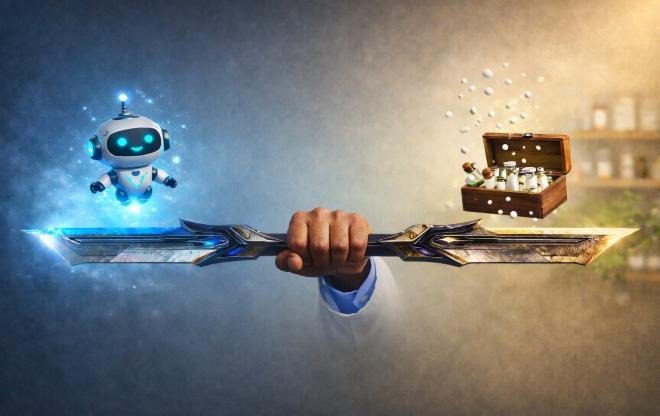
Throughout the years of evolution and adaptability of homoeopathic science, this task of the physician has been aided with the help of computer repertories and now Artificial Intelligence is finding its place too. Also, according to recent statistics, 22% of healthcare organizations have already implemented domain-specific AI tools, 7 times increase over 2024 and 10 times over 2023. Moreover, AI spending in healthcare has nearly increased by three-fold over each year reaching 1.4 billion in 2025 [2]. Therefore, certain questions might arise such as, to what extent it is accurate and to what extent it is beneficiary to both the patient and the physician. Henceforth Artificial Intelligence in the homoeopathic field has got both pros and cons, similar to a double-edged sword.
ADVANTAGES OF AI TO THE HOMOEOPATHIC FIELD:
- Usage of artificial intelligence to evaluate the medical images with high accuracy and provide diagnostic analysis to further enhance the treatment procedure. [3]
- The usage of AI systems such as HomoeoGPT which uses complex algorithms to aid the physician in tasks such as repertorization and analysis of symptoms. These tasks which were done manually are now done with the help of AI which is time saving and also increases the accuracy of selection of similimum.
- HomoeoGPT not only improves diagnostic procedures and treatment strategies but also acts as a user-friendly tool for students in helping them decipher complex homoeopathic topics. [4]
- Helps in drug discovery by analysing vast datasets and also can simulate chemical interactions which paves way for deeper understanding and discovery of drug actions.[5]
- Helps in the maintenance of electronic health records, which enables automated data entry of the patient and also saves desk space of the physician.
- Using AI a patient’s lifestyle, environmental data and personal data can be interpreted leading to a more individualized remedy selection.
- AI algorithms are efficient to analyse genomic data and identify genetic variations associated with disease and use this information to plan further treatment aspects for the patient.
- With the help of NLP – Natural Language Processing which is a sub branch of AI, vast amounts of medical literature can be analysed regarding latest research from which relevant information can be extracted depending on the needs of the physician, leading to enhanced research knowledge. [6]
- Artificial intelligence can be used for case taking and serve as an intermediate between the physician and patient in case of online consultations or as in telemedicine, serving as a bridge between the physician and patient, it also helps with the diagnosis and treatment plan of the case without the need of a one-to-one visit of the patient and physician.
- Appointment schedules, patient details, history, can be easily stored and retrieved with the help of AI.
LIMITATIONS OF AI IN THE HOMOEOPATHIC FIELD:
- Nowadays the use of AI in case of online consultation has increased, but one thing physician must understand is that he/she must not be completely dependent on this tool as it can-not take comprehensive or detailed case history. [7]
- AI fails to differentiate between the layers of case, unable to truly understand the mind of the patient.
- The usage of AI enhanced online consultations decreases one-to-one interaction, and also decreases social contact of the patient and the physician.
- Not all cases require deep search using repertories or algorithms to diagnose, but sometimes a keen listener which is the physician himself, observing and listening to the patient emotions can lead to a better understanding and remedy selection.
- AI analyses the data which is pre-entered by man, it fails to comprehend the in-depth meaning leading to generalization of homoeopathic drugs, failing the core of homoeopathy that is individualization.
- AI can-not generate new ideas, as it works on the basis of already known data, which lacks the creativity of human, and proves its limitation on forming new research ideas.[8]
- The quality and effectiveness of the usage of AI integrated software’s depends heavily on the data being used to frame it, therefore poor data collection may lead to faulty results hence making the use AI doubtful, and therefore leading to biased analysis. [9]
- Data privacy and security is one of the biggest concerns as it involves sensitive content in relation to the patient. In case of misuse or any unauthorized access can lead to severe personal, ethical and legal consequences. [10]
- The increasing job replacements have led to devastating impact in the life of persons whose roles are now filled-in using AI, like for example radiologists, who have lost their jobs due to the usage of AI-driven medical image diagnostic tools. This creates a great impact on not only one person but an entire educational system, which may no longer be seen as a field of interest to study.
- Also, the cost of setup of AI integrated systems to medical field is expensive therefore, not all healthcare providers may be able to adapt to the changes in the technology.
CONCLUSION:
To conclude, Artificial Intelligence is never a replacement to doctors. It is just a tool to enhance the treatment given to the patient. There can be both pros and cons in the usage of Artificial Intelligence in health care system, but it is up to the physician to make right use of this exceptional tool and make sure it benefits the patients. There is no right or wrong but simply put, it depends on the ability of the homoeopathic practitioner to incorporate his wisdom with the use of Artificial Intelligence for the betterment of humanity.
REFERENCES:
- ChatGPT [Internet]. ChatGPT. 2025. Available from: https://chatgpt.com/
- Jain SH. AI Adoption In Healthcare Is Surging: What A New Report Reveals. Forbes [Internet]. 2025 Oct 21; Available from: https://www.forbes.com/sites/sachinjain/2025/10/21/ai-adoption-in-healthcare-is-surging-what-a-new-report-reveals/
- Sankar AS. AUTOMATED SYMPTOM RECOGNITION: A PROMISING FUTURE FOR HOMOEOPATHY.
- Revolutionizing Homeopathy: The Dawn of AI in Medical Science [Internet]. Homeopathy Resource by Homeobook.com. 2024 Available from: https://www.homeobook.com/revolutionizing-homeopathy-the-dawn-of-ai-in-medical-science/
- Singh SR, Patil AD. Bridging the Gap between Artificial Intelligence and Ancestral Intelligence in Conventional Medicine and Homeopathy. Indian Journal of Integrative Medicine. 2024 Apr 22;4(2):66-70.
- https://hpathy.com/author/drvivek. Applications of Artificial Intelligence in Homeopathy [Internet]. Hpathy.com. 2024. Available from: https://hpathy.com/homeopathy-papers/applications-of-artificial-intelligence-in-homeopathy
- Lotus Health Institute. AI and Homeopathy: What It Can and Can’t Do [Internet]. Lotushealthinstitute.com. Lotus Health Institute; 2025. Available from: https://lotushealthinstitute.com/articles/homeopathic-medicine-mainmenu-33/ai-homeopathy
- AI in Clinical Research: Opportunities, Limitations, and What Comes Next | Harvard Medical School Professional, Corporate, and Continuing Education [Internet]. Harvard.edu. 2025. Available from: https://learn.hms.harvard.edu/insights/all-insights/ai-clinical-research-opportunities-limitations-and-what-comes-next
- Jiang L. Opportunities and challenges of artificial intelligence in the medical field: current application, emerging problems, and problem-solving strategies. Journal of International Medical Research [Internet]. 2021 Mar;49(3):030006052110001. Available from: https://journals.sagepub.com/doi/full/10.1177/03000605211000157
- Corn J. Council Post: Balancing the Pros and Cons of AI In Healthcare. Forbes [Internet]. 2024 Aug 12; Available from: https://www.forbes.com/councils/forbesbusinesscouncil/2023/12/01/balancing-the-pros-and-cons-of-ai-in-healthcare/
AUTHORS:
Dr. R.R. KARTHIKEYAN 1,
Ms. APARNA ALAGESAN 2,
Ms. SRUTHI. K.J 3
- DEPUTY MEDICAL SUPERINTENDENT, PROFESSOR AND HOD, DEPARTMENT OF COMMUNITY MEDICINE, RVS HOMOEOPATHY MEDICAL COLLEGE AND HOSPITAL, COIMBATORE, TAMILNADU. MEMBER- EXPERT COMMITTEE (COMMUNITY MEDICINE, RESEARCH METHODOLOGY AND BIOSTATISTICS) HOMOEOPATHY EDUCATION BOARD, NATIONAL COMMISSION FOR HOMOEOPATHY.
- STUDENT, FINAL YEAR BHMS, RVS HOMOEOPATHY MEDICAL COLLEGE AND HOSPITAL, COIMBATORE, TAMILNADU
- STUDENT, FINAL YEAR, B. TECH (ARTIFICIAL INTELLIGENCE AND DATA SCIENCE), KUMARAGURU COLLEGE OF TECHNOLOGY, CHINNAVEDAMPATTI, COIMBATORE.