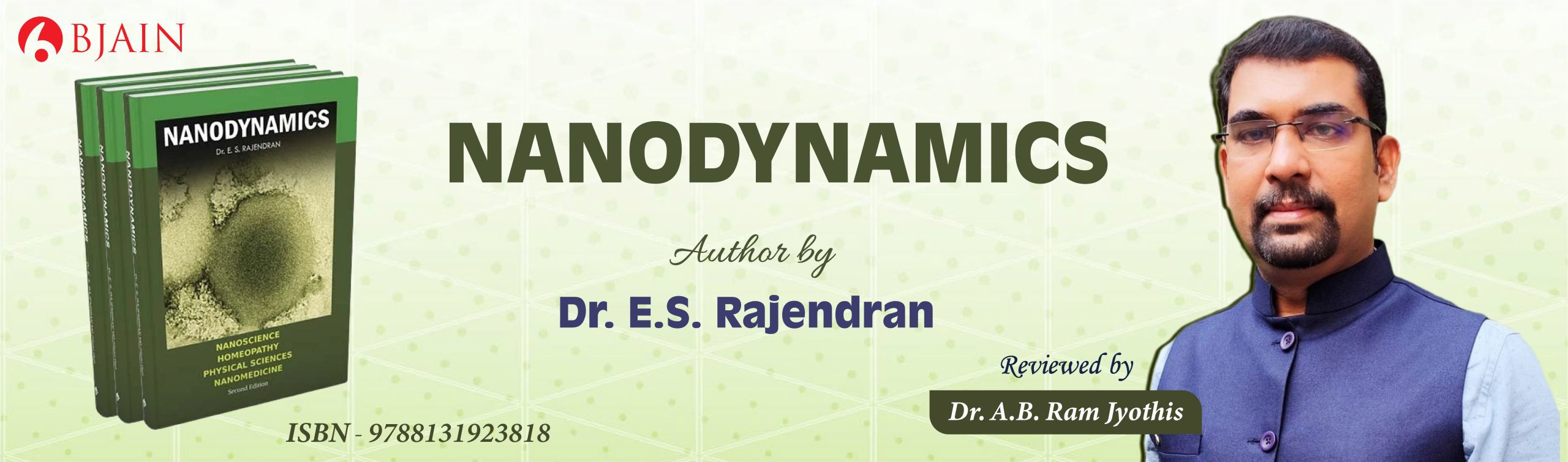
NANODYNAMICS by Prof. E. S. Rajendran, Ph.D., represents a landmark scholarly work that bridges two seemingly distinct domains—Homeopathy and Nanoscience—through a scientifically grounded, conceptually coherent, and experimentally validated framework. This pioneering contribution stands as the first comprehensive research-based publication in Homeopathy employing advanced nanotechnological methods to explore the material basis of potentised medicines.
Dr. Rajendran’s research adopts a rigorous experimental approach using some of the most sophisticated analytical and imaging techniques available in modern science, including High-Resolution Transmission Electron Microscopy (HRTEM), Field Emission Scanning Electron Microscopy (FESEM), Energy Dispersive Spectroscopy (EDS), Dynamic Light Scattering (DLS), and Selected Area Electron Diffraction (SAED). These methodologies are applied to the study of ultra-high dilutions of various homeopathic medicines to investigate their nanoscale composition and structural organisation.
Through these advanced analyses, Nanodynamics provides compelling evidence that homeopathic medicines, despite undergoing extreme dilution, retain nanoparticles and quantum dots of the original drug substance. This discovery challenges long-held assumptions that homeopathic preparations are devoid of material content, instead establishing a tangible physicochemical basis for their therapeutic action.
The book reports detailed nanoparticle analyses of medicines such as Silicea, Aurum metallicum, Natrum muriaticum, Psorinum, Lycopodium, and X-ray across both centesimal (6C–CM) and LM potency scales. The findings consistently reveal the presence of nanostructures predominantly composed of carbon and oxygen, along with elemental signatures specific to the original source substances (for instance, Si in Silicea, Au in Aurum metallicum, and Na and Cl in Natrum muriaticum). Remarkably, the particle size was observed to decrease progressively with increasing potency, stabilizing within the quantum dot range (<10 nm) from the 30C potency onwards. LM potencies displayed greater uniformity, smaller particle dimensions, and higher structural stability under electron beam exposure compared to centesimal preparations.
As potency increased, the nanoparticles demonstrated enhanced dispersion, reduced agglomeration, and improved homogeneity—indicating that the process of potentisation induces systematic refinement and stability at the nanoscale. These findings support the concept that homeopathic preparations are not inert but constitute stable, dynamic nanosystems capable of interacting with biological systems at molecular and cellular levels.
A particularly profound contribution of NANODYNAMICS lies in the author’s interpretation of Hahnemann’s principle of potentisation as an early precursor to modern nanoscience. Dr. Rajendran convincingly elucidates that the mechanical processes of trituration and succussion function as top-down nanofabrication techniques—transforming bulk substances into nanometric and sub-nanometric entities through controlled mechanical energy input. His extensive investigations on Natrum muriaticum, Aurum metallicum, Silicea, Ferrum metallicum, Platina, Psorinum, Calcarea carbonica, and Nux vomica consistently demonstrate the presence of nanoparticles even within ultra-high dilutions, sometimes reaching dimensions within the quantum dot range (below 10 nm).
Among the many original findings highlighted in the book, two are particularly noteworthy:
- The universal presence of nanoparticles and quantum dots in all ultra-high dilutions studied.
- The remarkable SAED discovery that Platina, a noble metal considered chemically inert, undergoes oxidation to platinum dioxide (PtO₂) in its potentised form—an observation that challenges established chemical principles and underscores the dynamic transformations induced during potentisation.
The author’s analytical data, micrographs, and spectral characterizations decisively counter the perception of homeopathic medicines as “placebo-like.” Instead, they establish that these medicines are complex, dynamic nano-systems with quantifiable physicochemical identities and potential bioactivity. The nanoscale dimension of these entities allows plausible interactions with biological receptors, cellular membranes, and even genetic material, offering a scientifically grounded explanation for the therapeutic effects observed in homeopathic practice.
Dr. Rajendran also draws an intellectually stimulating parallel between Richard Feynman’s visionary statement, “There is plenty of room at the bottom,” which marked the conceptual birth of nanoscience, and Hahnemann’s concept of potentisation, formulated more than a century earlier. This connection underscores that the homeopathic process of serial dilution and succussion inherently embodies the principles of controlled material refinement, situating Homeopathy within the conceptual framework of nanoscience long before the discipline was formally recognized.
NANODYNAMICS is not merely an analytical exposition but a visionary work that proposes a paradigm shift in the scientific understanding of medicine. It calls for interdisciplinary collaboration among researchers from physics, chemistry, biology, nanotechnology, and medicine to further explore the nano-bio interface underlying homeopathic remedies. The book’s arguments, fortified by experimental data, challenge conventional reductionist views and open new avenues for integrative and holistic approaches in medical science.
In conclusion, Nanodynamics stands as a milestone in the evolution of homeopathic research and contemporary scientific thought. Its original discoveries, rigorous experimentation, and philosophical depth collectively redefine the interface between traditional healing and modern nanoscience.
This seminal work is an indispensable reference for academicians, researchers, and practitioners seeking to understand the material reality of potentised medicines and their nano-biological mechanisms of action. It represents a transformative step towards a new era of evidence-based understanding in Homeopathy—rooted in the language of modern science yet faithful to its foundational principles.
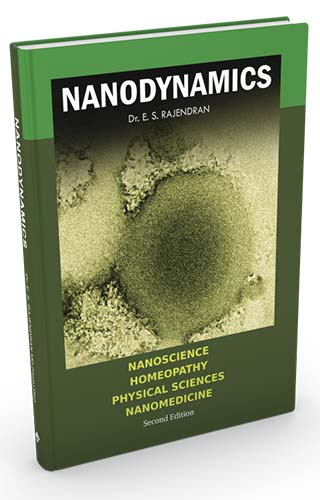
Title: NANODYNAMICS
Author: Dr E.S Rajendran
ISBN: 9788131923818
Imprint: BJain Regular
Pages: 269
Format: Paperback
Language: English