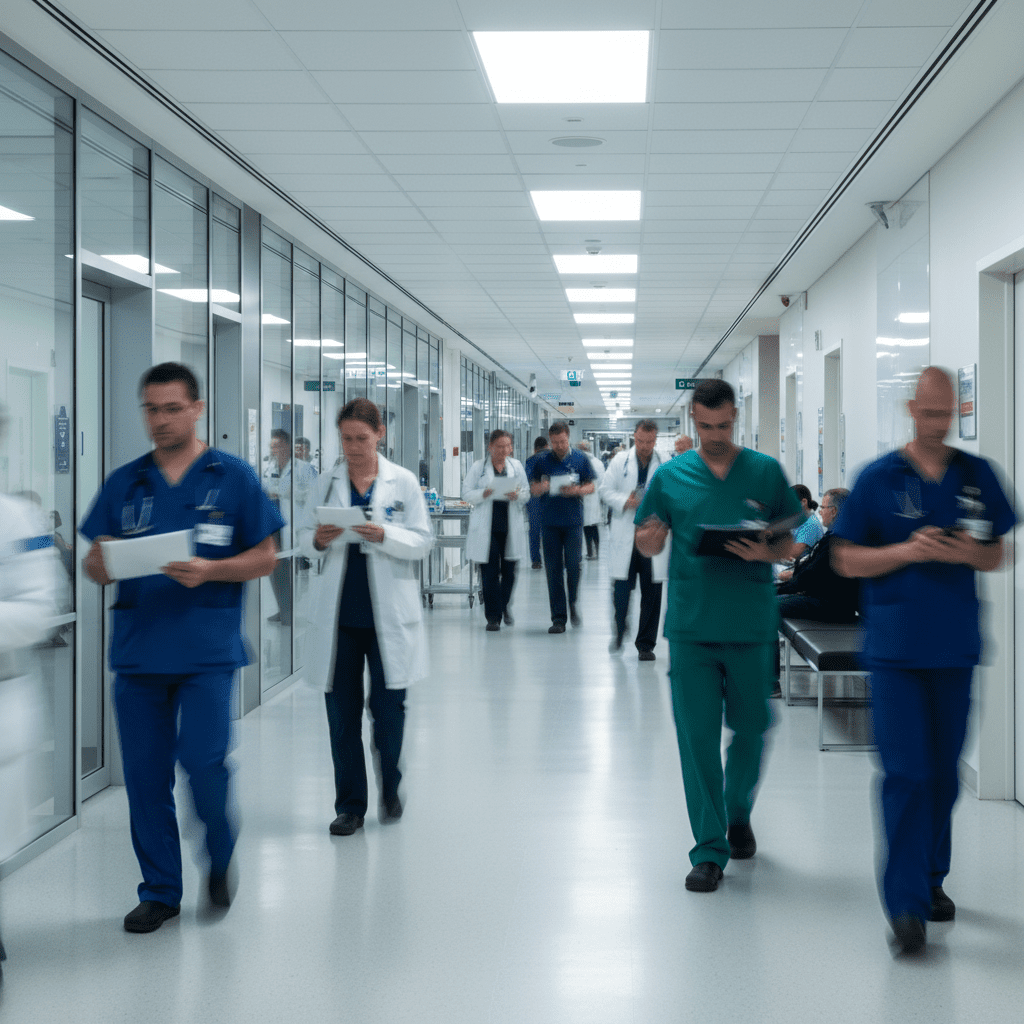
Hospital corridors fill with students and staff as clinical training demand rises
Clinical training is where healthcare students learn to become healthcare professionals. Whether studying nursing, naturopathy, or homeopathy, every student needs supervised patient contact before they can practise independently. The gap between classroom theory and clinical reality is wide, and bridging it requires structured, well-managed placements.
That gap matters because patient safety depends on it. A student who has only read about diagnosing a chronic condition isn’t ready to treat it. The clinical placement is where they learn to recognise symptoms, interpret results, and communicate with patients under the guidance of experienced practitioners.
For students in complementary and integrative medicine, clinical training carries added weight. Many patients seek homeopathic or naturopathic care for complex conditions that haven’t responded well to standard treatment. These cases demand deeper diagnostic skills, longer consultation times, and a strong understanding of when to refer to conventional specialists.
Across every healthcare discipline, the challenge is the same. There aren’t enough clinical placement sites to meet demand. This shortage affects nursing, medicine, homeopathy, and every other field that requires hands-on training.
Clinical training in homeopathy and integrative medicine
A homeopathy student reviewing case notes during a clinical rotation
The BHMS (Bachelor of Homeopathic Medicine and Surgery) programme runs for 5.5 years. The first 4.5 years cover academic subjects: anatomy, physiology, materia medica, and the principles of homeopathy. The final year is a compulsory rotating internship across medicine, surgery, obstetrics and gynaecology, and community medicine.
That internship mirrors conventional medical training in important ways. Students rotate through hospital departments, manage patients under supervision, and build competence in real clinical settings. For homeopathy students, this period is especially important because it trains them to integrate homeopathic principles with standard diagnostic and therapeutic procedures.
Managing these rotations requires careful coordination. Each student needs a placement schedule that covers all required specialties, meets regulatory standards, and fits within the hospital’s capacity. This is where clinical placement management becomes essential. Schools that handle scheduling, compliance tracking, and preceptor assignments manually often struggle to keep up with the administrative load. Digital systems help schools organise placements more efficiently and ensure every student completes their required hours.
Naturopathic programmes face similar requirements. The National University of Natural Medicine (NUNM) mandates 1,264 clock hours of supervised clinical training for naturopathic doctor students. These hours cover primary care, physical medicine, and botanical medicine clinics. Like BHMS programmes, naturopathic schools must manage placement logistics across multiple clinic sites and preceptors.
The growing demand for clinical training across healthcare
The numbers are stark. In 2025, 93,176 qualified nursing school applicants were turned away nationwide due to insufficient clinical placement sites, faculty shortages, and budget constraints, according to the American Association of Colleges of Nursing. The U.S. Bureau of Labor Statistics projects 189,100 registered nurse openings each year through 2034, yet nursing schools can’t expand capacity without solving the placement bottleneck.
That demand isn’t limited to nursing. BHMS programmes in India produce thousands of graduates annually, all of whom require the same one-year compulsory internship. Naturopathic programmes in North America and Europe send students into clinics and hospitals for hundreds of supervised hours. Integrative health schools compete with nursing and medical schools for the same limited pool of clinical training sites.
The competition for placement slots is a zero-sum game in many regions. A hospital that hosts nursing students one semester may not have capacity for homeopathy or naturopathy students the next. This creates particular pressure on integrative health programmes, which often lack the institutional relationships that larger nursing and medical schools maintain.
What is causing the clinical placement shortage
Several factors drive the shortage, and none of them is easy to address.
A 2025 survey of 150 nursing programme administrators from Cisive and PreCheck found that 30% identified clinical placements as the single biggest inefficiency in their programmes. Over 90% of administrators reported that difficulty securing enough placements had at least some impact on their operations. The same Cisive report notes that fragmented scheduling systems are a primary cause of wasted administrator hours and unfilled rotation slots.
Faculty shortages compound the problem. The AACN reports a 7.2% vacancy rate in nursing faculty positions, which limits how many students programmes can accept. Preceptor burnout is another factor. Experienced practitioners who supervise students take on extra work without always receiving adequate compensation or recognition from the institutions they serve.
Fragmented systems make things worse. Many programmes still manage placements through spreadsheets, email chains, and phone calls. When each hospital, clinic, and preceptor uses a different scheduling process, the administrative burden multiplies. Students may wait weeks for placement confirmations, and last-minute cancellations can derail carefully planned rotations.
Integrative health programmes often manage with even fewer resources. Unlike large nursing schools with dedicated clinical coordination teams, a homeopathy college might have 1 or 2 staff members handling all placement logistics. Without efficient systems, those staff members spend more time on administration and less on actually building relationships with clinical sites. Read more about homeopathic medical training requirements on the site.
How technology improves clinical placement management
Digital placement platforms replace manual scheduling with automated workflows
Digital platforms are beginning to address these inefficiencies. Tools such as Exxat, InPlace, and myClinicalExchange offer centralised scheduling, compliance tracking, and communication features that replace manual coordination. Exxat alone reports serving over 1,600 educational programmes and 10,000 affiliate organisations.
For integrative health programmes, adopting similar technology could close the gap with conventional medical schools. A 2026 clinical placement benchmark report from Cisive and PreCheck documents how institutions that invest in placement management systems reduce administrative overhead and improve placement fill rates. Schools that manage placements digitally also collect better data on student progress and preceptor capacity, which helps them plan future rotations more strategically.
Automated compliance verification is one of the biggest time-savers. Instead of manually checking each student’s immunisation records, background checks, and liability waivers against each site’s requirements, coordinators can upload documents once and let the system verify them. This eliminates repeated paperwork and reduces the risk of students being turned away at the last minute because of missing documentation.
For BHMS and naturopathic programmes, these same tools work well. The placement requirements may differ, but the operational challenge is the same: matching students with clinical sites, tracking hours, and ensuring regulatory compliance. Many schools are already using platforms built for nursing education and adapting them to their own needs.
The future of clinical education in integrative healthcare
The regulatory environment is changing. In India, the National Commission for Homeopathy (NCH) has introduced competency-based reforms that shift the curriculum away from purely text-based learning toward clinical skills assessment. These reforms recognise that what matters most isn’t how many lectures a student attends but how well they can diagnose and treat real patients.
The World Health Organisation’s Global Centre for Traditional Medicine, established in Jamnagar, India, reflects the growing international interest in traditional medicine systems and their educational standards. As traditional and integrative medicine gains legitimacy in global health policy, the demand for structured, well-managed clinical training will increase.
Virtual and simulation-based placements supplement in-person clinical hours in some programmes. While they can’t replace direct patient contact, they provide valuable preparation and can reduce the total number of in-person hours needed. The shift toward competency-based education in India and elsewhere suggests that assessment of clinical skills will drive future curriculum design.
For schools that train homeopaths, naturopaths, and other integrative practitioners, investing in better clinical placement management isn’t optional. It’s what produces graduates who are ready to practise safely and effectively. Explore integrative healthcare education trends and regulatory updates on the site.
Clinical placements are the bridge between learning and practice
Clinical placements are the bridge between learning and practice in every healthcare field. Homeopathy students need their rotating internships. Naturopathic students need their clinical hours. Nursing students need their precepted rotations. Without enough placement sites and efficient systems to manage them, none of these students can complete their training.
The shortage of clinical placements affects every discipline, but the solutions are shared. Better technology, stronger partnerships between schools and clinical sites, and regulatory reforms that prioritise clinical competence will all play a part.
As demand for both conventional and integrative healthcare practitioners grows, solving the placement bottleneck presses harder each year. Schools, hospitals, and technology platforms need to work together. The goal is straightforward: give every student the clinical experience they need.