The current era of rapid technological transformation challenges every facet of medicine. Debates now center not just on whether artificial intelligence (AI) will change healthcare, but which roles will endure and which might vanish altogether. Homeopathy, often occupying the periphery of mainstream discussions, finds itself at a unique crossroads amidst this revolution.[1]
Can AI Prescribe Like a Homeopath?
Technological optimists suggest AI could rapidly process symptoms, compare materia medica with dazzling efficiency, and suggest remedies using repertorization algorithms. Today’s AI can pass a Turing Test, but could it pass a “Hahnemannian Test”? Can it perceive patient totality, the subtle emotional currents beneath the case, the generational miasmatic influences, or the soul-anchored expressions that hint toward the simillimum? Homeopathy is both art and science—a nuanced, interpretative journey far beyond rubric matching. The core of homeopathic prescribing is perceiving the unique individual, taking into account family history, intrauterine experiences, personality traits, and energetic shifts. To truly see without prejudice, as Hahnemann urged, is a skill AI cannot yet claim[2].
Is AI Here Yet?
Not quite—but its presence is felt. AI tools for remedy selection, automated repertorization, and even outcome prediction are now on the horizon. These systems primarily function through structured data: rubrics, modalities, remedy outcome statistics. Their limitation is profound, they cannot grasp the unspoken suffering, the transformative healing after correct remedy action, or the subtleties encoded in Hering’s Law of Cure. AI can identify patterns, but not the underlying purposes; it can process symptoms, but not the patient’s journey behind them[3].
More Information, Less Insight?
An undeniable strength of AI in healthcare is its ability to extract and manage vast diagnostic and prognostic information. However, in homeopathy, discernment, not quantity of data, is key. Case-taking is the art of filtering noise to listen to the voice of the vital force. Without deep philosophical grounding, AI risks amplifying this noise: over-prescribing remedies, misreading proving symptoms, or even suggesting polypharmacy that runs counter to Hahnemannian wisdom. More data, paradoxically, can sometimes cloud the path to healing[2,4].
Automation vs Individualization
While AI is the master of automation, homeopathy thrives on individualization. Just as tractors took over farm labor but didn’t replace the farmer, AI might expedite repetitive tasks but will flatten the nuanced complexity of patient narratives. The homeopath’s goal is not to treat diseases but to treat the person with the disease, a distinction often too subtle for current AI to understand. Automated repertories may suggest “Lycopodium” for anxiety, but could they appreciate the patient’s unique blend of insecurity, pride, fear of responsibility, and childhood wounds? Herein lies the crux: context and consciousness[2,4].
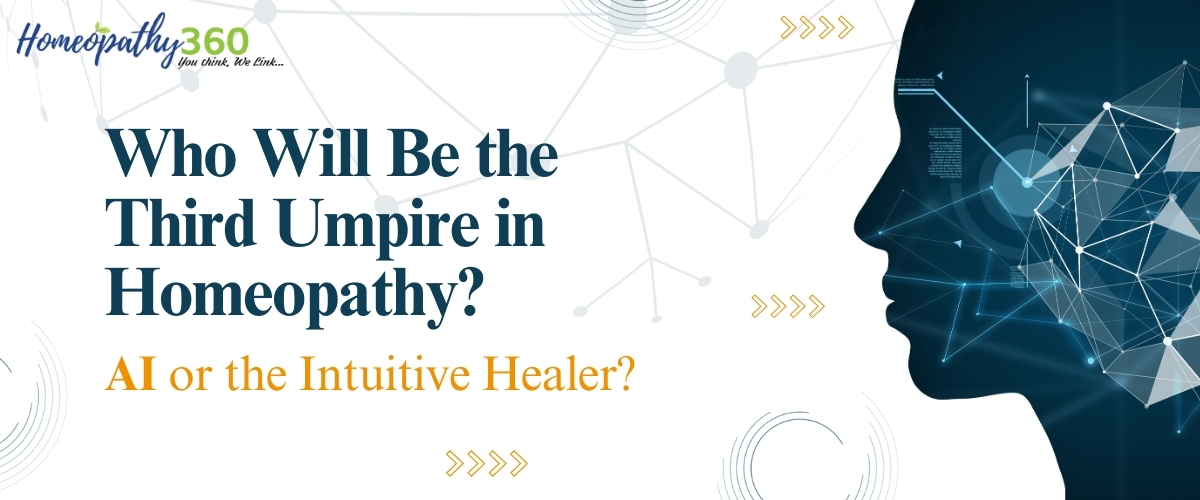
The Third Umpire: AI or the Intuitive Healer?
There is a temptation to cast AI as medicine’s new “third umpire,” an arbiter of remedy choice and outcome assessment, analogous to adjudication in cricket. But healing resists static definitions and algorithmic boundaries. Homeopathy, like Gödel’s Incompleteness Theorem suggests, accepts the unknowable and relies on the wisdom of knowing when not to act, something no automated system can yet replicate[4,5].
Toward Symbiosis: AI as Assistant, Not Replacer
Rather than a battleground, the confluence of AI and homeopathy should be seen as a partnership. AI can be a diligent assistant, drafting repertorization grids, flagging overlooked symptoms, or managing case records. But the final judge must always be the human healer, one grounded in philosophy, experienced in the art of healing, and attuned to the patient’s story[4].
Let AI be Watson; Let the homeopath be Sherlock Holmes.
References:
1.Ullah W, Ali Q. Role of artificial intelligence in healthcare settings: a systematic review. J Med Artif Intell. 2025;8. doi:10.21037/jmai-24-294
2.Teixeira MZ. “Scientific Evidence for Homeopathy”. Clinics (Sao Paulo). 2023 Jul 25;78:100255. doi: 10.1016/j.clinsp.2023.100255. PMID: 37499427; PMCID: PMC10413079.
3.Doherty R, Pracjek P, Luketic CD, Straiges D, Gray AC. The Application of Artificial Intelligence in Acute Prescribing in Homeopathy: A Comparative Retrospective Study. Healthcare (Basel). 2025 Aug 6;13(15):1923. doi: 10.3390/healthcare13151923. PMID: 40805956; PMCID: PMC12345833.
4.Alhejaily AG. Artificial intelligence in healthcare (Review). Biomed Rep. 2024 Nov 12;22(1):11. doi: 10.3892/br.2024.1889. PMID: 39583770; PMCID: PMC11582508.
5.Mani, M.C. (2024). Benefits and Risks of AI in Health Care: Narrative Review. Interact J Med Res 2024;13:e53616. doi:10.2196/53616.