
Abstract
Homeopathy encourages us to look beyond the surface, to pay attention to the subtle signs of a symptom rather than the overt manifestations of illness. However, in modern practice, there is often a focus on well-known polychrests, whose widespread use overshadows the quiet efficacy of lesser-known remedies that lie dormant in the Materia Medica. Many challenges in treatment stem not from a lack of healing potential but from the undiscovered remedy that remains hidden. This article reveals the beauty and potency of these rare medicines, examining why they are often overlooked, how they can be identified, and the transformative impact they have when appropriately applied. Through the narratives of Abroma Augusta, Heloderma, Lac caninum, Senega, and others, we see remedies that emerge as hidden treasures in difficult cases. The journey concludes with a reminder that true homeopathy involves moving beyond routine and embracing the unknown for more profound healing.
Keywords: Boericke materica medica, rare medicine, homoeopathic materia medica
Introduction
The foundation of homeopathic practice lies in acknowledging the unique differences among patients and prescribing remedies based on the comprehensive assessment of symptoms. The aim is to identify the similimum, a remedy that corresponds with the patient’s entire constitution and symptom pattern. In line with Samuel Hahnemann’s principles, this approach requires careful attention to peculiar, characteristic, and distinguishing symptoms. While this theoretical emphasis on individualization is well recognized, it is observed that contemporary clinical practice often relies on a limited group of polychrest remedies—such as Nux vomica, Pulsatilla, Sulphur, Lycopodium, Calcarea carbonica, and Arsenicum album. Their prevalent use in education and practice contributes to their prominence in prescription patterns. However, it is important to note that the therapeutic scope of homeopathy extends well beyond these commonly used medicines. A considerable number of remedies remain underutilized and infrequently prescribed, not due to any therapeutic inferiority, but rather due to unfamiliarity. These lesser-known medicines hold significant potential within Materia Medica: subtle in action, limited in proving data, yet profoundly effective when accurately indicated. If these remedies are overlooked, the true power and possibilities of homeopathy may remain untapped.[1,2]
NEED TO KNOW THE PATHOGENETIC POWER OF RARE MEDICINE
Hahnemann stressed the importance of a physician having a comprehensive grasp of the medicinal pathogenetic effects to achieve genuine healing. In Aphorism 105, he clarifies that understanding the tools necessary for treating illnesses requires examining and analyzing the impacts medicines have on a healthy human body. This knowledge enables the physician to accurately choose the remedy that aligns with the patient’s complete set of symptoms when confronted with a case. In Aphorism 106, Hahnemann further asserts that the full pathogenetic effects of each medicine must be understood through meticulous observation and systematic testing. Such understanding is crucial for comparing, distinguishing, and precisely applying remedies in practice.[3]
Why Explore Rare Remedies?[1]
The label “rare” or “small remedy” does not mean the remedy is weak or unimportant. Instead, these remedies are described as rare because they are:
- Overlooked because well-known polychrests have similar but broader indications.
- Given Not commonly prescribed, mainly due to limited awareness among practitioners.
- Supported by fewer provings and clinical records.
- Often less attention in modern teaching, repertories, and training programs.
- Clinical Significance of Rare Remedies (Condensed)
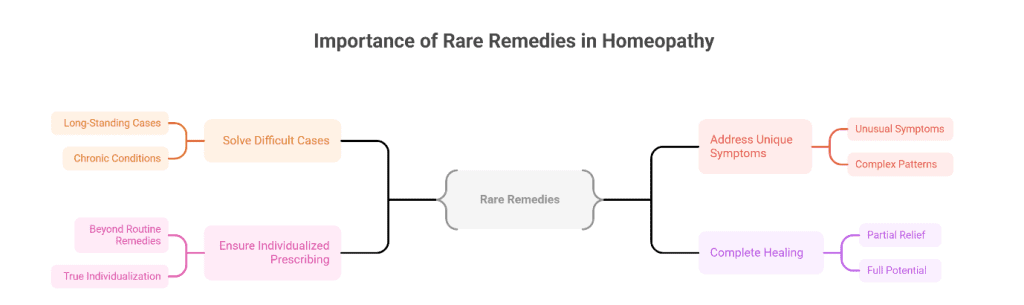
Rare remedies are crucial in homeopathy because they:
- Solve difficult, long-standing, or chronic cases.
- Address unique, unusual, or complex symptom patterns.
- Ensure true individualized prescribing beyond routine remedies.
- Complete healing where common remedies provide only partial relief.
- They are the hidden tools that reveal the full potential of homeopathic treatment.
Why Rare Remedies Are Often Neglected
Rare remedies are often overlooked because:
- They have fewer provings and documented cases, making their indications less certain (Mathur) [2].
- Many practitioners lack confidence in prescribing unfamiliar medicines (Kent) [6].
- Education focuses on polychrests, leaving rare remedies underrepresented (Boericke) [4].
- Symptoms may overlap with common remedies, causing confusion (Murphy) [5].
- Their subtle or highly specific action can make them seem difficult to use in practice.
Identifying the Rare Remedy
Selecting the correct rare remedy requires careful and detailed observation (Hahnemann)[3]. Key principles include:
| Principle | Why It Matters |
| PQRS symptoms | Peculiar, queer, rare, or strange symptoms often point directly to the correct remedy[3] |
| Mental and emotional signs | Deep insights into personality and emotions help distinguish remedies[6] |
| Modalities | Factors that worsen or improve symptoms (time, position, weather) guide precise selection[2] |
| Miasmatic or constitutional background | Helps determine the deeper chronic layer and correct potency[6] |
| Unique individual features | Small, unusual details can be decisive in choosing the right remedy[3] |
| Repertory + Materia Medica confirmation | After repertorisation, always confirm in the Materia Medica before prescribing[4,5] |
Often a commonly used polychrest may appear “almost right,” but careful observation reveals the rare remedy as the true similimum.
Indication of some rare remedies Portraits of Selected Rare Remedies
Abroma Augusta
Useful in diabetes with exhaustion, irritability, sleeplessness, thirst and weakness.[5]
Keynote: Sleeplessness from nervous excitement.
Heloderma
For extreme coldness, slow circulation, numbness.[4]
Keynote: Icy chill down the spine.
Lac Caninum
For deep emotional trauma, lack of confidence, alternating complaints.[5]
Keynote: Alternating sides of symptoms.
Senega
For chest weakness, tough mucus, exhaustion after illness.[4]
Keynote: Hard expectoration with fatigue.
Carcinosinum
For suppressed emotions, sensitivity, perfectionism, trauma history. [5,6]
Keynote: Oversensitivity and emotional burden.
SPHERE OF ACTION [4-6]
MIND – angel, aur-m, bruc, boug-c, cent, calc-br cereus-s, dir-p, eucal, gaer, gent-c, hed, kali-fc, latr-h, laff-ac, lace, lob-syp, lon-p, mand, mir, pedi, past, sul-h, scop, stry-v, stry-n, xan-s, zinc-ars, zinc-pic, zinc-p, zea-i
HEAD INTERNAL – acon-c, angel, arum-i, aur-ars, aur-br, boug-c, caes, calc-lac, derr-p, fag, ferr-pyr, form-a, geni, guan, hell-f, hydr-ac, hydro,ilex-p, iri-chl, iris-f, lapa, lob-syp, nat-nit, pimp, plat-mur, rhus-r, rumx-o, sal, stron-n, tel-a, vitx-t, zinc-p, zinc-s
HEAD EXTERNAL – calc-m, hell-f, jug-c
CENTRAL NERVOUS SYSTEM
BRAIN – arist-s, calc-br, dir-p, ferr-pro, mir, merc-aur, stry-v, sen-j
MENINGES – bung-f, cup-cyn, lum, urot, zinc-cу.
NUCLEI, lenticular – mang-o.
NUCLEI – bulbar – mang-o.
SPINAL CORD -bung-f, bung-k, pect, plum-i, sen-j.
TRIGEMINAL NERVE – must-o
EYES
EYEBALLS- Atox, benz-d, card-b, chrom-s, crot-c, eph, eser, hed-h, hydro, merc-acet, musc, merc-nit, mir, plum-c, sang-t, spi-m, thy-g-e
CORNEA – aetho, merc-nit, zinc-s
CANTHI – succ-ac
OPTIC NERVE – atox
CONJUNCTIVA – merc-nit, mir, prot.
PUPIL – eser, mir, plum-c, spi-m
RETINA – benz-di
EYELIDS – Benz, calc-pic, cod, eser, hydro, nico, succ-ac, zinc-sEAR
EAR – atrop, acon, arun-d, calc-pic, chin-sal, cit-dec, cul, eucal-r, hydr-ac, kino, lob-syp, mul-o, pyr-m, pilo-m, stron-n, sko-c, trad
AUDITORY CANAL – calc-pic, mul-o
EUSTACHIAN TUBE – Atrop, lob-syp
LABYRINTH – pyr-m
MIDDLE EAR must-o, sko-c,
TYMPANUM – atrop
NOSE-acon-l, ars-s-r, calc-caust, cean-try, ferr-acet, guan, hed-h, iri-chl, lob-syp, lob-e, lapa, merc-aur, marr, nep-c, ono-s, phel-p, rumx-o, succ-ac, tan-a
NOSE, ROOT OF – lob-syp
NASAL CAVITY – must-o.
NARES – iri-chl, lob-syp.
NARES – posterior nare – lob-syp
SEPTUM – kali-sil
ANTRUM – euphr -a.
FACE
FACE – acon-c, calc-caust, euon, ferr-mur, hoi, hydr-ac, lob-e, mang-o, must-o, nat-sf, rhus-d, rumx-a, sol-v, salu, sphi, trif-r, zinc-oxy, zinc-pic.
CHEEKS – ferr-mur
ETHMOID – nat-sf, salu,
MALAR BONE – calc-caust,
JAW – amphis, anac-occ, bapt-c, calc-caust, chrys-l, mag-a, ner-o, sphi
MASSETER – nico.
ZYGOMA – sphi
TEETH – calc-r, cheir, chrys-l, ferr-s, lith-chl, phos-hyd, trif-r, Zinc-br
LIPS-acon-c, mir, nat-nit, ox-acet, Scop.
GASTRO INTESTINAL TRACT
TONGUE – acon-c, aur-m, carbo, cit-ac, kali-tel leo, lob-p, mir, nect-a, pel-brhus-r, stan-i, vib-pr, zinc-s
MOUTH – bras-n, fag, geni, hydr-m, hoi, iris-t, lob-e, nat-cac, nat-tel, plum-l, rumx-a, scop, tan-a, trif-r, tril-e, zea-i
OESOPHAGUS –
sin-a
STOMACH – agar-e, agari, agro, ascl-n, atrop, boug-c, cad-br, chim-m, cup-law, cyd-vul, cynan, dir-p, euon, euphr-c, euphr-hyp, ferr-s, fic-v, form-a, gent-q-f, geum, hydr-m, hydr-s, ing, iris-t, lev, mat, myr-c, nat-ch, orex-t, pancr, pep, peum-b, plum-a, prun-v, res, sed-t, stron-br, stry-e-f-c, stry-s, thy, xanth-a.
INTESTINES: caes, colch, colos, cheli, cot, eser-sal, hen, iris-t, jugl, kino, mang-s, nar-p, prun, vacc-m, xanth-a
EPIGASTRIUM: pamb, pep
OMENTUM –
lob-e
PERITONEUM – atrop
APPENDIX –
iris-t.
ILEO-CAECAL – iris-t
MESENTERIC – calc-hyp.
RECTUM AND ANUS – acon-l, aesc-g, cad-j, cup-o-n,
fran-r, glach-h, hell-f, hello, hen, lap-c, mag-a, mac-p, muc-u, neg-a, prun-p, rub-v, sacc-l, sangs, sed-t, sax, slag, sq-c, slag-sil.
URINARY SYSTEM
KIDNEY – aral-h, canthr, ceref, calc-r, cic-ar, ele-g, ferr-mur, form-a, hyos-hy, ilex-p, ilex-v, jun-v, kali-cit, koch-l, men-v, ono-s, poly-p, par, past, pip, sant, xanth-arb.
URINARY BLADDER – alth, agari, areto-m, bruc, bold,
chim-u, camp-ac, ceref, ele-g, fab, juni-v, lith-b, pop-t, sau, tere, urot, vesi, xan-s, xanth-ar
URETHRA – euphr-pil, geum, merc-acet, merc-prae, pip, sau, trad.
MALE REPRODUCTIVE SYSTEM
MALE GENITALIA – ferr-mur, gual, hedy, iksh, manz, merc-aur, meth-s, pot-x, rhus-d, teuc-s, tri-t, vero, zinc-pic
PROSTATE – chrom-s, iksh, pop-t, polyc,sau, tri-f.
SCROTUM – teuc-s.
EPIDIDYMUS guai, meth-s, teuc-s,
PENIS – hedy.
FEMALE REPRODUCTIVE SYSTEM
FEMALE GENITALIA -anag, api, arcto-m, arg-oxy, asar-c, ascl-n, asp, atrip, aur-m-k, calc-br, calc-s-st, cit-lim, dict, erod, fer-glau, ferr-s, ferr-mur, hed-h, hello, jun-v, kali-fc, leo, lac-v-f, lapa, mang-o, manz, pin-l, pis, pitui, psor, rhus-d, rosm, sangui, sed-t, vib-pr
UTERUS – asp, aur-m-k, antim-jod, alum-ac, cheli, calc-br, ferr-br, hello, lapa, nab, psor, pyr, sangui, sed-t, vib-pr.
OVARIES – aur-iod, atrop
RESPIRATORY SYSTEM
RESIRATORY ORGANS – cat, cetr, euphr-hyp, ferr-acet, gad-m, lip-m, oen-b, pneumx, peum-b, phel-p, pulm-v, pect, ran-g, succ-ac, sul-h, tel-a, terp-h, tost-p
LUNGS- ars-stib, aman-p, antim-jod, calc-hyp, caff, emet, fic-v, gad-m, koch-l, lob-ca, nat-s-c, pneumx, peum-b, pulm-v, sangui, sol-ac, stan-i
LARYNX – Marr, crot-c, nico, nat-sel,
THROAT – aesc-g, alum-ac, amyg-a, arg-iod, atrop, cean-try, cephal, cit-lim, geni, gent-c, gual, hoi, hydr-ac, hydr-m, ilex-p, lace, lac-v-f, lob-syp, merc-acet, nat-sel, nym-o, pect, phos-pc, phyt-b, plat-m, prun-p, sin-a, stan-i, trif-r, zinc-c
Conclusion
This article highlights the importance of rare homeopathic remedies, which are often overlooked in favor of well-known polychrests. Despite their limited use, these remedies hold significant potential for healing, particularly in difficult, chronic cases requiring individualized treatment. The article emphasizes the need for practitioners to understand the full pathogenetic effects of each medicine for accurate prescribing. Factors contributing to the neglect of rare remedies include lack of provings, limited awareness, and focus on polychrests in education. Careful observation and attention to unique symptoms are crucial in identifying the appropriate rare remedy. The article presents examples of rare remedies, such as Abroma Augusta, Heloderma, Lac caninum, Senega, and Carcinosinum, and their specific indications. By studying and using rare remedies, practitioners can expand the effectiveness of homeopathy and rediscover its depth.
Listening to the “whispers of healing” helps uncover extraordinary results beyond the boundaries of common prescriptions.
STUDY HIGHLIGHTS
- Rare homeopathic remedies are often overlooked but hold significant potential for healing.
- Understanding the full pathogenetic effects of each medicine is crucial for accurate prescribing.
- Rare remedies are essential for solving difficult, chronic cases and ensuring individualized treatment.
- Lack of provings, limited awareness, and focus on polychrests contribute to the neglect of rare remedies.
- Careful observation and attention to unique symptoms are key to identifying the appropriate rare remedy.
- Examples of rare remedies include Abroma Augusta, Heloderma, Lac caninum, Senega, and Carcinosinum.
- Studying and using rare remedies expands the effectiveness of homeopathy and rediscovers its depth.
References
- Hansen O. Text-Book of Materia Medica and Therapeutics of Rare Homoeopathic Remedies. Classic Reprint.
- Mathur K. N. Systematic Materia Medica of Homeopathic Remedies. B. Jain Publishers.
- Hahnemann S. Organon of Medicine; Fragmenta de viribus medicamentorum.
- Boericke W. Pocket Manual of Homoeopathic Materia Medica with Repertory. Boericke & Tafel.
- Murphy R. Lotus Materia Medica, 3rd Edition.
- Kent J. T. Lectures on Homoeopathic Philosophy. Boericke & Runyon.