Keywords
UTI, Homoeopathy, Aetio pathogenesis, Remedy, Prevention
Introduction
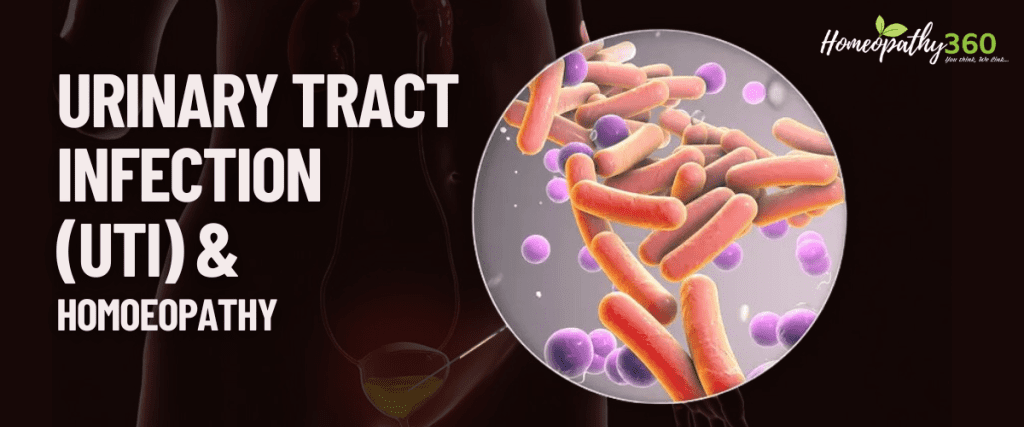
UTI is the presence of microbial agent in urinary tract which is usually sterile. UTI is the condition in which microbial agent enter and multiply within the urinary tract. UTI is a common, distressing and occasionally life-threatening. UTI can be either symptomatic or asymptomatic.
Uncomplicated UTI occurs in healthy women. Complicated UTI is associated with anatomical, functional, or metabolic abnormalities of the urinary tract that disable the natural innate host defences and lead to tissue injury.
Epidemiology
The incident of UTI is 0.5 to 0.7 episodes per person per year in females of whom 25% of them have recurrences.
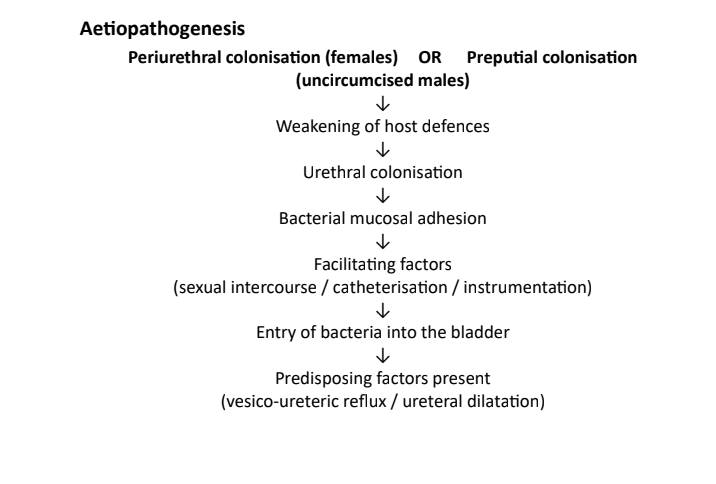
Host Factors for urinary tract infection
Anatomical factors
- Posterior urethral value
- Vesico-ureteric reflux
- Urethral stricture
- Benign prostatic hypertrophy
Functional factors
- Neurogenic bladder
Other factors
Males and females
- Diabetes mellitus
- Immunosuppression (post-transplant)
- Calculi Congenital abnormalities
- Foreign bodies: catheters, stents
Females
- Post-menopausal state (oestrogen deficiency)
- Voiding habits
- Spermicidal jelly
- Vaginal douching
- Perineal hygiene
Clinical Feature
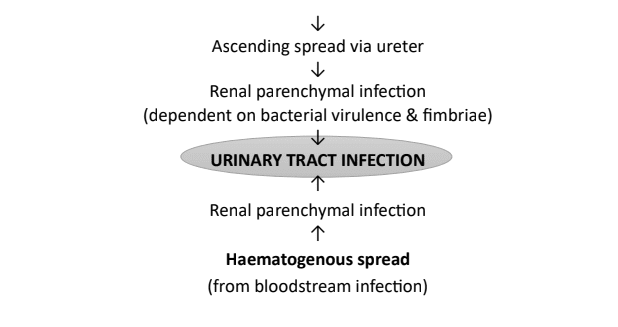
Clinical features depend on whether the infection involves the upper or lower urinary tract. Irritative voiding symptoms are more common in lower tract infection whereas constitutional symptoms are more common in upper tract infections.
Asymptomatic UTI- Significant bacteriuria is often not associated with symptoms and does not require treatment except in pregnant women, in infants and before urological surgery.
Cystitis and Urethrtitis- Infection of the bladder is common in women during their reproductive years. Patents with cystitis or urethritits may be Urinary Tract Infections asymptomatic or present with frequency, urgency, dysuria, nocturia, urge incontinence, suprapubic pain or a sensation of incomplete bladder emptying. The urine may have an offensive smell and haematuria occurs in approximately 30% cases. Physical examination usually may reveal mild suprapubic tenderness.
Prostatits and Seminal Vesiculitis- The usual symptoms of prostatic infection are frequency, dysuria, perineal or groin pain, difficulty in voiding and painful ejaculation. Per-rectal digital examination may reveal an enlarged, tender prostate or seminal vesicle. Relapsing UTI, associated with the above symptoms in men is suggestive of chronic bacterial prostatitis. In acute bacterial prostatitis, the patent is often acutely ill with sudden onset of fever and chills in addition to other symptoms. Per-rectal digital examination should be avoided in them during the acute stage.
Pyelonephritis- Infection of the renal parenchyma is called pyelonephritis. It may be acute or chronic. Symptoms of acute pyelonephritis include fever with shaking chills, myalgia, nausea, vomiting and loin pain which develop rapidly over a period of hours to days. Chronic pyelonephritis is diagnosed by radiological demonstration of clubbed calyces associated with focal or diffuse renal scarring and it may be unilateral or bilateral.
Renal Abscess- Renal cortical abscess (renal carbuncle) occurs as a result of haematogenous spread of Staphylococcus aureus from a primary focus elsewhere in the body. Patients present with fever and loin pain. Bladder symptoms are absent. The diagnosis of abscess can be confirmed by aspiration and culture from the suspicious areas under ultrasound guidance.
Xanthogranulomatous Pyelonephritis (XGP)- XGP is a distinct form of chronic kidney infection which predominantly affects elderly women. The condition is commonly associated with renal calculi or obstructive uropathy and is usually unilateral. Infections are caused by Proteus mirabilis, E. coli or Klebsiella group of organisms.
Complicated UTI presents as symptomatic disease in a man or woman with an anatomic predisposition to infection, with a foreign body in the urinary tract, or with factors predisposing to a delayed response to therapy
Modalities of diagnosis
Microscopic examination of urine is the crucial first step in confirming UTI. A properly collected early morning sample of urine is ideal. Random samples may also be used for regular testing. Pyuria is defined as presence of more than 5 WBCs/high power field (hpf) in a centrifuged urine sample. In women of child bearing age group, more than 10 WBCs/hpf is considered significant.The gold standard for diagnosis of UTI is urine culture.
Investigation of patents with urinary tract infection
All patients
- Dipstick estimation of nitrite, leucocyte esterase and glucose
- Microscopy/cytometry of urine for white blood cells, organisms
- Urine culture
Infants, children, and anyone with fever or complicated infection
- Full blood count; urea, electrolytes, creatinine
- Blood cultures
Pyelonephritis: men; children; women with recurrent infections
- Renal tract ultrasound or CT
- Pelvic examination in women, rectal examination in men
Continuing haematuria or other suspicion of bladder lesion
- Cystoscopy
Homoeopathic Remedies
Chimaphila Umbellate: Urging to urinate. Urine turbid, offensive, containing ropy or bloody mucus, and depositing a copious sediment. Burning and scalding during micturition, and straining afterwards.
Equisetum Hyemale: Severe, dull pain and feeling of fullness in bladder, not relieved by urinating. Frequent urging with severe pain at the close of urination. Urine flows only drop by drop. Sharp, burning, cutting pain in urethra while urinating.
Jonosia Asoka: Frequent, bloody, scanty and involuntary micturition at night; tenderness in bladder and pain in loin
Ocimum Canum: High acidity, formation of spike crystals of uric acid. Turbid, thick, purulent, bloody; brick-dust red or yellow sediment. Odor of musk. Pain in ureters. Cramps in kidneys.
Ocimum Caryophyllatum: Frequent micturition; extreme burning during urination, passage of pus with urine; haematuria.
Tinospora Cordifolia: Frequent passage of small quantity of urine with burning while urinating; urine mixed with pus
Prevention of UTI
- Ensure proper hydration
- Urinate regularly and after intimacy
- maintain good hygiene practices. Wiping from front to back contribute to reducing the risk of infection
- Address any underlying medical conditions promptly.
Conclusion
Lifestyle changes can significantly reduce risk of UTI occurrences, but whenever you experience symptoms, it’s essential to visit the doctor. If you experience three or more UTIs annually, you might need an extensive evaluation. Homoeopathy is based on the law of Similia and it shows a promising result in the treatment of UTI promptly with a safety.
Reference
1. API Textbook of Medicine 9th edition
2. Golwalla’s medicine for Students Twenty-Fifth edition
3. Davidson’s Principles and Practice of Medicine 23rd EdiƟon 4. Pocket manual of Homoeopathic materia medica & repertory by William Boericke, MD