
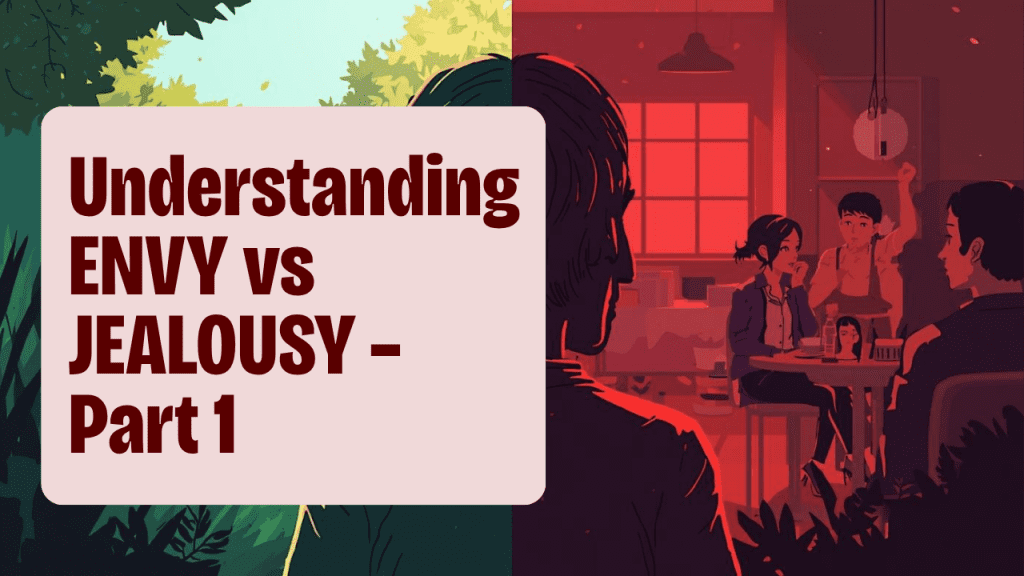
ENVY vs JEALOUSY – Part 1
In day to day usage so often these two words envy and jealousy are often used interchangeably, though it is so incorrect to do so.Both in terms of Repertory and English dictionary these two words have different meanings though they may seem confusing. The study of such closely related rubrics such as – envy vs jealousy, duty vs responsibility, reverence vs veneration, happiness vs joy etc. will help us use them properly both in terms of English language and their reportorial use as well.
Meaning of envy (noun)
Discontented longing aroused by someone else’s possessions
Meaning of envy with references in Homoeopathic literature
Resentful desire for another’s possession or advantages. A desire to achieve some prosperity or some possession, which others are, have. It is mostly positive. (Rub-App)
This is felt when a person desiring something is deprived of it and sees another person having that thing which he has longed for (FJM)
Desire to possess goods or qualities of other people. It is on material level. Jealousy is on the affective level – jealous about people. (ROS-FN)
Envy is a distressing and rather complex symptom. It combines burning desire for the thing that cannot be had with regard and a feeling of ill-will, or even hatred, for the person who has it.The coveted thing may be a material object or an abstract quality such as talent,power,honour,knowledge,glory,fortune,youth,nobility,or social standing, and so on. The envious person is constantly comparing himself with others, and this leads him to compete whenever possible with the person he envies. (ROS-FN)
Meaning of jealousy
Jealous (adjective)
- Envious of someone else’s achievements or advantages
- having a resentful suspicion that one partner is sexually attracted to or involved with someone else
- very protective of one’s right rights or possessions
Meaning of Jealousy with references in Homoeopathic literature
The uneasiness which arises from the fear of another robbing us of the love or affection of one whom we love. (FJM)
The prosperity of other is not tolerable. It is mostly negative (Rub-App)
Great care must be taken in assessing this feeling, for it is very common, which detracts from its value as symptom. Children and young couples show signs of jealousy in one way or another, and in such cases it must exist to an unusual degree before one can consider it to be true symptom. One or more of the following characteristics should always be present: – The jealousy is groundless. If a motive exists then it is not a symptom. – the feeling is intense and obsessive. – the jealousy causes feelings of suffering. – The patient is reproachful, and this leads to rows with the partner. Although there is always an element of envy in the jealous person, one should distinguish between the two feelings. (ROS-FN)
(Ask 10 different people and you might get 10 different views on how the emotions of envy and jealousy are distinct.)
It turns out that Psychologists agree on a fairly straightforward distinction.
Envy occurs when we lack a desired attribute enjoyed by another.
Jealousy occurs when something we already possess (usually a special relationship) is threatened by a third person.
And so envy is a two-person situation whereas jealousy is a three-person situation. Envy is a reaction to lacking something. Jealousy is a reaction to the threat of losing something (usually someone).
This seems straightforward, so why the confusion?
One problem is an unfortunate semantic ambiguity with the word “jealousy” (but NOT with the word “envy”). If you ask people to describe a situation in which they felt jealous, they are as likely to describe an experience of envy (e.g., “I wished I had my friend’s good looks”) as of jealousy (e.g., “my girlfriend danced with an attractive guy”). Naturally, this creates a sense that jealousy and envy are very similar—even though they are actually quite different.
Therefore, when someone says, “I’m feeling jealous,” you don’t know whether he or she is experiencing an envy situation or a jealousy situation—unless more context is provided (e.g., “I felt jealous when I saw my girlfriend dancing with the attractive guy”).
The second problem is that envy and jealousy often travel together. What kind of rival to your partner’s affections is likely to create jealousy? It is the rival with characteristics that you are likely to envy—that is, the attractive rival.
This means that when you are feeling jealous, you are often feeling envious as well.
And yet envy and jealousy are not the same emotions. Envy, as unpleasant as it can be, usually doesn’t contain a sense of betrayal and resultant outrage, for example. Jealousy need not contain an acute sense of inferiority (if the rival is not enviable). (psychologytoday.com – Richard .H. Smith, Ph.D.)
Jealousy vs Envy
Jealousy is double-edged. Neither he/she can tolerate other possessing something which he/she doesn’t possess nor can he/she tolerate others having the same thing which he/she possesses.A jealous person will remain busy in suspecting others of robbing him of his/her possessions.
Envy is spirit of competitiveness, or race for gain, to excel others without entertaining the idea of harming or destroying others possessions.
Summary /Take home message/Gist
1) Envy is a two person situation while jealousy is three person situation.
2) Envy is a feeling where there is desire for another person’s qualities or possessions. Jealousy is insecurity/possessiveness about one’s own possessions, qualities or relationships.
3) Examples
A) Mr. ABC has a posh luxury car Mr.XYZ feels he should also have such car – this is envy; while jealousy would be Mr.ABC had the best car in a residential area now Mr.XYZ has bought a superior car or just like the same one that Mr.ABC has. What Mr.ABC might be feeling now is the example of jealousy
B) A college student XXX has a pretty looking girlfriend another college student YYY feels he should also have such a girlfriend is envy, while jealousy would be if,ZZZ is getting close to XXX’s girlfriend and XXX cannot tolerate that, it gives him distress.
| Aspect | Jealousy | Envy |
| Definition | Fear of losing something you have | Wanting something someone else has |
| Focus | Involves a third part – triangular | Involves you and another person – direct |
| Emotion triggered | Possessiveness,insecurity,threat of loss | Longing,desire,comparison |
| Example emotion | “I am scared they will leave me for someone else.” | “I wish I had what they have.” |
| Positive use | Can signal care or value for a relationship | Can motivate self-improvement |
| Negative outcome | Can lead to control, mistrust or resentment | Can lead to bitterness or low self-esteem |
This was part1, In part 2 we shall study some important medicines and rubrics related to envy and jealousy.
References
- Compact Oxford dictionary
- Cambridge dictionary
- Merriam-Webster dictionary
- Perceiving rubrics of the mind by Dr.Farokh Master (FJM)
- RadarOpus software (ROS-FN)
- An Android application – Mind rubrics dictionary by Dr.Dinesh Solunke and Dr.Tushar Kolhe (Rub-app)
- Volume 4 – ROH books series by Dr.Sehgal
- Decoding mental rubrics –Dr.Gaurang Gaikwad & Dr.Rameez Chougle
- Psychology.com
- Visaliarecoverycenter.com
- Some rubrics and words explained by Dr.Narendra Gupta