Abstract:
Onychomycosis is a fungal infection affecting the fingernails and toenails, often presenting as discoloration, thickening, and fragility of the nail plate. It can become chronic and resistant to conventional therapies. This case report highlights the successful resolution of a two-year-long case of onychomycosis in a 48-year-old individual of the thumb and second finger of the right hand through individualized homeopathic treatment. The patient had previously sought conventional treatment with no lasting relief. After careful case taking and repertorization, an individualized homeopathic remedy was prescribed, resulting in significant improvement within three months and still the medicine is going on. This case underscores the potential of classical homeopathy in managing chronic dermatological conditions non-invasively.
Keywords:
Onychomycosis, Nail fungus, Homeopathy, Individualized treatment, Chronic dermatophytosis, Case report
Introduction:
Onychomycosis is a common fungal infection of the nail unit, accounting for up to 50% of all nail disorders and affecting around 10% of the global population. It is mainly caused by dermatophytes, though yeasts and non-dermatophyte molds may also be involved. Clinical features include nail discoloration, thickening, brittleness, and sometimes pain, which can impact daily life. The condition is more prevalent with increasing age and in individuals with risk factors such as diabetes, immunosuppression, poor circulation, and nail trauma.
Conventional treatments like oral terbinafine and topical ciclopirox are commonly used but have limitations, including long treatment durations, potential side effects, and high recurrence rates. These drawbacks have led to growing interest in alternative therapies.
Homeopathy, based on the principle of “like cures like,” offers a holistic approach using highly diluted natural substances to stimulate the body’s healing response. In onychomycosis, homeopathy aims to treat both the infection and underlying susceptibility. Its minimal side effects and individualized treatment approach make it appealing, especially in chronic or recurrent cases.
Given the limitations of standard therapies, further research into the effectiveness and role of homeopathy in managing onychomycosis is warranted.
CASE REPORT
This case of a 48-year-old male reported on 2 January ,2025 with complaint of Onychomycosis from 2 years, causes thickening of the nail plate, brittle nail, yellowish of the nails and sometimes there is a pain (fig-1, fig-2). he had already consulted many homoeopathic doctors but without any significant change
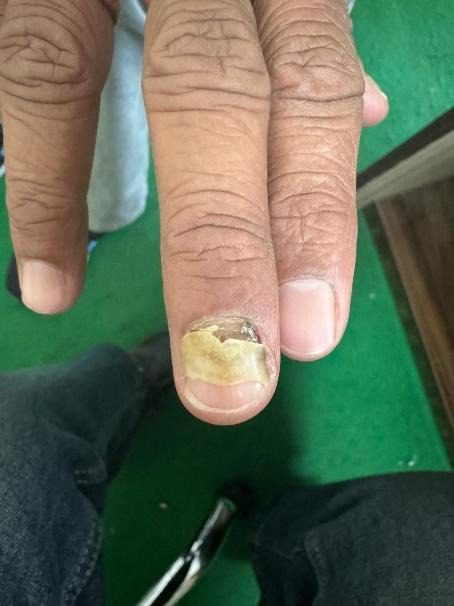
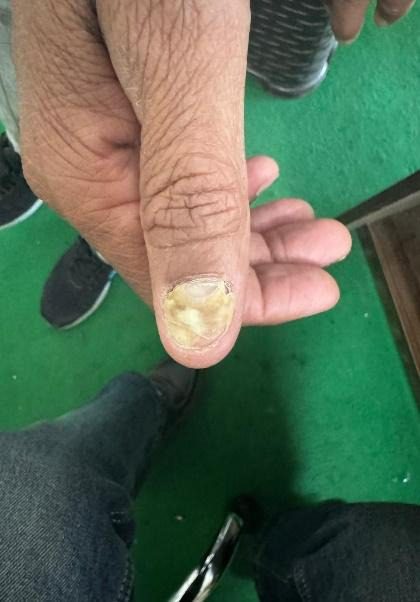
Fig-1 fig-2
History of present illness
. Yellow brittle nails
. Pain in the nails on pressing
. Thickening of the nail plate
Past illness
. Hairfall history from 2 years
. Warts on the neck
Family history
. father having rheumatism
. mother having hypertension
Treatment history
Took various treatment but without any significant change
Patient history
. Patient is non vegetarian
. Educated – MA
. Marital status- married
Physical general
. Appetite- normal appetite
. Thirst- drink 8-10 glass of water regularly
. Sleep- mind remain active even during sleep
. Stool- constipation
. Craving- for raw onion and tea desire
. Dreams – not specific
. Urine-normal
. Thermals– chilly
Mental generals
. The patient is very religious, he has extreme faith in God, and go to gurudwara twice in a day.
. When I ask him about his anger, he told that, he do not like if his family members do not listen to him or do not follow the things according to his will, he wants that every thing should be according to his way, and if someone do not follow as per his wish, then he got extreme angry.
. Very reserved in nature do not share any problem with anyone.
. Anxiety was not marked but he got anxious about his problem, that how will it get cured.

Prescription- Thuja occidentalis 200, Placebo for 15 days
Follow-Up Record
20 January 2025
- Nail complaint: Slight reduction in pain on pressing the nail. No further worsening of thickness. Yellow discoloration persists.
- Mental / generals: Patient reported slightly better sleep; though mind still remains active, less tossing and turning.
- Plan: Thuja occidentalis 200, plussing dose given (3 doses in water) + placebo for next 15 days.
5 February 2025
- Nail complaint: Noticed that edges of the nail are becoming less brittle, slight reduction in thickening at margins. Pain on pressing almost negligible.
- Mental / generals: Sleep improved, patient feels more refreshed on waking. Less anxious about his nail complaint.
- Plan: Placebo for 15 days to observe action.
22 February 2025
- Nail complaint: Yellow discoloration appears slightly faded, nail plate seems to be growing healthier from root. No pain at all.
- Mental: Anger episodes less intense; family also reports he’s calmer.
- Generals: Constipation slightly improved — reports passing stool without much strain on some days.
- Plan: Thuja occidentalis 200, single dose, followed by placebo for 15 days.
9 March 2025
- Nail complaint: New nail growth is visibly clearer. Patient himself notices it and is hopeful. Old thick portion is still present but starting to push outward.
- Mental / generals: Continues to visit Gurudwara regularly; says feels more peaceful and less irritable. Appetite and thirst are normal.
- Plan: Placebo for 15 days.
25 March 2025
- Nail complaint: About 80-90% improvement overall. The new nail is half grown out, clearer and less thick. (Fig-3, fig-4)
- Mental / generals: Sleep is now normal, no active thoughts during night. Reports feeling overall light and positive.
- Plan: Thuja occidentalis 200, single dose, then placebo for 15 days.
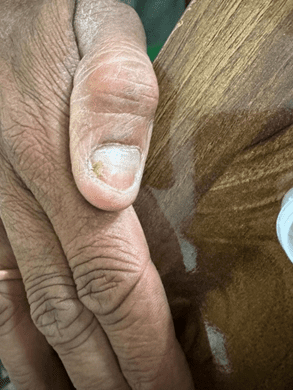
Fig-3 fig-4
11 April 2025
- Nail complaint: the nail has grown out healthy. No fragility. Mild residual yellowish streak on one side. (Fig-5, fig-6.)
- Mental / generals: Patient feels more communicative, starts discussing small personal matters which he never did before. Constipation under control.
- Plan: Placebo continued to complete observation over next few weeks.
`
Fig-5 fig-6
Discussion
This case illustrates the efficacy of individualized homeopathic treatment in managing chronic onychomycosis resistant to previous therapies. Thuja occidentalis was selected considering the patient’s constitutional and pathological symptoms. The improvement observed supports the holistic approach of classical homeopathy, which not only targets the local pathology but also strengthens the patient’s general vitality and resistance.
Conclusion
This case demonstrates the potential of individualized classical homeopathy as a safe and effective modality in treating chronic onychomycosis, even in cases unresponsive to previous treatments. Larger controlled studies are encouraged to substantiate these findings.
Patient consent
The author certifies that he has obtained appropriate consent from the patient. In the consent, the patient has given his consent for reporting his clinical information in the journal.the patient understand that his name willnot be mentioned and published, and due efforts will be made to hide his identity, but anonymity cannot be guarantee
References:
- Elewski BE. Onychomycosis: Pathogenesis, diagnosis, and management. Clin Microbiol Rev. 1998;11(3):415-429.
- Gupta AK, Paquet M. Review of current therapies for onychomycosis. J Cutan Med Surg. 2015;19(4):352-360.
- Kaliyaperumal K, Rajalakshmi V. Efficacy of individualized homoeopathic treatment in dermatological conditions: A case series. Indian J Res Homoeopathy. 2020;14(3):213–218.
- Kent JT. Lectures on Homeopathic Philosophy. B. Jain Publishers; 1997.
- National Center for Complementary and Integrative Health. Homeopathy. https://nccih.nih.gov