Smooth skin but uneven tone after acne is something most people experience, even when breakouts finally stop and the skin feels healed.
The reason lies in how the skin heals. Texture repair and pigment recovery follow different timelines and rely on separate biological mechanisms.
As a result, the surface can look healthy while colour remains patchy, dark, or red.
In this article, we will explain why tone often improves more slowly than texture, which factors prolong discolouration, and when targeted medical aesthetics treatments become necessary rather than optional.
How Surface Healing Differs From Pigment Recovery
Surface healing and pigment recovery are two very different jobs your skin has to complete after acne. One rebuilds the “surface layer” so skin feels smooth again, while the other clears leftover colour changes that can linger long after everything feels healed.
Here is an in-depth comparison to show why smooth texture can return first, while uneven tone takes longer to settle.
| What you’re noticing | Surface healing (how skin feels) | Pigment recovery (how skin looks) |
| The simple definition | The skin’s “outer wall” repairs | The leftover “stain” is still clearing |
| What you feel | Smoother, flatter, less sensitive | Feels like normal skin in most cases |
| What you see | Spots flatten and stop looking raised | Flat marks that stay red, pink, brown, or grey |
| What’s happening underneath | Barrier rebuilds and swelling settles | Pigment cells overreact to inflammation, or tiny vessels stay visible |
| Typical timeline | Often improves first within days to a few weeks | Often lingers for weeks to months, sometimes longer |
| What slows it down | Picking, harsh scrubs, ongoing breakouts | Sun, heat, irritation, repeated inflammation |
| What helps most | Gentle cleansing, moisturising, hands off | Daily SPF, calming care, pigment-safe treatments |
Why Texture Can Improve Before Colour
Texture often improves first because swelling and surface disruption are the quickest parts of acne damage for your skin to settle.
Once inflammation calms, the lesion flattens, tenderness drops, and the barrier rebuilds. That change is easy for you to feel, so you may interpret it as “healed”, even if your skin still looks uneven.
Colour lingers because pigment is not a “surface problem”. During inflammation, chemical messengers can stimulate melanocyte production of melanin, and that extra pigment can sit in the epidermis while your skin slowly turns over.
Even with healthy turnover, clearance is gradual. It often slows further if the area stays irritated, if new breakouts keep restarting inflammation, or if UV exposure keeps signalling pigment cells to stay active.
That is why you can look healed in texture but still see brown patches, grey shadowing, or persistent redness in the exact same places. Smoothness signals calmer structure. Even tone signals pigment regulation, and that process usually takes longer.
Sun Exposure and Persistent Pigmentation
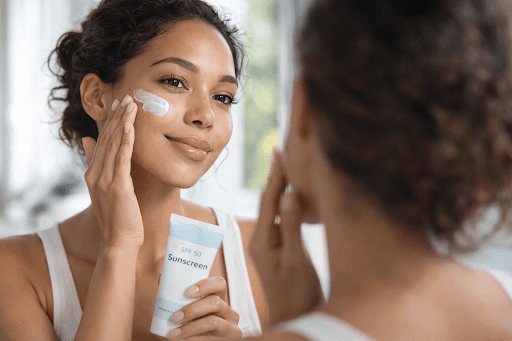
If you have smooth skin but uneven tone, sun exposure is often the reason the colour does not “catch up” to the texture. UV does not need to burn you to cause trouble. Even low-level daily exposure can keep pigment cells switched on, especially in areas that recently had inflammation.
Here is what makes it tricky. Inflammation already primes your pigment cells to produce extra melanin.
When UV and visible light hit that area, your skin interprets it as a reason to keep producing pigment, which can deepen dark marks or make them linger longer than they should. That is why pigment can look “stuck” even when the skin feels calm and smooth.
Here is how you can reduce cumulative exposure without overcomplicating your routine.
1. Apply broad-spectrum SPF every morning
Think of this as your daily baseline, not a beach-only habit. Broad-spectrum protection helps reduce the ongoing signals that keep pigment active, even on cloudy days or short errands.
2. Reapply when you are outdoors for extended periods
One morning application is rarely enough if you are outside for hours. Reapplication matters most around midday, and it is one of the simplest ways to speed up visible improvement.
3. Reduce “incidental sun” with better positioning
Small choices add up. Walk on the shaded side of the street, pick covered seating outdoors, and avoid standing in direct sun while waiting for transport.
4. Use physical barriers when exposure is unavoidable
A wide-brim hat and UV-rated sunglasses reduce direct exposure to the most pigment-prone areas, especially cheeks, temples, and under-eyes.
5. Minimise high-exposure habits around windows and driving
UVA can still reach you through glass. If you sit near windows for long stretches or drive often, that steady exposure can keep uneven tone hanging around longer than it should.
Skin Types More Prone to Dark Marks
Uneven tone after acne is not only about the breakout itself. Your baseline skin tone and how readily your skin produces melanin strongly influence whether you develop lingering dark marks, how intense they look, and how long they take to fade.
Clinically, we often describe this tendency using the Fitzpatrick Skin Type scale. It was originally designed around how skin burns or tans with sun exposure, but it is still a useful shorthand for discussing pigment behaviour after inflammation.
Fitzpatrick Skin Types (I to VI)
- Type I: Very fair skin, often with freckles. Always burns, rarely tans. Post-acne marks may look pink or red rather than brown.
- Type II: Fair skin. Usually burns, tans lightly. May get some mild brown marks, but redness is often more noticeable.
- Type III: Light to medium skin. Sometimes burns, gradually tans. Can develop both redness and brown marks, depending on irritation and sun exposure.
- Type IV: Medium to olive skin. Rarely burns, tans easily. More prone to brown post-inflammatory marks that can linger if not protected from UV.
- Type V: Brown skin. Very rarely burns, tans very easily. Higher risk of noticeable hyperpigmentation after acne, especially with picking or harsh products.
- Type VI: Deeply pigmented skin. Does not burn. Most prone to persistent dark marks after inflammation, and also more prone to rebound pigmentation from irritation.
If you sit in Types IV to VI, your best results usually come from a gentler approach:
- minimise irritation and over-exfoliation
- prioritise sun protection daily
- treat pigment steadily, rather than aggressively
When Uneven Tone Needs Targeted Treatment
Even when acne settles and your skin feels smooth, uneven tone can linger because pigment heals on a slower clock than the surface. Understanding acne scar vs hyperpigmentation helps explain why skin can feel smooth yet still appear uneven in tone.
Targeted treatment becomes useful when you have done the basics consistently and the colour still will not budge. That typically means breakouts are controlled, you have stopped picking, and you have worn daily SPF long enough to judge change.
Consider professional support if marks remain obvious after eight to twelve weeks, if they darken with irritation or heat, or if you keep breaking out in the same zones and creating pigment. In medical aesthetics, the aim is to calm inflammation, regulate pigment, and increase turnover without triggering rebound darkening.
Conclusion
If you are dealing with smooth skin but uneven tone after acne, you are not imagining things. Texture and colour recover on different timelines for valid biological reasons.
Surface healing can finish quickly, while pigment regulation continues quietly in the background. That delay makes skin look “stuck” even when it feels fine.
When you match treatment to the cause, you reduce irritation, avoid wasted effort, and see steadier progress. Consistency beats intensity with pigment issues.
If uneven tone persists despite good basics, targeted medical aesthetics support can help you move from slow improvement to predictable results.