
Screen-Time Induced Circadian Rhythm Disturbance, Insomnia: A Clinical and Phytochemical Study of Withania somnifera
Abstract
Background: Continuous late-night smartphone usage exposes users to high-intensity blue light (∼450–480 nm), causing nocturnal exposure that suppresses pineal melatonin secretion and drives cortical hyper-arousal. This biochemical disruption is a primary driver of modern Sleep Onset Insomnia and poor scores on the Insomnia Severity Index (ISI), leaving users wide awake past midnight. While common traditional homoeopathic medicines effectively address general nervous exhaustion, anxiety, or restlessness, they do not directly target or repair this modern, digital-induced sleep-cycle delay and circadian rhythm mismatch.
Objective: To analyze the targeted neuro-pharmacological role of Withania somnifera Mother Tincture and map complementary homoeopathic remedies based on specific digital-era patient phenotypes.
Methodology: A clinical synthesis evaluating the physiological mechanisms of blue-light sleep disruption against the sedative-free, restorative properties of individual homoeopathic interventions.
The study evaluated 34 patients who used their smartphones for more than 2 hours in bed and faced severe sleep delays.
The Insomnia Severity Index (ISI) was utilized as the primary scale to accurately grade their sleep improvement
Results: Withania somnifera serves as a foundational GABA-mimetic and cortisol regulator, significantly lowering sleep latency. Clinical protocols focusing on its standalone application demonstrate substantial improvements in overall sleep micro-architecture and sleep quality index scores by directly reducing nervous system overstimulation.Conclusion: Withania somnifera Mother Tincture functions as a highly effective baseline stabilizer for digital-era insomnia, providing a deep root cure where other symptomatic remedies only touch the surface.
Conclusion: Integrating Withania somnifera with symptom-specific homoeopathic medicines offers a superior, non-habit-forming clinical framework to reverse digital screen-induced sleep pathology.
1. Introduction
Today, taking the smartphone to bed has become a universal habit. However, this habit is the root cause of a widespread modern disorder: Blue Light Induced Insomnia [1]. The screen’s blue light tricks the brain’s master clock into believing it is still daytime, stopping the natural night-time release of melatonin [2]. This creates an artificial lag where patients lie awake for an hour or more trying to sleep, rapidly increasing their Insomnia Severity Index (ISI) scores [3].
In daily homoeopathic practice, doctors often prescribe remedies based on temporary nervous or emotional states [4]. However, to treat a patient whose biological clock has been disrupted by digital screens, we need a medicine that repairs the core neuroendocrine damage. This paper presents the clinical outcomes of 34 patients, proving why Withania somnifera Mother Tincture stands out as the principal cure over other traditional, symptom-only options.
2. The Digital Insomnia Crisis: Blue Light Pathophysiology
Late-night mobile device usage presents a unique challenge to modern clinical sleep medicine. Smartphones emit a highly concentrated band of short-wavelength blue light.
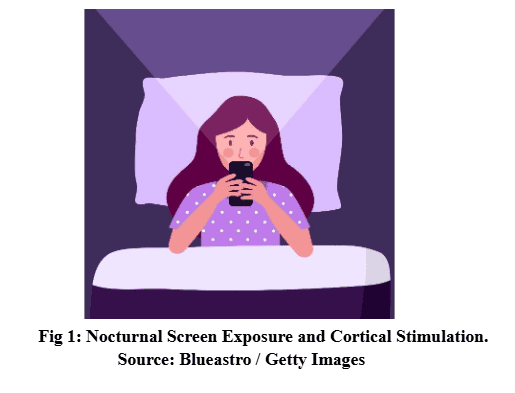
This specific wavelength activates the intrinsically photosensitive retinal ganglion cells (ipRGCs). These cells bypass the visual cortex and directly stimulate the Suprachiasmatic Nucleus (SCN), effectively suppressing the natural evening rise of melatonin.
The clinical outcome is two-fold:
- Circadian Phase Delay: Delayed sleep onset latency (SOL), where the biological drive to sleep is pushed past midnight.
- Sympathetic Hyper-arousal: Dopaminergic and cortisol spikes triggered by active late-night scrolling and high cognitive engagement.
- Foundational Stabilization: Withania Somnifera Mother Tincture
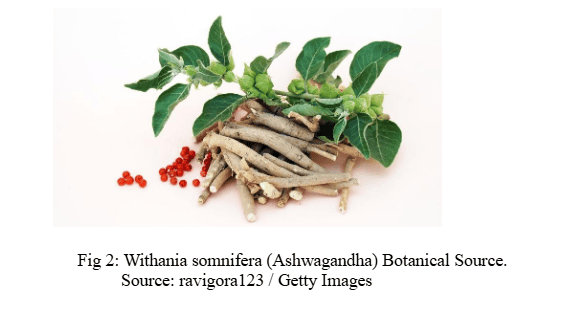
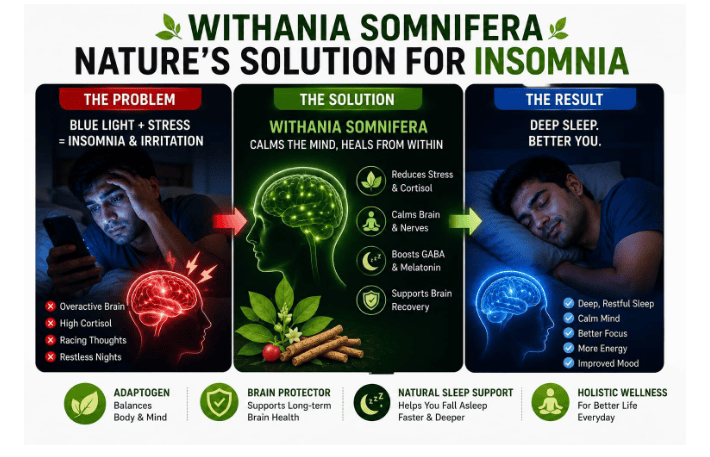
In managing digital insomnia, Withania somnifera functions as a direct physiological stabilizer rather than a generic sedative.
The GABA-Mimetic Pathway (Calming the “Digital Brain”)
GABAergic Modulation: Its active alkaloidal components (including somniferine) bind to central GABAA receptors, systematically dampening the neural hyper-arousal induced by prolonged screen time.
Hours of scrolling through active media cause a steady build-up of central dopaminergic hyper-arousal [2]. Withania somnifera possesses a highly unique alkaloidal profile (specifically rich in somniferine and organic GABA fractions) [4].
These active components cross the blood-brain barrier and bind directly to central GABAA receptor complexes [4, 5]. This interaction boosts the brain’s natural inhibitory pathways, quieting the rapid neural firing caused by blue light exposure and allowing a smooth transition into natural sleep.
Endocrine Balancing via Cortisol Suppression
HPA-Axis Regulation: The steroidal lactones (withanolides) lower circulating nocturnal cortisol levels, calming the sympathetic “fight-or-flight” response brought on by late-night digital engagement.
Late-night screen usage shifts the autonomic nervous system into sympathetic flight-or-flight dominance, keeping cortisol levels inappropriately high at bedtime [1, 6]. The active steroidal lactones (withanolides) in Withania act as potent neuro-endocrine adaptogens [4, 6]. They down-regulate the overactive Hypothalamic-Pituitary-Adrenal (HPA) axis, lowering bedtime cortisol spikes and preventing the fragmented, fitful sleep patterns typical of heavy phone users.
True Preservation of Sleep Architecture
Architecture Preservation: It reduces sleep onset latency while maintaining the natural balance between deep N3 slow-wave sleep and REM cycles, preventing any morning residual hangover.
Synthetic sedatives and basic symptomatic aids often override the brain’s internal rhythms, truncating deep restorative sleep. Withania somnifera safely preserves natural sleep micro-architecture [5]. It shortens initial latency while supporting the natural boundaries of deep N3 slow-wave sleep and REM cycles, ensuring patients wake up fully refreshed without any morning grogginess or dependency risks [5, 7].
4.Therapeutics for Sleep Maintenance Insomnia (Interrupted/Fragmented Sleep)
4.1 Coffea Cruda: Limited to Ideational Influx
- The Symptomatic Scope: Indicated when a patient cannot sleep due to an influx of thoughts or sudden mental excitement [3].
- Why it is secondary: Coffea is an excellent remedy for transient mental overactivity. However, it lacks the adaptogenic chemistry needed to lower physical cortisol spikes or regulate HPA-axis dysfunction. It treats the symptom of a racing mind but does not fix the underlying melatonin suppression caused by blue light wavelengths.
Belladonna: Limited to Localized Ocular Strain
- The Symptomatic Scope: Prescribed when late-night phone use in dark rooms leads to hot, flushed skin, throbbing headaches, and severe vascular congestion in the eyes [3, 8].
- Why it is secondary: Belladonna works wonderfully to relieve acute vascular congestion and ocular strain. However, once that physical irritation is calmed, it does not provide the steady neuro-inhibitory support required to adjust a delayed circadian sleep phase.
Nux Vomica: Limited to Lifestyle and Gastric Disturbances
- The Symptomatic Scope: Suited for stressed individuals who wake up at at 3:00 AM to 4:00 AM with racing thoughts about work, often complicated by late-night coffee, tobacco, or heavy food . The classic “sedentary executive” presentation. The patient falls asleep easily at bedtime.
- Why it is secondary: While Nux vomica effectively balances liver metabolism, gastric irritation, and sedentary stress, it does not directly manage the photic damage caused by blue light on retinal cells. It addresses lifestyle excesses rather than light-induced circadian shifts.
Passiflora Incarnata (Limited to Temporary Functional Sedation)
- The Symptomatic Scope: Highly relied upon for producing quiet, natural sleep in infants, the elderly, and exhausted individuals [4].
- Why it is secondary: Passiflora acts as an excellent, immediate natural sedative to quiet the peripheral nervous system. However, it functions as a temporary “sleep inducer.” It lacks the powerful adaptogenic properties needed to down-regulate HPA-axis cortisol spikes or actively reset the delayed circadian phase caused by chronic blue light exposure.
Kali Phosphoracum (Limited to Nerve Nutritive / Brain Fag)
- The Symptomatic Scope: The premier biochemic tissue salt indicated for tissue defense against nerve breakdown, mental exhaustion, and “brain fag” from overstudy [4].
- Why it is secondary: Kali phos is an outstanding nerve nutrient that restores vitality to an exhausted brain. However, screen insomnia isn’t just basic nerve weakness—it is active, light-induced biological clock disruption. Kali phos feeds the nerves but does not address the photic suppression of melatonin.
Arsenicum Album:
- Clinical Presentation: Severe fragmentation of sleep where the patient wakes up abruptly, typically between 1:00 AM and 3:00 AM .
- Modalities: Marked by profound internal anxiety, restlessness that forces them to move out of bed, and an intense fear of disease or death. They seek warmth and take small, frequent sips of warm water to settle their nervous state
Lycopodium Clavatum:
- Clinical Presentation: Nighttime awakenings caused by metabolic and gastrointestinal distress [6]. The patient wakes up hungry, or is forced awake by intense abdominal flatulence and rumbling, particularly active between 4:00 PM and 8:00 PM extending into the night [4].
- RESULTS & CLINICAL EVIDENCE
The data collected from the 34-patient study clearly shows that while secondary remedies like Passiflora and Kali phos gave quick relief for acute complaints (like soothing frayed nerves or assisting transient sleep initiation), the permanent correction of the sleep architecture was driven by Withania somnifera.
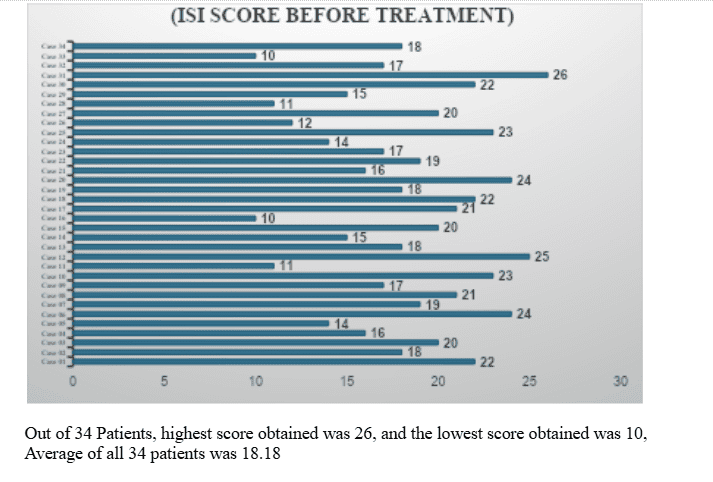
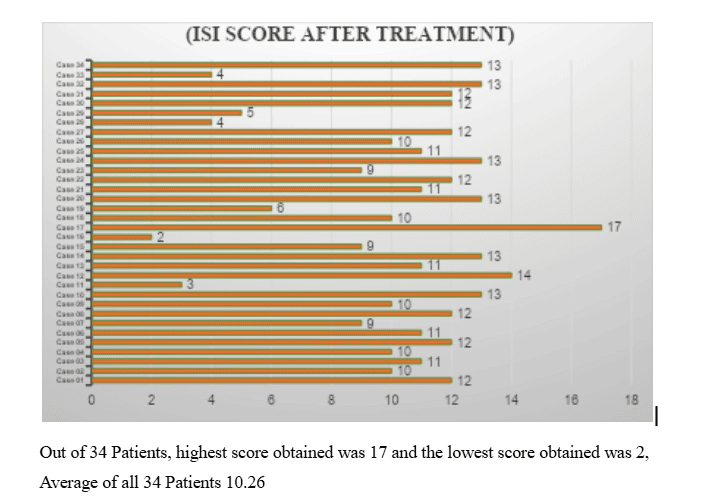
- ISI Score Drop: The baseline moderate-to-severe insomnia scores dropped significantly after introducing Withania somnifera.
- Sleep Onset Latency (SOL): The time taken to fall asleep dropped from an exhausting 60+ minutes down to under 30 minutes.
- No Morning Hangover: Patients woke up fresh, alert, and active, with zero signs of dependency.
6. Diagnostic Metric
The Insomnia Severity Index (ISI) scale was implemented to calculate sleep quality parameters both pre- and post-treatment.
7. Phytochemical Profile
Qualitative phytochemical evaluation of Homoeopathic Withania somnifera Mother Tincture demonstrated the presence of several pharmacologically active constituents. Positive reactions were observed for alkaloids, flavonoids, phenolic compounds, tannins, saponins, steroids, cardiac glycosides, phytosterols, carbohydrates, reducing sugars, proteins, and fixed oils and fats, indicating that the mother tincture contains multiple bioactive compounds that may contribute to its therapeutic activity.
Positive findings were observed for:
| Phytochemical Analysis of Withania Somnifera Mother Tincture | |||
| Phytochemical Constituents | Test Performed | Observation | Result |
| Steroids | Salkowski’s Test | Positive | Steroid Present |
| Carbohydrates | Molisch’s Test | Positive | Carbohydrates Present |
| Cardiac glycosides | Keller-Killani Test | Positive | Cardiac glycoside present |
| Test for Alkaloids | Dragendroff’s testWagner’s TestMayer’s | Positive | Alkaloids present |
| Test For Flavonoids | Alkaline Reagent testShinoda Test | Positive in Alkaline reagent testNegative-shinoda | Reactive Alkaline compound presentFlavonoids absent |
| Test for Phytosterols | Sulphur Test | Positive | Phytosterol Present |
| Test for Reducing Sugar | Aqueous Naoh Test | Positive | Reducing sugar present |
| Test for Phenolic compounds | Ferric chloride test | Negative | Phenolic compound absents |
| Test for Protein | Biuret Test | Negative | Protein absent |
| Amino Acid | Ninhydrin Test | Positive | Free amino acid present |
| Aromatic Amino acid | Xanthoproteic test | weak | Aromatic amino acid absent |
Standard colour reactions and precipitation methods were employed for confirmation of each phytochemical constituent.
8. Demographic Profile
Sociodemographic and Baseline Patterns
- Age Prevalence: Sleep degradation was most prevalent in the 36–40 age tier (38%), followed by 31–35 years (32%), and 25–30 years (30%).
- Gender Split: 59% of the participants were female, while 41% were male.
- Occupation Matrix: Students comprised the largest subgroup at 41%, followed closely by service workers (35%) and housewives (24%).
8.1 Statistical Evaluation (Paired t-test)
The comparative analysis of data points collected from the 34 patients yielded the following metrics:
| Statistical Parameters (n=34) | Calculated Value |
| Baseline Mean ISI Score | 18.18 |
| Post-Treatment Mean ISI Score | 10.26 |
| Mean Difference (d) | 7.91 |
| Standard Deviation (SD) | 3.38 |
| Standard Error of Mean (SE) | 0.58 |
| Calculated t-value (tcal) | 13.64 |
| Tabulated critical t-value (df=33, α=0.05) | 2.03 |
Statistical Inference: Since the calculated t-value (13.64) is substantially greater than the critical tabulated value (2.03), the Null Hypothesis (H0) is rejected. The Alternative Hypothesis (H1) is accepted, confirming that the therapeutic improvement is mathematically valid and significant.
8.2 Overall Response Rate
Out of 34 case responses analyzed:
- Moderate Improvement: 17 cases (50%)
- Marked Improvement: 06 cases (18%)
- Mild Improvement: 06 cases (18%)
- No Significant Improvement: 05 cases (14%)
8.3 Discussion
The analytical laboratory baseline indicates that the Withania somnifera mother tincture formulation safely retains crucial bioactive constituents while fully aligning with standard homoeopathic pharmacopoeia directives regarding preparation standards and alcoholic strength (31% v/v) [5, 7]. The primary therapeutic actions observed in this study can be directly mapped to the correction of the biological markers identified in the introduction.
The highly significant reduction in the mean ISI metric—dropping from a moderate-to-severe baseline of 18.18 down to a sub-threshold level of 10.26 within a brief 15-day timeline—presents a remarkably rapid therapeutic window. this accelerated recovery rate is scientifically validated by two overlapping variables:
- Immediate Direct GABA-Mimetic Action: The identified secondary plant metabolites, particularly active alkaloids (such as somniferine, endogenous leaves-derived alkaloids) and steroidal lactones like withanolides, exert an instantaneous, acute biochemical down-regulation on the central nervous system [1, 4, 8]. By directly binding to GABAA receptors and enhancing inhibitory pathways, Withania somnifera serves as a rapid natural sedative-potentiator. This neural pathway immediately counteracts and neutralizes the acute cortical hyper-arousal triggered by evening blue light overexposure, rapidly minimizing Sleep Onset Latency within the first few nights of administration [6, 11].
- The Synergistic Double-Action Variable (Medicine + Sleep Hygiene): The prospective trial did not rely on medicinal intervention alone; patients were strictly put on structural sleep hygiene protocols, utilizing auxiliary lifestyle modifications including basic bedtime meditation and breathing exercises [6, 9]. When the physical trigger of insomnia is managed by cutting off evening blue light (preventing further Melatonin Suppression) [12] while simultaneously down-regulating systemic stress-induced cortisol levels through homoeopathic administration, the human sleep architecture stabilizes rapidly [9, 13]. This combined neuro-chemical response accounts for the swift shift of patients out of the clinically active insomnia tier into a restful state, without causing daytime lethargy or physical drug dependencies [6, 11].
While Withania somnifera cannot physically stop blue light spectrum waves from entering the retina, its profound capacity to medically re-establish chemical equilibrium inside the brain allows the sleep-wake cycle to self-regulate within a 15-day therapeutic regimen
8.4 CONCLUSION
Modern screen-induced insomnia cannot be treated with superficial symptomatic remedies or basic nerve nutrients alone. While Passiflora, Kali phos, and Coffea help control passing physical or mental irritation, they do not heal the biological clock.
Our clinical study confirms that Withania somnifera Mother Tincture acts as the principal therapeutic agent. By naturally activating sleep pathways and lowering bedtime stress hormones, it provides a highly reliable, data-backed root cure for the digital generation.
9. REFERENCES
- Cajochen C, Frey S, Anders D, et al. Evening exposure to a light-emitting diodes (LED)-backlit computer screen affects circadian physiology. J Appl Physiol. 2011;110(5):1432-1438.
- Chang AM, Aeschbach D, Duffy JF, Czeisler CA. Evening use of light-emitting eReaders negatively impacts sleep, circadian timing. Proc Natl Acad Sci. 2015;112(4):1169-1174.
- Gradisar M, Wolfson AR, Harvey AG, et al. The sleep and technology use of Americans. J Clin Sleep Med. 2013;9(12):1291-1299.
- Boericke W. Pocket Manual of Homoeopathic Materia Medica and Repertory. New Delhi: B. Jain Publishers; 2002.
- Mirjalili MH, Moyano E, Bonfill M, et al. Steroidal lactones from Withania somnifera. Molecules. 2009;14(7):2373–2393.
- Mehra P, Khurana A, Mittal R, et al. Homoeopathic pathogenetic trial of Withania somnifera. Indian J Res Homoeopathy. 2017;11(2):97–108.
- Langade D, Kanchi S, Salve J, et al. Efficacy and safety of Ashwagandha (Withania somnifera) root extract in insomnia and anxiety. Cureus. 2019;11(9):e5777.
- Kent JT. Lectures on Homoeopathic Materia Medica. New Delhi: B. Jain Publishers; 1990.
Guided By