Abstract:
Background: Eczema, or atopic dermatitis, is a chronic inflammatory skin disorder characterized by itching, redness, and dryness. Conventional treatments often provide symptomatic relief but may lead to side effects or dependency. Homeopathy, a holistic system of medicine, offers individualized remedies that aim to address the root cause of the disease while minimizing adverse effects.
Objective: This study aims to evaluate the effectiveness of individualized homeopathic remedies in the management of eczema and to assess improvements in symptoms, quality of life, and recurrence rate.
Keywords: Eczema, Atopic Dermatitis, Homeopathy, Individualized Medicine,Petroleum,Chronic Skin Disease.
Introduction:
Eczema, or atopic dermatitis, is the most common form of dermatitis.Many factors, including genetic and environmental factors, are thought to play a part in the pathogenesis of eczema. It is most commonly seen in children but can be seen in adults as well. People with eczema tend to have dry, itchy skin prone to infection. The condition is commonly known as the “itch that rashes” because dry, itchy skin leads to a rash due to scratching or rubbing the skin.
Etiology:
The exact etiology of eczema is not entirely understood, but it is believed to be a combination of genetic and environmental factors.
Genetic Factors
There is a strong genetic component to eczema, with a family history of eczema, asthma, or allergies commonly found in affected individuals. Several genes associated with eczema have been identified, including those involved in the skin barrier function and the immune system.
Filaggrin Gene
One of the most well-known genes associated with eczema is the filaggrin gene (FLG). This gene provides instructions for making a protein called filaggrin, which is important in maintaining the skin barrier function. Mutations in this gene have been linked to eczema and other skin conditions and are thought to increase susceptibility to environmental irritants and allergens.
Environmental Factors
Environmental factors also play a role in the development of eczema. Patients with eczema have a defect in their skin barrier function, leading to increased water loss and susceptibility to environmental irritants and allergens. Common triggers for eczema flares include exposure to irritants such as detergents, soaps, solvents, and allergens such as dust mites, pet dander, and certain foods. Other factors that can exacerbate eczema symptoms include stress, changes in temperature and humidity, and infections.
Immune System Activation
In addition to genetic and environmental factors, the immune system is also thought to play a role in the development of eczema. Patients with eczema have an overactive immune response to environmental triggers, leading to inflammation and skin damage.
Epidemiology:
The lifetime prevalence of eczema is about 15% to 30% in children and 2% to 10% in adults. About 60% of cases will develop the disease within the first year of life. The prevalence of eczema is more common in rural areas than in urban ones. This incidence emphasizes the link between lifestyle and environmental factors in the mechanisms of AD.
Symptoms:
Atopic dermatitis (eczema) symptoms can appear anywhere on the body and vary widely from person to person. They may include: Dry, cracked skin,Itchiness (pruritus),Rash on swollen skin that varies in color depending on your skin color,Small, raised bumps, on brown or Black skin,Oozing and crusting,Thickened skin, Darkening of the skin around the eyes,Raw, sensitive skin from scratching.
Differential Diagnosis:
The differential diagnosis for eczema includes many eczematous dermatitides, including: Contact dermatitis, Cutaneous fungal infections, Seborrheic dermatitis, Drug eruptions, Scabies, Psoriasis,Ectodermal dysplasia ,Hyper-IgE syndrome.
Presenting complaint:
A 50-year old female visited our OPD at Govt Homoeopathic medical college and hospital,Bhopal(M.P.) on 06 Feb 2024, experiencing dry,itchy patches/ rash on her skin particularly on left forearm and arm from past 8 months. Dryness started few months back with itchy skin and burning
especially at night and which is worse in winter.
Location: left forearm and arm
Sensation: burning after scratching.Modalities:
Aggravation: at night and in winters.
Amelioration: Temporary relief by scratching.
Concomitant: right side paresis
Duration: 8 months
History of present complaint:
Onset: slow
Treatment adopted: allopathic
Result: mild relief
Past history: DM -ll, Right sided paresis.
Personal history:
Mind and disposition: irritable,quarrelsome and easily offended by little trifles.
Physical generals:
Diet : vegetarian and non vegetarian
Desire : salty things
Aversion: fatty food
Tongue: dry
Taste: No altered taste as mention
Salivation: profuse
Perspiration: foul smelling
Stool: normal bowel movement.
Urine: passes urine 2-3 times/ hours
Bathing: regular
Covering: Not specific
Dwelling place: well ventilated
Habits /Addiction: no
Tobacco: yes occasionally
Coffee / tea: tea drinker
Drugs etc: no
Thermal reaction: HOT
Skin: dry and rough
Sleep: disturb due to burning, itching.
Dreams: forget
Gynaecological history:
Menarche: 13yrs of age
Period: 28 -29days of cycle
Menopause: 48yrs of age
Obstetrical history:
Pregnancy: 3
Labour : 3
Delivery: 3
Abortion: 0
Clinical findings:
Anaemia: present
Pulse: 74bpm
BP: 110/70 mm hg
Provisional diagnosis:
Eczema?
Dominant miasm: Psora , syphilis
Repertorial Analysis:
1 MIND – IRRITABILITY
2 MIND – QUARRELSOME -morning
3 MIND – RESTLESSNESS – night
4 SKIN – ERUPTIONS – dry – bleeding scratching; after
5 SKIN – ERUPTIONS – eczema
6 SKIN – ERUPTIONS – eczema -winter agg.
7 SKIN – ERUPTIONS – syphilitic
8 SKIN – ERUPTIONS – vesicular
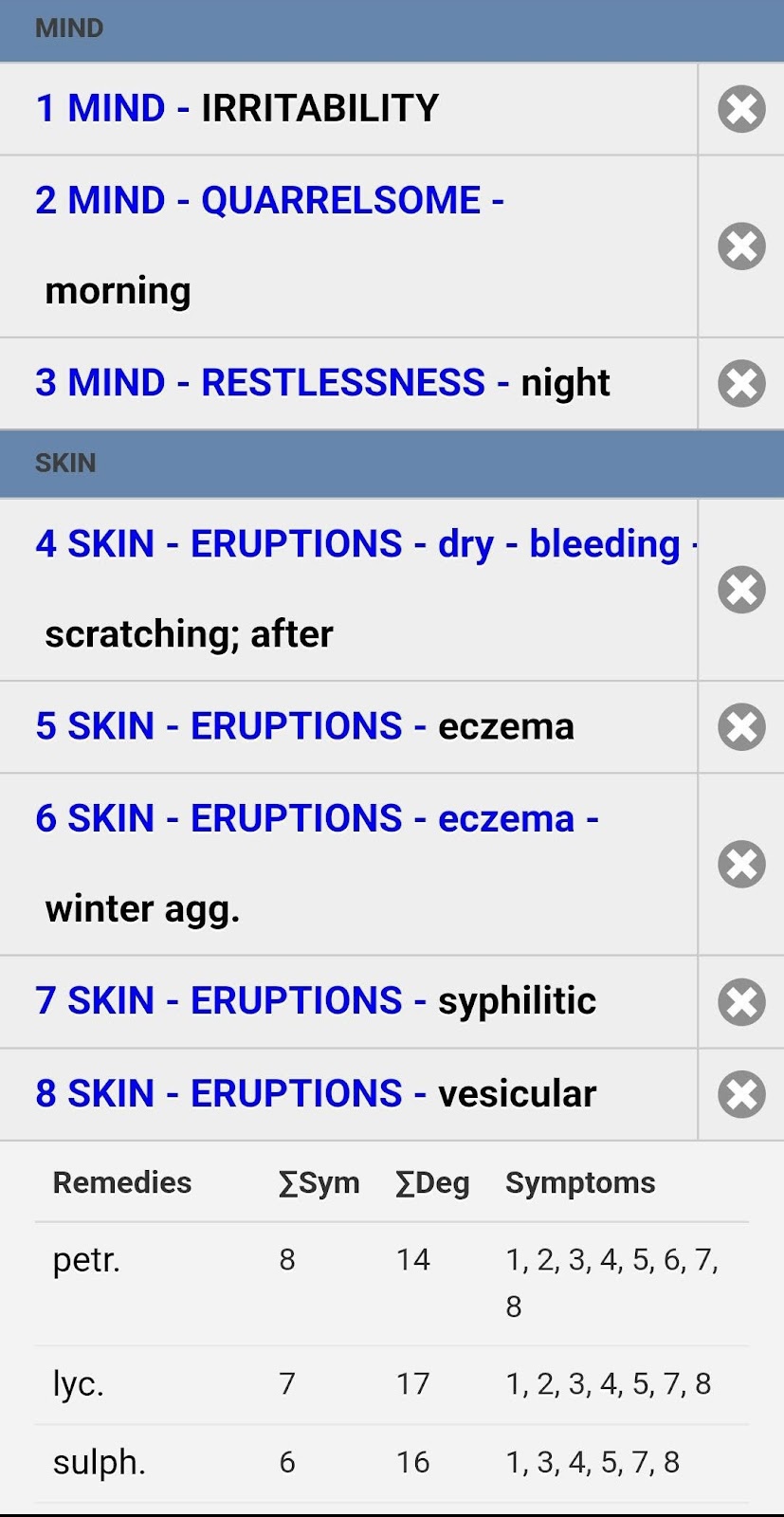
Prescription:-
Date:- 06/02/24
Rx: Petroleum 200/ OD/ 3 doses
For 3 days.
1st follow up: 29/02/24
Itching and burning was reduced and no new eruptions appeared.
Rx: Rubrum 200/BD/ 10days.
2nd follow up: 12/03/24
The patient was improved.
No new complaint appeared.
But mild itches with few eruptions were left.
Rx: Petroleum 200/OD/ 2 doses
For 2 days.
3rd follow up: 01/04/24
The patient improved.
Itching and eruptions subsided.
No new complaints were seen.

DECLARATION OF PATIENT CONSENT – Patient’s consent was taken for image and clinical information to be reported for this article.
Conclusion -This case is one of the evidence-based documented research studies, that shows effectiveness of homoeopathic treatment not only in relieving the symptoms of Eczema, but also in bringing favourable changes in pathology as evident in the investigations. Thus, this study is the classical example of the holistic approach of homoeopathy.
Bibliography:
1. Kantor R, Thyssen JP, Paller AS, Silverberg JI. Atopic dermatitis, atopic eczema, or eczema? A systematic review, meta-analysis, and recommendation for uniform use of ‘atopic dermatitis’. Allergy. 2016 Oct;71(10):1480-5. [PMC free article] [PubMed]
2.Brown SJ. Molecular mechanisms in atopic eczema: insights gained from genetic studies. J Pathol. 2017 Jan;241(2):140-145. [PubMed].
3.Drislane C, Irvine AD. The role of filaggrin in atopic dermatitis and allergic disease. Ann Allergy Asthma Immunol. 2020 Jan;124(1):36-43. [PubMed]
4.Rice NE, Patel BD, Lang IA, Kumari M, Frayling TM, Murray A, Melzer D. Filaggrin gene mutations are associated with asthma and eczema in later life. J Allergy Clin Immunol. 2008 Oct;122(4):834-836. [PMC free article] [PubMed]
5. Nemeth V, Syed HA, Evans J. Eczema. [Updated 2024 Mar 1]. In: StatPearls [Internet]. Treasure Island (FL): StatPearls Publishing; 2025 Jan-. Available from: https://www.ncbi.nlm.nih.gov/books/NBK538209/
6. Kim JP, Chao LX, Simpson EL, Silverberg JI. Persistence of atopic dermatitis (AD): A systematic review and meta-analysis. J Am Acad Dermatol. 2016 Oct;75(4):681- 687.e11. [PMC free article] [PubMed]
7.Boericke, W., & Boericke, O. E. (1990). Homoeopathic materia medica with repertory comprising the characteristic and guiding symptoms of the remedies (R. B. Savage, Ed.;2nd ed.). Homoeopathic Book Service.
AUTHOR
DR ADITI TIWARI – MD scholar, Department of homoeopathic materia medica, Govt. homoeopathic medical college and hospital. Bhopal ,Madhya Pradesh.
UNDER THE GUIDANCE
DR SHOBHANA SHUKLA, HOD and Professor of homoeopathic materia medica, Govt. homoeopathic medical college and hospital. Bhopal , Madhya Pradesh.