Abstract
Dermatophytes are fungi that infect skin, hair, and nails and include members of the genera Trichophyton, Microsporum, and Epidermophyton. Infection with these organism are common.
About 20–25% of the world’s population is estimated to be affected at any given time.
This condition can be managed by Homoeopathic medicines.There are various remedies which cover this condition.Also various repertories have rubrics for this condition.
In this article an attempt has been made to describe the clinical aspect of this condition along with homoeopathic approach.
Keywords-Homoeopathy ,Dermatophytosis, Skin Disease
Introduction
Dermatophytes are fungi that infect skin, hair, and nails and include members of the genera Trichophyton, Microsporum, and Epidermophyton.
Tinea corporis, or infection of the relatively hairless skin of the body (glabrous skin), may have a variable appearance depending on the extent of the associated inflammatory reaction.
Dermatophytes are capable of infecting keratinized tissue
These include-
- Trichophyton species-infects the skin hair and nails
- Microsporum species-infects skin and hair
- Epidermophyton species-infects skin and nail
ICD 11 Classification
1F28
- Dermatophytosis Scalp-1F28.0
- Dermatophytosis Nail-1F28.1
- Dermatophytosis Foot-1F28.2
- Genitocrural Dermatophytosis-1F28.3
- Kerion-1f28.4
- Disseminated dermatophytosis-1f28.5
- Other specified-1F28.Y
- Dermatophytosis , unspecified-1F28.Z
Prevalence
- Global prevalence
About 20–25% of the world’s population is estimated to be affected at any given time.
Higher prevalence is seen in tropical and subtropical regions due to heat and humidity.
- Regional variations
In Asia, especially India, dermatophytosis is highly prevalent and often recurrent.
In some rural communities in Africa and South America, prevalence can exceed 30%.
In developed countries, prevalence is lower but still significant, especially among athletes (tinea pedis, tinea corporis).
- Factors influencing prevalence
Climate (warm and humid)
Overcrowding and poor hygiene
Frequent use of occlusive footwear
Close contact in communal living spaces (e.g., hostels, military camps)
Immunocompromised states (diabetes, HIV)
Age & gender
More common in children (e.g., tinea capitis).
In adults, tinea pedis and tinea cruris are more common, especially in men.
- Major risk groups: Children, athletes, people in close-contact settings, diabetics
Transmission
- DIRECT CONTACT-with infected individuals
- INDIRECT CONTACT-Fomites are any objects that are contaminated with infectious agent-clothes , grooming supplies , beddings
Clinical presentation
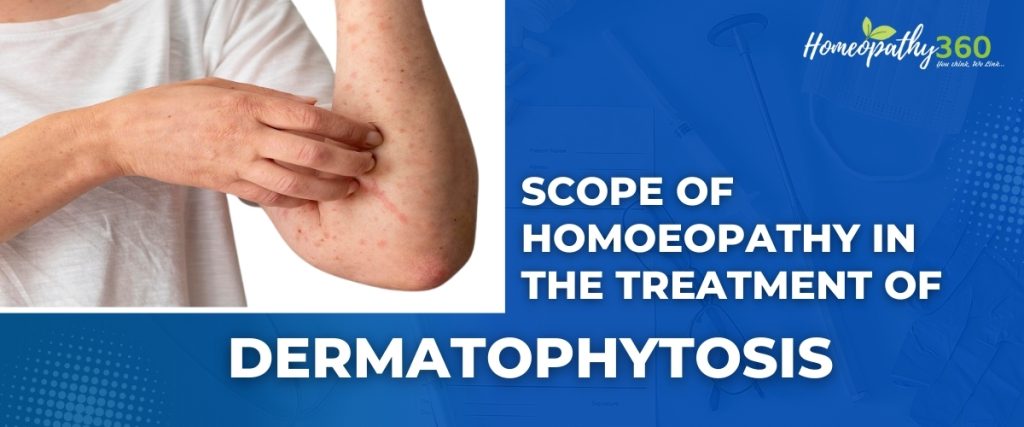
- Typical infections present as erythematous, scaly plaques, with an annular (ring-like) appearance, hence the name “ringworm.”
- Deep inflammatory nodules or granulomas may occur, especially in cases inappropriately treated with mid- to high-potency topical glucocorticoids.
- Groin involvement (tinea cruris):
More common in males than females.
Presents as scaling, erythematous eruption sparing the scrotum.
- Foot infection (tinea pedis):
Most common dermatophyte infection.
Can become chronic.
Characterized by variable erythema, edema, scaling, pruritus, and occasionally vesiculation.
Often involves web spaces between the fourth and fifth toes.
- Nail infection (tinea unguium/onychomycosis):
Common in patients with tinea pedis.
Nails become opacified, thickened, and have subungual debris.
The infection may be localized or widespread, depending on severity and site. Proximal subungual onychomycosis may be a marker for HIV infection or other immunocompromised states.
- Tinea capitis (scalp infection)
Common in children, especially inner-city children, but can also affect adults.
Predominantly caused by Trichophyton tonsurans.
Can produce a relatively noninflammatory infection, with:
Mild scaling.
Diffuse or localized hair loss.
- Inflammatory variants
T. tonsurans and Microsporum canis can cause markedly inflammatory dermatosis.
Features include edema and nodules.
The severely inflammatory presentation is called a kerion.
The diagnosis of tinea can be made from skin scrapings, nail scrap ings, or hair by culture or direct microscopic examination with KOH. Nail clippings may be sent for histologic examination with periodic acid–Schiff (PAS) stain.
Quality of life
Dermatophytosis, though a superficial fungal infection, has a significant negative impact on patients’ quality of life (QoL).
- Physical Effects
Severe itching causes discomfort and interferes with sleep.
Pain and secondary bacterial infections can occur due to scratching.
Difficulty in performing daily activities, especially if lesions are on hands or feet.
- Psychological and Emotional Effects
Patients often feel embarrassed or ashamed, particularly if lesions are on visible body parts.
Low self-esteem and anxiety about appearance and social acceptance.
Chronic and recurrent nature of infection leads to frustration and mental distress.
- Social and Occupational Effects
Avoidance of social gatherings or close physical contact due to fear of stigma and transmission.
Possible absenteeism and reduced productivity at work.
Financial burden due to long treatment courses and recurrences.
Overall Impact
Studies using tools like the Dermatology Life Quality Index (DLQI) have shown that dermatophytosis patients often experience moderate to severe QoL impairment, comparable to chronic dermatoses like psoriasis or eczema.
Homoeopathic Approach
REPERTORY OF THE HOMOEOPATHIC MATERIA MEDICA-J T KENT
SKIN-Eruptions, ringworm
SKIN-Eruptions, herpetic
SKIN-Eruptions, herpetic, circinate
SKIN-Eruptions, herpetic, itching
SKIN-Eruptions, herpetic, patches
ABDOMEN-Eruptions, herpes
ABDOMEN-Eruptions, herpes, ringworm
BOGER BOENNINGHAUSEN’S CHARACTERISTICS AND REPERTORY-C M BOGER
RINGWORM(Tetter)
Tetter-in general
burning
chapped
circular
Itching
Ringworm
BOERICK’S REPERTORY
- HERPES(tetter)
- Herpes , circinatus , tonsurans(Trichophytosis)
- Herpes , circinatus ,in isolated spots
- Herpes , circinatus ,in intersecting rings
- Pruritus
- SYCOSIS(Barber’s itch)
- TRICHOPHYTOSIS
Common Remedies
Tellurium Metallicum
- Itching of hands and feet.
- Herpetic spots: ringworm.
- Ring-shape lesions, offensive odors from affected parts.
- Barber’s itch.
- Stinging in skin.
Chrysarobinum
- Powerful irritant of the skin
- Foul smelling discharge from the lesion
- Crust formation.
- Violent itching , thighs , legs and ears
- Used externally , should be used with caution on account of its ability to produce inflammation.
Sepia
- Ringworm like eruptions every spring.
- Itching not relieved by scratching ; worse in bends of elbows and knees
- Hyperidrosis and bromidrosis.
Natrum Mur
- Dry eruptions especially on margin of hairy scalp and bends of joints
- Eczema raw red and inflamed worse eating salt,seashore.
Thuja
- Dry skin with brown spots
- Nails crippled ; brittle and soft
- Eruptions only on covered parts ; worse after scratching.
- Very sensitive to touch.
Bacillinum Burnett
- Ringworm , pityriasis
- Constant disposition to take cold
- Useful as an intercurrent remedy
Conclusion– This article describes the clinical aspect of dermatophytosis and also the homoeopathic approach which includes the remedies as well as the rubrics from various repertories.
Reference–
1.Kasper D, Fauci A,Hauser S, Longo D , Jameson J ,Loscalzo-Harrison principle of internal medicine.
2.Kent J T-Repertory to the homoeopathic materia medica
3.Boger C M-Boger Boenninghausen’s characteristics and repertory
4.Boericke W-Pocket manual of homoeopathic materia medica and repertory
Dr. Sangamesh
PG Scholar
Department of Practice of medicine
Government Homoeopathic Medical College and Hospital
Bengaluru, 560079
Under the Guidance of
Dr. Praveen Kumar P D
Head of Department
Department of Practice of Medicine
Government Homoeopathic Medical College and Hospital
Bengaluru, 560079