
Abstract
Urinary tract infections (UTIs), particularly cystitis and urethritis, are highly prevalent among females due to anatomical and physiological factors. This descriptive study evaluates the role of individualized homoeopathic treatment in managing these conditions. Thirty female patients from C.D. Pachchigar College of Homoeopathic Medicine & Hospital were assessed. Significant improvement occurred in 50% of cases, moderate improvement in 20%, while 20% showed no improvement and 10% dropped out. Remedies frequently prescribed included Natrum muriaticum, Pulsatilla, Sepia, Berberis vulgaris, and Apis mellifica. The study concludes that individualized homoeopathic medicine, supported by diet and hygienic measures, plays a beneficial role in the management of cystitis and urethritis.
Keywords: Cystitis and Urethritis; Homoeopathic therapeautics; Co-morbid condition; Incidence Prevalence rate; Diet and regimen
Introduction
Urinary tract infections (UTIs) are among the most common bacterial infections in women, with 50–80% experiencing at least one episode in their lifetime. Cystitis and urethritis constitute the majority of lower urinary tract infections. While conventional therapy relies mainly on antibiotics, recurrence and resistance remain major concerns. Homoeopathy offers an individualized, holistic approach based on the law of similars. This study aims to explore the role and therapeutic outcomes of homoeopathic remedies in managing cystitis and urethritis among female patients.
Review of Literature
UTIs occur when uropathogens, particularly Escherichia coli, invade the urinary tract. Risk factors include female anatomy, sexual activity, diabetes, obesity, poor hygiene, and menopausal changes. Homoeopathic remedies such as Cantharis, Apis mellifica, Berberis vulgaris, Pulsatilla, Lycopodium, and Sepia are documented for urinary symptoms. Previous observational research supports the efficacy of individualized prescribing in recurrent or chronic urinary conditions.
Materials and Methods
Study Design: Descriptive clinical study
Population: Female patients (10–60 years) with diagnosed cystitis or urethritis.
Sample Size: 30
Sampling Technique: Purposive sampling
Tools: Case proforma, LUTS scoring scale, Zomeo 13.8.0 software.
Follow-up: Every 15 days for 4–5 visits.
Inclusion criteria: Females with cystitis or urethritis, comorbidities allowed.
Exclusion: Cervical cancer, CKD, concurrent antibiotic therapy.
OBSERVATIONS
The data obtained from the 30 cases were analysed and presented as graphical presentation in forms of tables and charts.
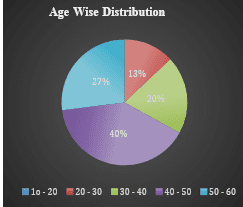
Age wise distribution of Cases
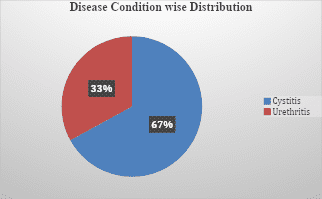
DISTRIBUTION ACCORDING TO DISEASE CONDITION
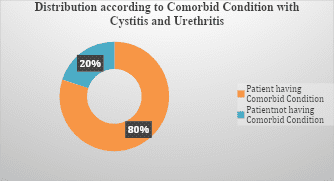
DISTRIBUTION OF ACCORDING TO COMORBID CONDITION WITH CYSTITIS AND URETHRITIS
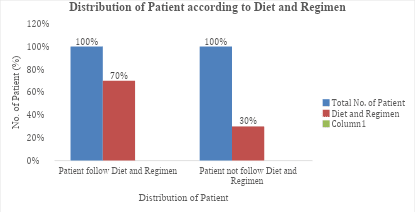
DISTRIBUTION ACCORDING TO DIET AND REGIMEN
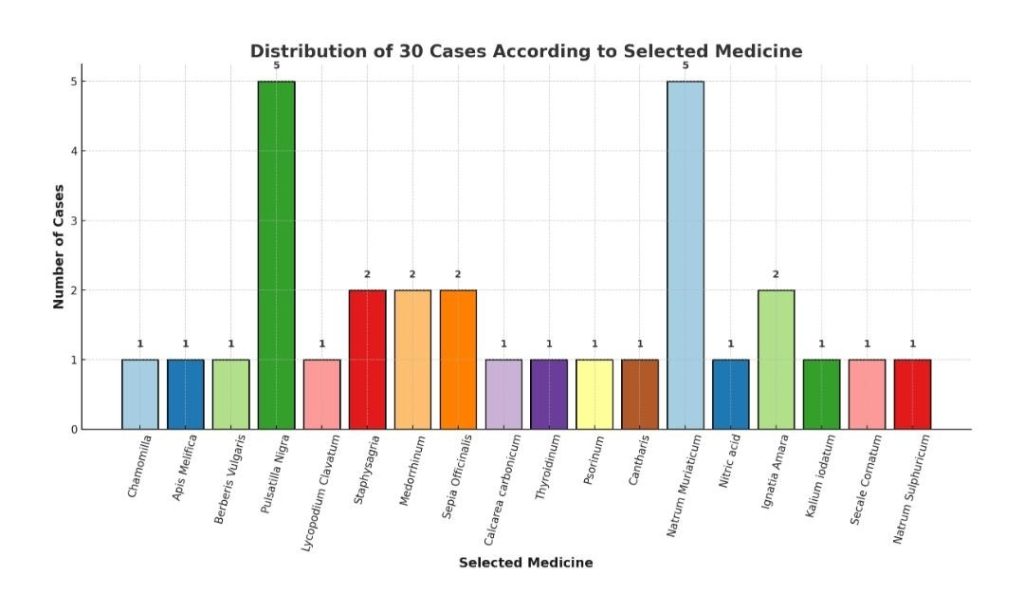
DISTRIBUTION OF 30 CASES ACCORDING TO SELECTED MEDICINE
| Selected Medicine | No. Of Cases | Percentage (%) |
| Chamomilla | 1 | 3.33% |
| Apis Melifica | 1 | 3.33% |
| Berberis Vulgaris | 1 | 3.33% |
| Pulsatilla Nigra | 5 | 16.66% |
| Lycopodium Clavatum | 1 | 3.33% |
| Staphysagria | 2 | 6.66% |
| Medorrhinum | 2 | 6.66% |
| Sepia Officinalis | 2 | 6.66% |
| Calcarea carbonicum | 1 | 3.33% |
| Thyroidinum | 1 | 3.33% |
| Psorinum | 1 | 3.33% |
| Cantharis | 1 | 3.33% |
| Natrum Muriaticum | 5 | 16.66% |
| Nitric acid | 1 | 3.33% |
| Ignatia Amara | 2 | 6.66% |
| Kalium iodatum | 1 | 3.33% |
| Secale Cornatum | 1 | 3.33% |
| Natrum Sulphuricum | 1 | 3.33% |
| Total | 30 | 100% |
RESULT
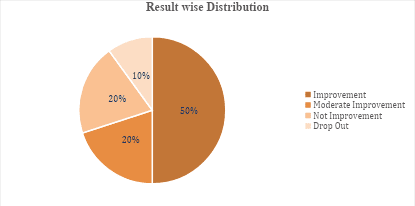
The total number of cases studied was 30 female patients diagnosed with Cystitis and Urethritis. The cases were assessed on the basis of clinical improvement after homoeopathic treatment, and outcomes were categorized as follows :
DISTRIBUTION OF CASES AS PER RESULT
| Result | No. of Cases | Percentage (%) |
| Improvement | 15 | 50% |
| Moderate Improvement | 6 | 20% |
| Not Improvement | 6 | 20% |
| Drop Out | 3 | 10% |
| Total | 30 | 100% |
Out of 30 cases 15 (50%) were Improvement, 6 cases (20%) were Moderate Improvement, 6 Cases (20%) were Not Improvement and 3 cases (10%) were drop out cases.
DISTRIBUTION OF RESULT ACCORDING TO DIET AND REGIMEN
| Result | Follow Diet and Regimen | Not Follow Diet and Regimen |
| Improvement | 11 | 4 |
| Moderate Improvement | 4 | 2 |
| Not Improvement | 4 | 2 |
| Drop out | 2 | 1 |
| Total | 21 | 9 |
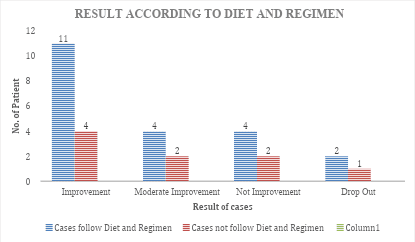
out of 30 cases 70% cases followed Diet and regimen shown 11 cases Improvement, 4 Cases showed Moderate improvement, 4 cases not Improvement. Cases were not followed Diet and regimen Shown 4 cases Improvement, 2 cases Moderate improvement, 2 cases Not Improvement.
Discussion
This study highlights the potential of individualized homoeopathic medicines in urinary tract infections. Higher prevalence in the 40–50 age group aligns with hormonal and physiological changes. Remedies like Natrum muriaticum and Pulsatilla were most commonly indicated, correlating with materia medica indications. Lifestyle factors played a crucial role, as adherence to diet and hygiene significantly improved outcomes. Although the study shows promising results, a larger sample size and comparative studies would enhance evidence strength.
Conclusion
Homoeopathic medicines, when prescribed on an individualized basis, provide encouraging results in the management of cystitis and urethritis among females. The combined influence of remedy selection, comorbidities, and lifestyle measures contributes to improved outcomes. Further controlled clinical studies are recommended.
References
1. Park K. Textbook of Preventive and Social Medicine. 25th ed.
2. Boericke W. Pocket Manual of Homoeopathic Materia Medica.
3. Clarke JH. A Dictionary of Practical Materia Medica.
4. Farrington EA. Comparative Materia Medica.
5. Murphy R. Homoeopathic Clinical Repertory.