

Abstract
Subclinical hypothyroidism is a condition characterised by normal thyroxine level (T3) levels and elevated thyroid stimulating hormone (TSH) level. Also called mild thyroid failure. It is more common in women than men and its prevalence increases with age.
keyword –
Homeopathy, subclinical hypothyroidism, mild thyroid failure case report
Case Summary:
A 27-year-old female presented with menstrual irregularity, Excessive hair fall and
obesity. An individualized homeopathic treatment was prescribed based on her symptoms. Significant
recovery was observed, with TSH levels returning to the normal range after treatment. The outcome
was assessed by comparing TSH levels before and after the intervention.
This case highlights the potential of homeopathic medicine in managing subclinical hypothyroidism.
CASE:
A 27year old women come to the outpatient department of government homoeopathic
medical college, Bhopal on 15 march 2024.
Presenting Complaints
- Complaint of delayed and scanty menses since1 year.
- Complaint of severe hair-fall since 8month.
- Severe Dandruff on scalp with itching.
- Complaint of weight gain.
- Excessive hair on body specially on face.
History of Presenting Complaints
- The patient attained menarche at the age of 12 and the menstrual cycle was regular. But now the patient has been presenting with delayed and scanty menses since1 year.
- Cycle- irregular, once in 3 month, 2-3 days /3month cycle
- Nature of flow- scanty, 2 pads/1stday
- Nature of blood- Dark red, no clots, not offensive
- There are no other associated complaints.
- LMP –10 /01/2024(PLMP- 2/10/2023
- Complaint of hair-fall for 8 months. There is scaly dandruff and itching in the scalp.
- Complaint of weight gain (54kg -61kg)
- Dullness, lethargic and sleepiness all time.
- Burning during urination with frequent history of UTI.
- Excessive Hair on body specially on face.
Menstrual History
- LMP- 10 /01/2024(PLMP- 2/10/2023)
- Cycle- irregular, once in 3 month 2-3days/3month cycle.
- Nature of flow-scanty, 2 pads/1st day.
- Nature of blood- Dark red, no clots, not offensive.
- There is severe dysmenorrhoea.
Family history –
- Mother – PCOD
Personal history –
- History of recurrent UTI.
- Red moles on the body.
Mental Generals-
- Can not concentrate on work.
- Fear of darkness when alone.
- Forgetful, can’t remember duty.
- Weakness of memory.
Physical general –
- Diet – vegetarian
- Desire-sour food specially Pani-puri
- Disagree-not any
- Tongue-clean, moist
- Taste-no altered taste as mention
- Salivation-profuse
- Perspiration-not easily
- Stool-clear daily
- Urine-burning during urination with frequent desire urination
- Bathing-regular
- Covering- not desire
- Dwelling place-well ventilated
- Aversion-nothing specific
- Thermal reaction-hot patient
- Skin-red moles on back
- Sleep – Sound, 6-7hour, sleep lying on abdomen
- Dreams- not any
Clinical Findings
- Physical examination reveals normal blood pressure-120/70mmHg, normal pulse rate (76 bpm), no pretibial oedema, no swelling in the neck region, no lymphadenopathy and no tenderness in the neck region.
Diagnosis: -hypothyroidism
Investigations: -Done on 14 /03/2024
- TSH:51.6uIU/ml
- Total-T3: 1.2ng/dl
- Total-T4: 5.4/dl (Fig 1 A)
RUBRIC AND REPERTORISATION
- Mind -concentration difficult
- Mind -fear -alone of being darkness, in the
- Mind -memory -weakness of memory
- Head- dandruff itching
- Urethra -pain urination burning
- Female genitalia/sex – menses late, too scanty
- Skin- hair -growth of hair, excessive
- Skin – moles – red
- Generals -food and drink, sour drink desire
- Generals -obesity- over weight, slightly
- Generals – hypothyroidism
Basis of Prescription-: The above mentioned rubrics were taken for REPERTORISATION. After
REPERTORISATION and consultation with Materia medica MEDORRHINUM was selected.
FIRST PRESCRIPTION ON 15.03.2024
- The patient was advised to take MEDORRHINUM 200 twice a day, for 2 days followed by placebo twice a day for 10 days.
SECOND PRESCRIPTION ON 25/03/2024
- dullness gone, hair fall persist, burning after urination persist, LMP- 30.03.2024
- Rx MEDORRHINUM 1 m once in a day, for 2 days followed by placebo twice a day for 10 days
THIRD PRESCRIPTION ON 05/04/2024
- Patient is better than before, hair fall decrease, burning after urination persist
- Rx MEDORRHINUM 0/1 once in a day, for 3 days followed by placebo twice a day for 15 days
FOURTH PRESCRIPTION ON 20/04/24
- Patient is better than before, slight decrease burning in urination
- Rx MEDORRHINUM 0/1 once in a day, for 2day followed by placebo twice a day for 15 days
FIFTH PRESCRIPTION ON 05/05/24
- No more burning during urination, LMP – 02/05/24
- Rx MEDORRHINUM 0/2 once in a day, for 1 days followed by placebo twice a day for 15day
SIXTH PRESCRIPTION ON 20/05/25
- Patient is better than before
- Rx sac lac 200, for 30 days
After treatment (20.05.2024)
- TSH-6.5uIU/ml
- Total T3-1.04ng/ml
- Total T4 9.4 (Fig2)
Fig. 1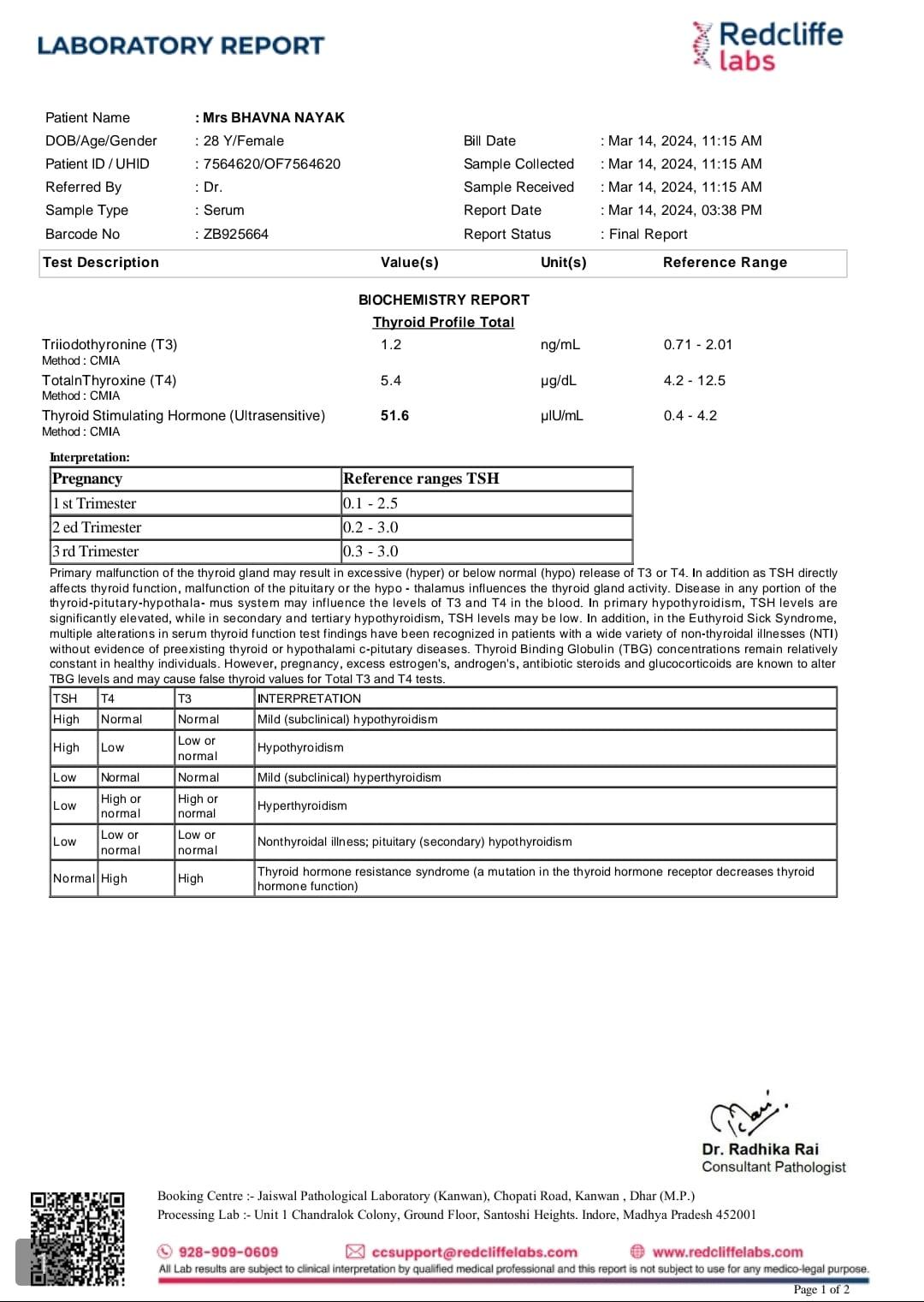
Fig.2

DECLARATION OF PATIENT CONSENT – patient consent was taken foe image and clinical information to be reported for this article.
CONCLUSION –This case is one of the evidence-based documented research studies, that shows effectiveness of homoeopathic treatment not only in relieving the symptoms of sub clinical hypothyroidism, but also in bringing favourable changes in pathology as evident in the investigations. Thus, this study is the classical example of the holistic approach of homoeopathy.
REFERENCES
1)Gosi SKY, Kaur J, Garla VV. Subclinical Hypothyroidism. [Updated 2024 Feb 15]. In: Stat Pearls [Internet]. Treasure Island (FL): Stat Pearls Publishing; 2025 Jan-. Available from: https://www.ncbi.nlm.nih.gov/books/NBK536970/
2) Fatourechi V. Subclinical hypothyroidism: an update for primary care physicians. Mayo Clin Proc. 2009;84(1):65-71.doi: 10.4065/84.1.65. PMID: 19121255; PMCID: PMC2664572.
3) Boericke, W., & Boericke, O. E. (1990). Homoeopathic materia medica with repertory comprising the characteristic and guiding symptoms of the remedies (R. B. Savage, Ed.; 2nd ed.). Homoeopathic Book Service.
4) Allen, H. C. (2022). Allen’s keynotes & characteristics: With comparisons of some of the leading remedies of the Materia medica with bowel Nosodes. B Jain.
SUBMITTED BY:
DR. SHEETAL KATARIYA
PG scholar, department of homeopathic Materia Medica
Under the guidance of
DR. SHOBHANA SHUKLA
(HOD of department of homeopathic Materia Medica )
GHMC BHOPAL (M.P.)
