

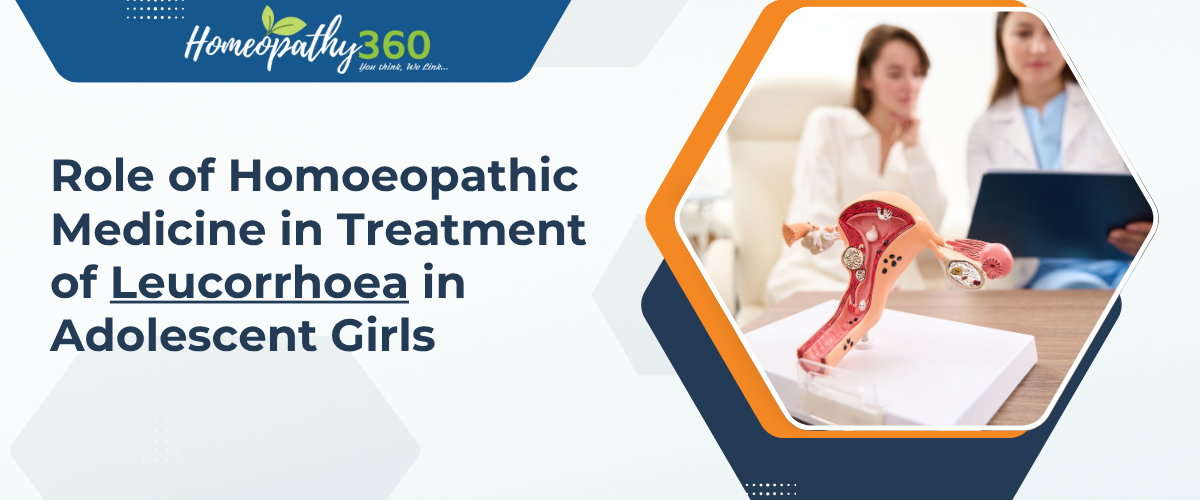
Abstract : Reproductive tract infections from one of the major burdens of disease in developing countries. Most of the women suffer from leucorrhoea and do not present themselves for seeking medical treatment in the early stage as the women have poor understanding regarding leucorrhoea. The complaints of vaginal discharge are very common, particularly in India, it is associated with considerable disability, health seeking and associated cost.
Homoeopathy treats the person as a whole. It means that in homoeopathic treatment we believed in the holistic approach to treat the patient. The homoeopathic medicine for leucorrhoea is selected after complete case taking, constitution miasmatical approach, investigation analysis and evaluation which frame a true portrait of the medicine, that is the totality of symptoms.
Epidemiology
In the global population one fifth is contributed by women in the reproductive age group (15-45 years). In India, as per 2001 census, women of child bearing age constitute 19%. WHO (1995) reported that nearly one third of all healthy life lost among adult women is because of reproductive health problems.
Indian Scenario:
In India, the prevalence was recorded at 28.9%, while surveys conducted in Saudi Arabia showed a prevalence of 47.7%. Two published studies in India reported a strong association between low socioeconomic status and leucorrhoea. In one study, 28.9% of women in India were found to have leucorrhoea. Another study found that 27.47% of women in Nagpur, India, had leucorrhoea. A study in Mumbai found that 66.9% of women in an urban slum community had leucorrhoea.
Definition:
Leucorrhoea is a very common complaint in obstetric and medical practice. The term “leucorrhoea” is applied to cases of abnormal vaginal discharge, non-haemorrhagic in nature, which is not caused by neoplasm or other serious organic disease. It is also a difficult condition to treat satisfactorily in view of its uncertain etiology. The aetiology of leucorrhoea is complex and not well understood. It is considered that changes in the vaginal epithelium; changes in the normal bacterial flora and PH of the vaginal secretion predispose to leucorrhoea. Chronic illness, fatigue, malnutrition, emotional disturbance, chronic
retroverted uterus, congestive cardiac failure, gonococcal and monilial infection, vulvovaginitis, lesions of the vaginal wall and uterine cervix have all been associated with leucorrhoea.
Any discharge that is not blood is called leucorrhoea. It is not a disease, but the product of diseased state or condition of the system.
Causes of Leucorrhoea
Leucorrhoea, or abnormal vaginal discharge, can be caused by a number of factors, including infections, hormonal changes, and foreign objects.
Infections
- Bacterial infections: Such as aerobic vaginitis, which can cause a yellowish discharge or odour.
- Yeast infections: Such as Candida, which can be caused by non-Candida albicans Candida (NCAC)
- Trichomoniasis: A common vaginal infection that can cause leukorrhea
- Sexually transmitted infections (STIs): Such as chlamydia, gonorrhoea, and trichomoniasis
Hormonal changes
- Ovulation: Oestrogen levels increase before ovulation, which can cause more discharge
- Pregnancy: Sexual arousal during pregnancy can cause leukorrhea
- Menopause: Vaginal dryness and watery discharge can occur after menopause
- Hormonal birth control: Oestrogen levels can be high while taking hormonal birth control, which can cause more discharge
Effects of Leucorrhoea
Leukorrhea is a vaginal discharge that can have several effects, including weakness, pain, and infection. If left untreated, it can lead to more serious complication
Effects
- Weakness: Some people report feeling weak after experiencing
- Pain: Leukorrhea can cause aches and pains in the body
- Infection: Leukorrhea can be a sign of infection, especially if it’s yellow, green, or has an odour
- Itching: Thick white discharge with itching can be a sign of a yeast infection
- Inflammation: Leukorrhea can be caused by inflammation or congestion of the vaginal mucosa
- Infertility: If left untreated, leukorrhea can lead to infertility issues
- Chronic pelvic pain: Leukorrhea can lead to chronic pelvic pain
- Complications during pregnancy: Leukorrhea can cause complications during pregnancy
- Increased risk of STIs: Leukorrhea can increase the risk of STIs
Types of Leucorrhoea:
Leucorrhoea is a type of vaginal discharge that can be normal or abnormal. Normal leucorrhoea is called physiological leucorrhoea, while abnormal leucorrhoea is called pathological leucorrhoea.
Physiologic leukorrhea
It is not a major issue but is to be resolved as soon as possible. It can be a natural defence mechanism that the vagina uses to maintain its chemical balance, as well as to preserve the flexibility of the vaginal tissue. The term “physiologic leukorrhea” is used to refer to leukorrhea due to oestrogen stimulation. Leukorrhea may occur normally during pregnancy. This is caused by increased blood flow to the vagina due to increased oestrogen. Female infants may have leukorrhea for a short time after birth due to their in-uterine exposure to oestrogen.
Inflammatory leukorrhea
It may also result from inflammation or congestion of the vaginal mucosa. In cases where it is yellowish or gives off an odour, a doctor should be consulted since it could be a sign of several disease processes, including an organic bacterial infection or STD.
After delivery, leukorrhea accompanied by backache and foul-smelling lochia (vaginal discharge, containing blood, mucus, and placenta tissue) may suggest the failure of involution (the uterus returning to pre-pregnancy size) due to infection. A number of investigations such as wet smear, gram stain, culture, pap smear and biopsy are suggested to diagnose the condition.
Parasitic leukorrhea
Leukorrhea is also caused by trichomonads, a group of parasitic protozoans, specifically trichomonas vaginitis. Common symptoms of this disease are burning sensation, itching and discharge of frothy substance, thick, white or yellow mucus.
Pathological Leucorrhoea:
Pathological leukorrhea is an abnormal vaginal discharge that can be caused by infections, diseases, or hormonal imbalances. It can be yellowish, greenish, or grayish in color, and may smell foul or fishy.
Vaginal Discharge Colour
Normal discharge is usually clear or milky white, while yellow, green, or gray discharge can mean there’s a problem.
Signs of Infection
A vaginal discharge alone does not mean there is an infection. If you have any of these other signs
- Vaginal itching, burning or irritation
- Thick, white vaginal discharge
- A change in what the discharge usually looks like
- Bad odour that lasts more than a day
- Painful intercourse
- Painful urination
- Pain or tenderness in your lower abdomen (tummy)
- Blisters, bumps or sores in your genital area
Laboratory tests
- Examination of vaginal fluid: The vaginal discharge is placed under a microscope to determine the type of bacteria, yeast, or protozoa causing the vaginal infection. Identifying the cause helps the doctor prescribe targeted treatment.
- Absolute leukocyte count: Also known as WBC count, it also helps examine the vaginal fluid for white blood cells (WBCs), an indicator of any infection.
may take a sample of the discharge or do a PAP TEST to collect cells from your cervix for further examination.
Prevention of Abnormal Vaginal Discharge
Maintain personal hygiene
Keep your private parts clean using lukewarm water. Always pat the private parts dry after urinating using toilet paper or a soft cloth. Wipe the right way. Always make sure to clean your private parts from front to back, and not from back to front.
Maintain a healthy lifestyle –
Drink at least 8 glasses of water every day to wash out the toxic substances from the body. Eat a well-balanced wholesome diet rich in fresh fruits and vegetables, whole grains, healthy fats, and protein. Limit sugar, processed, and packaged foods in your diet. Exercise regularly and get enough sleep. Learn to manage your stress effectively.
Specialist To Visit
A general physician can evaluate the symptoms of vaginal infection and start the treatment. They can refer to a specialist for further assessment.
Home care for Vaginal Discharge-:
Aloe vera has multiple medicinal uses. Its consumption is useful for managing excessive discharge, itching, and burning sensation.
Consuming the fenugreek seeds decoction or one teaspoonful with a glass of water balances the pH level in the vagina.
Cumin seeds decoction is beneficial in reducing itching and discharge. Yogurt is rich in probiotics. Having yogurt in your daily meals can improve the gut microbiome and helps reduce vaginal infections.
Complications of Abnormal Vaginal Discharge
Abnormal white discharge is a sign of vaginal infections. These vaginal infections can cause several complications such as:
- Pelvic inflammatory disease- The symptoms of PID include chills, fatigue, fever, & abdominal pain, and can lead to reproductive complications, Dysmenorrhea (painful periods)
- Chronic pelvic pain
- Internal abscesses (collection of pus due to infection)
- Endometritis (inflammation and infection of the uterus)
Ectopic pregnancy (attachment of the egg outside the uterus.
Homoeopathic Medicine of Leucorrhoea-:
Alumina: For psora leucorrhoea. After menses great exhaustion both mental and physical with copious discharge of mucus from vagina during menses. Leucorrhoea profuse, yellow, corroding or acrid, creamy or transparent and worse after menses. Leucorrhoea is like cream, causing itching in the pudenda, copious only in the daytime, sensation as if everything would fall from the vagina with much weakness. Gonorrhoea and leucorrhoea of long standing, a whole week passes before she gets over the effects of menstruation which is prolonged by leucorrhoea.
Calcarea carbonica : For tubercular and pseudo-psoric leucorrhoea. Leucorrhoea after menses like mucus or milk; worse after urination; albuminous leucorrhoea from cervix with lassitude and debility, of little girls, the least excitement brings on the leucorrhoea or
menses. It is thick, yellow, acrid or bland. Indicated in pale, blonde, light haired anaemic women. Tubercular leucorrhoea in pale, fleshy, soft muscled blondes, perspiration about the face or head, hands and feet cold and damp always.
Sepia: For tubercular, psoric, psuedo-psoric and sycotic leucorrhoea. Syco-psoric. The leucorrhoea of this wonderful remedy is varied and changeable, but found to be either milky and white or thick and yellow, staining the linen. Occasionally it is yellowish-green in gonorrhoea, it is sometimes lumpy or of foetid Odor Aggravation forenoon and evening Relief from severe exercise. Sensation as of a ball in inner parts causing the genitals to feel as though everything were coming out through the vagina. This gives Sepia a good picture in pelvic difficulties.
Ammonium muriaticum: For psoric leucorrhoea. Leucorrhoea is like the white of eggs preceded by griping pains around the navel. Constant, painless, brownish, slimy, albuminous, great distension of abdomen and violent backache at night.
Borax: For psoric leucorrhoea. Leucorrhoea white, albuminous, feels hot like warm water while passing over the parts, appearing midway between the menstrual periods, like starch or white of egg, bland and without pain, between the menstrual period it may be corrosive.
Kreosotum : For sycotic and pseudo- psoric leucorrhoea. Leucorrhoea, thick mucus with bad odor, excoriating the perineum, menstrual and leucorrhoeal flow intermittent, discharges almost ceases then begin again, Acrid with voluptuous itching of pudenda and swelling, heat and redness, whitish leucorrhoea, bland, smelling like green corn, It may be bloody in the beginning, then yellowish, white and acrid, causing much irritation and itching of the vulva. It stiffens the linen and turns it yellow, Leucorrhoea like washings of meat, acrid, dark, bloody with stitches in the vagina and great debility of lower extremities
Natrum muriaticum: For psoric leucorrhoea. Leucorrhoea thick, white or transparent, profuse, acrid smarting in the vulva. Bearing down or pressure sensation as if the menses were coming or a cutting pain in the urethra after urinating. Leucorrhoea greenish, especially when walking, aversion to sexual intercourse, very irritable afterwards.


