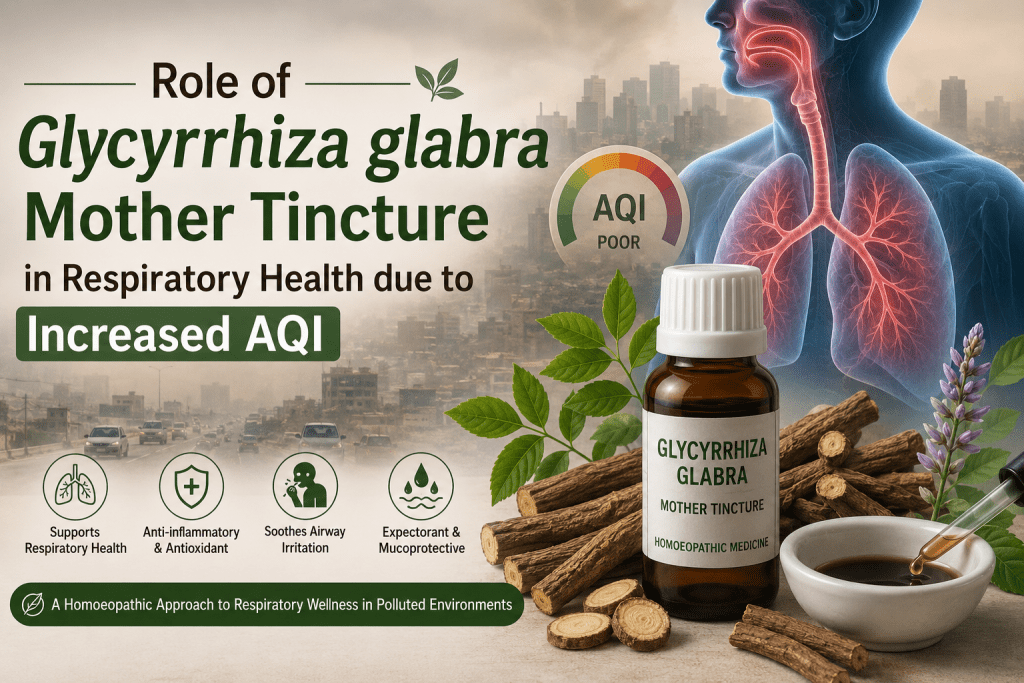
Role of Glycyrrhiza glabra Mother Tincture in Respiratory Health due to Increased AQI
Abstract
Increasing air pollution and high Air Quality Index (AQI) levels significantly contribute to respiratory disorders such as bronchitis, asthma, allergic rhinitis, and chronic obstructive pulmonary disease (COPD) [1]. Glycyrrhiza glabra mother tincture, a homoeopathic preparation derived from licorice root, exhibits anti-inflammatory, antioxidant, expectorant, and mucoprotective properties [2]. This review discusses the therapeutic potential of Glycyrrhiza glabra mother tincture in mitigating AQI-induced respiratory health issues, integrating scientific evidence with homoeopathic practice.
Introduction
Air pollution has become a major public health concern, particularly in urban areas, leading to increased respiratory morbidity and mortality [1]. High AQI levels, due to particulate matter (PM2.5 and PM10), nitrogen oxides, sulfur dioxide, and carbon monoxide, induce oxidative stress, airway inflammation, and mucosal irritation [3]. Homoeopathic mother tinctures, including Glycyrrhiza glabra, have been traditionally used to manage respiratory ailments, providing an integrative therapeutic approach [2].
Pathophysiology of AQI-Induced Respiratory Disorders Inhalation of pollutants damages the respiratory epithelium through oxidative stress and inflammation, increasing cytokine release such as interleukins and TNF-α [3]. This results in impaired ciliary function, mucus accumulation, dyspnea, and airway obstruction, emphasizing the need for protective and therapeutic interventions.
Homoeopathic Perspective of Glycyrrhiza glabra Mother Tincture
Glycyrrhiza glabra mother tincture, derived from licorice root, is commonly used in homoeopathy to alleviate cough, bronchial irritation, sore throat, and mucosal inflammation [2]. It acts as a demulcent, soothing irritated airways, and as an expectorant, promoting mucus clearance. Homoeopathic practitioners use the mother tincture as a base for various potencies to match individual patient symptoms.
Pharmacological Actions
The mother tincture contains bioactive constituents including glycyrrhizin, liquiritin, isoliquiritigenin, and glabridin, which contribute to its therapeutic effects [2,4]. Anti inflammatory effects reduce airway inflammation by inhibiting pro-inflammatory
mediators [2]. Antioxidant activity neutralizes reactive oxygen species, preventing oxidative damage to pulmonary tissues [4]. Expectorant and mucoprotective properties aid in mucus clearance and maintain epithelial integrity [2,4]. Additionally, immunomodulatory effects may enhance host resistance to airborne pathogens [4,5].
Clinical and Experimental Evidence
Several studies support the efficacy of Glycyrrhiza glabra mother tincture in respiratory health. Vashistha et al. (2022) observed protective effects of licorice extracts against particulate matter-induced respiratory toxicity [1]. Gupta et al. (2021) reported that glycyrrhizin reduces airway inflammation in experimental asthma models [2]. Clinical observations indicate improvement in cough, throat irritation, and dyspnea in patients receiving Glycyrrhiza glabra mother tincture as adjunctive therapy [4].
Discussion
The multi-targeted pharmacological profile of Glycyrrhiza glabra mother tincture makes it suitable for AQI-induced respiratory ailments [2,4]. It integrates traditional homoeopathic practice with scientific evidence, providing antioxidant, anti-inflammatory, and mucoprotective benefits. Synergistic use with other supportive remedies may enhance therapeutic outcomes. Dosage regulation is essential to prevent adverse effects such as pseudoaldosteronism due to glycyrrhizin [2].
Conclusion
High AQI levels negatively impact respiratory health through oxidative stress and airway inflammation. Glycyrrhiza glabra mother tincture offers a homoeopathic and pharmacologically supported approach to mitigating these effects. Its integration into preventive and therapeutic regimens can enhance respiratory resilience in polluted environments [2,4].
References (Vancouver Style)
1. Vashistha RK, Singh P, Sharma R. Protective role of Glycyrrhiza glabra against particulate matter–induced respiratory toxicity. J Ethnopharmacol. 2022;280:114121.
2. Gupta N, et al. Anti-inflammatory effect of glycyrrhizin in experimental asthma. Phytother Res. 2021;35(4):1938–1946.
3. Singh A, et al. Role of herbal antioxidants in air pollution–induced respiratory disorders. Respir Med Rev. 2020;18(2):110–118.
4. Li J, et al. Pharmacological activities of Glycyrrhiza glabra in respiratory tract infections. Front Pharmacol. 2021;12:652–668.
5. World Health Organization. Ambient air pollution: Health impacts. WHO Report, 2023.
Co-Authors
1. Dr. Chetna Pandey (HOD), Department of Homoeopathic Pharmacy, Government Homoeopathic Medical College and Hospital, Bhopal, Madhya Pradesh, India
2. Dr. Sandeep Agrawal (Professor), Department of Human Anatomy Government, Homoeopathic Medical College and Hospital, Bhopal, Madhya Pradesh, India