Abstract
Alopecia areata, commonly known as spot baldness, is a condition where hair loss occurs in small, circular patches on the scalp or other areas of the body. This autoimmune disorder affects approximately 1-2% of the global population and can develop at any age [1]. Typically, it results in coin-sized bald spots on the scalp, but the condition’s course is unpredictable, leading to various forms such as alopecia totalis, alopecia universalis, and ophiasis. Although it is an autoimmune condition, traditional medical treatments often lead to relapses and come with potential side effects. This case involved a 15-year-old female patient who sought treatment at the National Institute of Homoeopathy (N.I.H) outpatient department (OPD) for alopecia areata. The patient underwent individualized homeopathic treatment for seven months, resulting in a complete recovery without any adverse effects. Throughout the treatment process, both the MONARCH score and objective clinical evidence demonstrated significant improvement, confirming the effectiveness of homeopathic treatment. The individualized selection of homeopathic remedies, based on the totality of the patient’s symptoms, proved to be a valuable approach in achieving successful outcomes. This case report highlights the potential of homeopathy in managing alopecia areata, particularly in cases where conventional treatments may fail to provide consistent results or cause unwanted side effects. The positive response observed in this patient supports the role of homeopathy as a promising therapeutic option for this challenging condition
Keywords: Alopecia areata, Autoimmune, Homoeopathy, Inflammation, case report
Introduction
Alopecia areata (AA) is an autoimmune condition marked by patchy, nonscarring hair loss on the scalp and other body areas. This disease can manifest as a few isolated, round or oval patches of hair loss or, in more severe cases, as complete hair loss on the scalp (alopecia totalis) or throughout the entire body (alopecia universalis). AA affects individuals of all ages and genders. The hair loss in AA results from an autoimmune response, where the immune system attacks the hair follicles, particularly through the action of CD8+ T-cells, leading to inflammation. Various triggers, including infections, trauma, hormonal changes, and stress, can exacerbate the condition. Genetic factors are significant, and there is a higher likelihood of severe symptoms in individuals with first-degree relatives who have AA. The condition is also linked with other autoimmune disorders, such as vitiligo, lupus erythematosus, psoriasis, atopic dermatitis, thyroid disorders, allergic rhinitis, pernicious anaemia, diabetes, and rheumatoid arthritis [2].
While there is no definitive cure for AA, treatment options typically focus on controlling symptoms and managing flare-ups. Topical immunotherapy, corticosteroids (both topical and systemic), and intralesional steroids are commonly used treatments. Additionally, immunosuppressants and biologic drugs are employed in some cases. Patients undergoing these treatments need regular clinical monitoring due to potential side effects [3]. Psychological support is also a crucial component of managing AA, as it helps patients cope with the emotional toll of the condition, potentially contributing to long-term improvements [4]. Diagnosis is generally straightforward in typical cases, but for more diffuse or chronic forms, trichogram and biopsy may be necessary [5].
In recent studies, natural remedies have been explored for their potential benefits in promoting hair growth. Dong Hi Park’s research found that a hot water extract of Thuja orientalis stimulated hair growth in mice by inducing the anagen phase of hair follicles, as evidenced by the increased number and size of hair follicles and earlier activation of β-catenin and Shh proteins compared to the control and minoxidil-treated groups. This suggests that T. orientalis extract may serve as a potential hair growth promoter [6].
In another study, Hye Yoon Park investigated the effects of Thuja occidentalis semen (TOS) extract on hair growth and its inhibition of 5α-reductase. TOS extract showed a stronger inhibitory effect on 5α-reductase type 2 than γ-linolenic acid, though it was less potent than finasteride. Additionally, when applied to a rat model of androgenic alopecia (AGA), TOS extract significantly reduced sebum production and sebaceous gland size. The degree of alopecia was lower in groups treated with TOS extract or cyproterone acetate, indicating that TOS extract may be a useful agent in managing male pattern baldness [7][8].
Homeopathic treatments offer a safe and gentle alternative for managing alopecia areata by addressing the person as a whole. Homeopathy takes into account the patient’s medical history, family background, and environmental factors, considering any underlying predispositions. Various homeopathic remedies are recommended for alopecia, including Alumina, Arsenic album, Fluoric acidic, Graphites, Natrum muriaticum, Nitricum acidum, Phosphoricum acidum, Phosphorus, Pix liquida, Selenium, Sepia, Syphilinum, Thallium, and Vinca minor [9].
CASE STUDY
Patient profile
A female patient of 15 year old came to the N.I.H OPD and presented with multiple bald patches of hair loss which troubled her over a year. She was concerned about her condition as she did tried conventional treatments for the same complaint but could not get much benefit. On examination there were localized hair loss with two bald patches on the occiput region, shedding of hair in circumscribed manner with irregular margins, frontal hair line were intact , no recession/ visible damage of hair seen , volume of hair is very thin and the texture of hair is very dry, brittle and lustreless with split ends. There were more than 5 to 6 easily extractable hairs indicating a positive pull test and active hair loss. Also having profuse White coloured dandruff with itching over scalp region there. She is having a fear that someone is pursuing her constantly. She taken Vaccine 2 doses in 2021 afterwards gradually her hair fall started which lead to alopecia.Past Medical History: The patient had Typhoid at the age of 13, which was treated with allopathic medicine, leading to full recovery. No history of surgeries, accidents, burns, injuries.
Family History: Both parents have diabetes mellitus (DM). No history of Rheumatism, Hypertension, Haemorrhoids, Cancer, Venereal disease, and any contact with or nursing tubercular patients.
Medical History: The patient had tried various allopathic hair oil and homoeopathic, ayurvedic medicines without relief.
Personal History: Took Covid Vaccination in 2021, hair fall started after vaccinations.
Obstetric History: unmarried
Menstrual History: Menarche at 14 years of age, menstruation cycles are normal, pain before menses around hip joints.
Clinical findings : The patient appeared well-nourished and in no acute distress. Vital signs were within normal limits, with a heart rate of 74 beats per minute, blood pressure of 100/60 mmHg, respiratory rate of 18 breaths per minute, and an oral temperature of 98.6°F.
The patient was alert and oriented to person, place, and time. A general physical examination of the patient revealed normal findings across all systems.
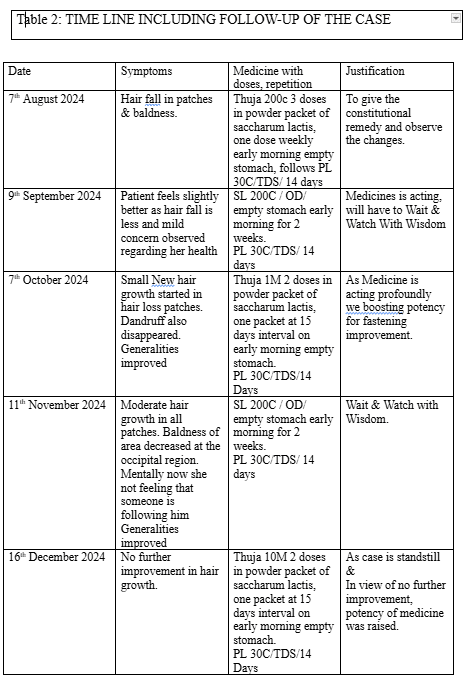
On inspection of scalp, a localized hair loss with two bald patches on the occiput region, shedding of hair in circumscribed manner with irregular margins, frontal hair line were intact , no recession/ visible damage of hair seen smooth, sharply demarcated, round patch of hair loss without atrophy with pointed hair observed on the periphery of the patch located at the occipital region.
Physical general
Appetite – Good, 3 meals/day. While eating, she must eat raw onion. craving for onion
Thirst – 2-3 litres per day, 2-3 hourly interval taking sip of water Desire – Salty food Aversion – Nothing specific Intolerance – Nothing specific
Thermal – Hot patient. Prefers winter,
Stool – Regular, Once a day, satisfactory, no complaints before, during or after stool.
Urine – 5-6/0 D/N, No complaints before, during or after micturition
Perspiration – On exertion in face, no stains, non-offensive
Sleep – 7hrs, No waking in between and No specific dreams
Mental Generals
Patient having constant fear that someone is walking or approaching him from behind when walking since 2 years how its started she don’t know. Mild in nature. Memory good. Patient maintains normal social relationships and activities. She having strong sexual urge.
Provisional Diagnosis – Alopecia Arerata (L63.9)
The following characteristic symptoms were considered for the repertorization.
1. Strong sexual urge
2. Fear – approaching him-of others
3. Not well since vaccination.
4. Perspiration profuse-Face
5. Desire Salty food & craving for raw onion while eating.
6. Hair falling
7. Hair dryness
8. Hair lustreless
9. Dandruff white itching with.
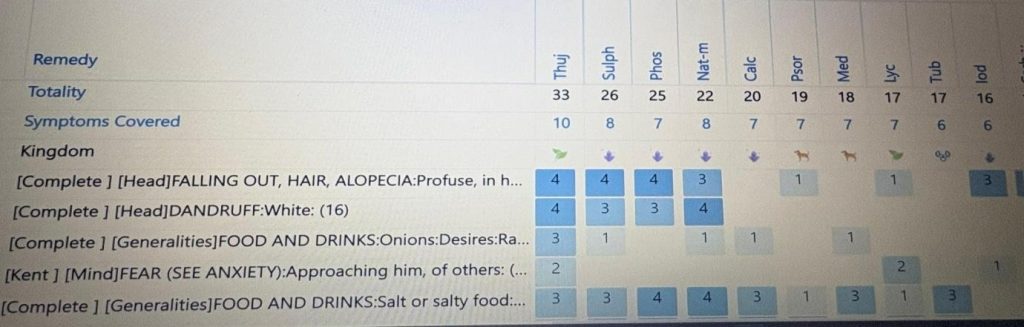
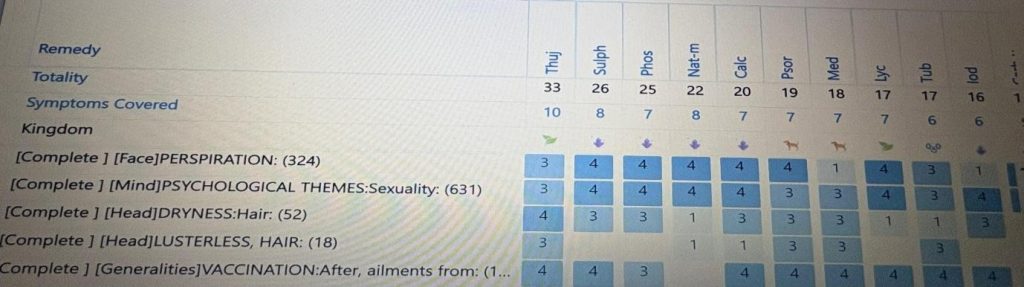
Repertorisation was done using Hompath8 Software (complete repertory) (Mind Technologies private limited, Mumbai, Maharashtra State, India),[10] and the repertorial result is shown in Table no.1
Table 1: Repertorisation chart
Therapeutic Intervention
After thorough case taking, totality formation, converting symptoms into rubrics, repertorisation and studying Comparative Materia medica with differentiating closely associated medicine Thuja occidentalis 200c was prescribed 7th August 2024.
Basis of prescription – Thuja occidentalis was chosen based on prominent symptoms like fear of being approached, craving for raw onion, hair fall with dandruff white colour, strong sexual urge & she stated that her complaints started after vaccination.
This Totality of symptoms after proper repertorization along with consultation with various Materia medica provide logical basis for Thuja occidentalis prescription in this case.
Thuja 200c 3 dose in powder packet in weekly interval is prescribed to taken empty stomach early morning & patient were told to report after 1 month.
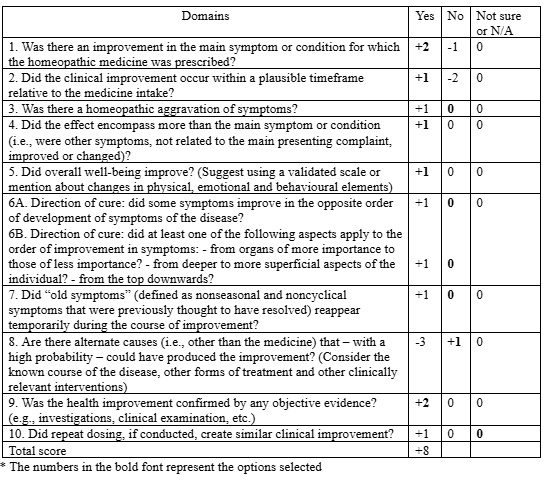
Furthermore the dose & potency of thuja were boosted as per the need of case.Possible causal attribution “Modified Naranjo Criteria for Homoeopathy” (MONARCH) score was assessed +8 after treatment which infers the possible causal attribution between intervention and result[11]. (table-3)
Follow Ups And Outcomes
The follow ups were done monthly with proper evaluation & was prescribed accordingly. The elaborate case follow ups are explained in a summarized way in Table no 2.
RESULT
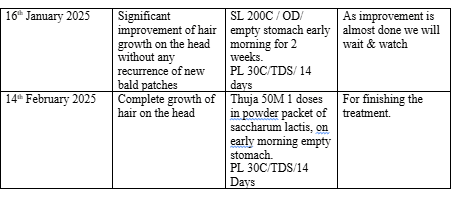
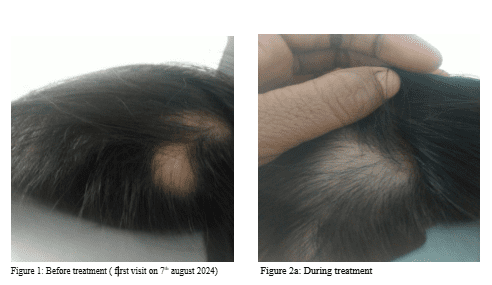
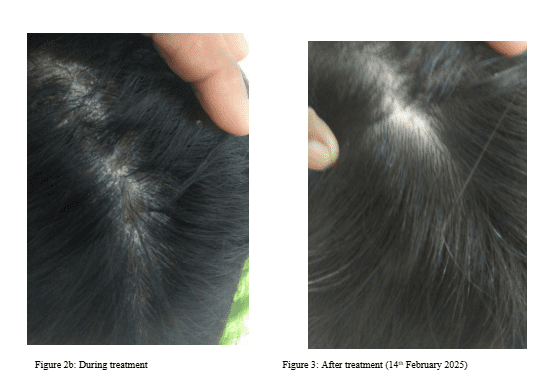
The bald patches on the head showed new hair growth. Initially, Thuja 200C showed improvement. However, much significant improvement was observed with higher potency Thuja 1M,10M,50M. Bald patches on the head completely disappeared within a period of 7 months of homoeopathic treatment with in general improvement of patient wellbeing {Figure 1,2a,2b.3}
DISCUSSIONS
Alopecia areata mostly presented as one-sided local disease [12]. The patient was presented with multiple hair loss patches over the scalp. This case was treated with individualized homoeopathic medicine, the case was cured with complete regrowth of hair in bald patches. As there is no effective treatment in modern medicine, mainline treatment is tropical immunotherapy in diffuse cases, intralesional corticosteroids in localized hair loss patches.
In this case, after careful history recording, repertorisation and consultation with Materia Medica, Thuja medicine was selected for prescription. Improvement was seen in patient in the beginning which proved correct selection of the remedy and there was little improvement with Thuja 200C. However, marked improvement was observed with higher 1M,10M,50M potency.
The total MONARCH score (Table: 03) was 08 after 30 days of treatment. A score of 08 indicates a ‘definite’ association between homoeopathic medicine and the observed outcome. To provide some context, here are the score ranges and their corresponding interpretations:
• Definite: Total score ≥ 9
• Probable: Total score 5-8
• Possible: Total score 1-4
• Doubtful: Total score ≤ 0
Since the total score was 08, it suggests a strong and definite association between homoeopathic medicine and the observed outcome in this case
in this case there is an strong causative factor of post covid vaccination after which hairfall started, along with mental characteristics, qualified physical general with craving for raw onion, prescription made in Centesimals potency, with treatment goes on potency were boosted as per as requirement of case & the result we can observe. This case demonstrates the usefulness of homoeopathic medications in treating Alopecia Areata when provided according to homoeopathic principles.
Table 3: Assessment by Modified Naranjo Criteria for Homoeopathy
CONCLUSION
As this case study shows, patients with alopecia areata may find that homeopathic treatment is a good and safe alternative. However more studies are required to prove homeopathy’s efficacy in treating a wider range of people. The possible advantages of this strategy in the treatment of autoimmune hair diseases are demonstrated by this example. Personalized care and patient well-being are key components of homeopathy’s helpful approach in treating the complex nature of alopecia areata. as this is a single case study and Alopecia Areata is associated with a variable, unpredictable remission so a well-designed studies may be taken up for scientific validation of results.
DECLARATION OF PATIENT CONSENT
The authors certify that they have obtained all appropriate patient consent forms. In the form, the patient has given his consent for his images and other clinical information to be reported in the journal. The patient understands that his name and initial will not be published, and due efforts will be made to conceal his identity, but anonymity cannot be guaranteed.
FINANCIAL SUPPORT AND SPONSORSHIP
NIL
CONFLICTS OF INTEREST
None declared.
REFERENCES
- Villasante Fricke AC, Miteva M. Epidemiology and burden of alopecia areata: A systematic review. Clin Cosmet Investig Dermatol. 2015; 8:397-403
- Shivanna CB, Shenoy C, Priya RA. Tofacitinib (selective Janus kinase inhibitor 1 and 3): A promising therapy for the treatment of alopecia areata: A case report of six patients. Int J Trichol 2018; 10:1037.
- JuárezRendón KJ, Rivera Sánchez G, Reyes López MÁ, García Ortiz JE, Bocanegra García V, Guardiola Avila I, et al. Alopecia Areata. Current situation and perspectives. Arch Argent Pediatr 2017;115: e40411.
- Rivetti EA. Alopecia areata: A revision and update. Bras Dermatol 2005; 80:5768.
- BrzezińskaWcisło L, BerglerCzop B, WcisłoDziadecka D, LisŚwięty A. New aspects of the treatment of alopecia areata. Postepy Dermatol Alergol 2014;31:2625.
- Zhang N-N, Park DK, Park H-J. Hair growth-promoting activity of hot water extract of Thuja orientalis. BMC Complement Altern Med [Internet]. 2013;13(1). Available from: http://dx.doi.org/10.1186/1472-6882-13-9
- Park HY, Park WS, Park PJ, Kim SN, Kim AR, Kang BH, et al., editors. Experimental Studies of Korean Medicinal Plant Extracts on the Effects of Hair Growth Activity and Physical Properties amor pacific r&d centre.
- Park W-S, Lee C-H, Lee B-G, Chang I-S. The extract of Thujae occidentalis semen inhibited 5α-reductase and androchronogenetic alopecia of B6CBAF1/j hybrid mouse. J Dermatol Sci [Internet]. 2003;31(2):91–8. Available from: http://dx.doi.org/10.1016/s0923-1811(02)00146-9
- Boericke W. Pocket Manual of Homoeopathic Materia Medica and Repertory. New Delhi: B. Jain Publishers Pvt. Ltd; 1994.
- Complete repertory of Hompath Classic. Ver. 8.0. Mumbai: Computer Software, Mind Technologies; 2006
- Lamba CD, Gupta VK, Van Haselen R, et al. Evaluation of the Modified Naranjo Criteria for assessing causal attribution of clinical outcome to homeopathic intervention as presented in case reports. Homeopathy. 2020;109(04):191-197
- Hahnemann S. Organon of Medicine. 5th and 6th edition. Dudgeon RE, Boericke W, eds.). New Delhi: B. Jain Publishers Pvt. Ltd; c2013.
- Dr. Chetan Singh Sengar, PGT Department of Case Taking & Repertory At National Institute Of Homoeopathy Kolkata West Bengal, India
- Dr. Avinesh Singh Rajput, PGT Department of Materia Medica At National Institute Of Homeopathy, Kolkata West Bengal, India