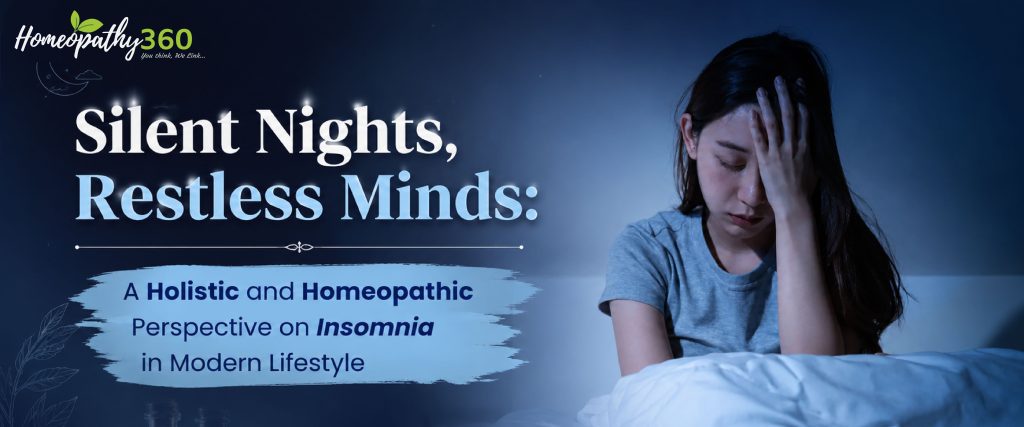
Silent Nights, Restless Minds: A Holistic and Homeopathic Perspective on Insomnia in Modern Lifestyle
Abstract
Insomnia is one of the most common sleep disorders affecting individuals of all age groups, especially young adults exposed to stress, excessive screen time, unhealthy dietary habits, and irregular lifestyles. It is characterized by difficulty in initiating or maintaining sleep, resulting in impaired daytime functioning. Chronic insomnia can negatively affect mental, emotional, and physical health. This article reviews the etiology, pathophysiology, clinical features, diagnosis, complications, and management of insomnia from both modern medical and homeopathic perspectives. Emphasis is given to individualized homeopathic treatment and constitutional prescribing.
Introduction:
Sleep is an essential physiological process necessary for restoration of the body and mind. Disturbance in sleep patterns significantly affects quality of life, cognitive performance, emotional stability, and immunity. Insomnia has become increasingly prevalent due to rapid modernization, mental stress, technological overuse, and unhealthy habits.
Homeopathy considers insomnia not merely as a disease but as an expression of disturbance in the vital force. Treatment is based on the totality of symptoms, mental state, constitution, and causative factors.
Definition
Insomnia is a sleep disorder characterized by:
• Difficulty in falling asleep
• Difficulty in maintaining sleep
• Early morning awakening
• Non-refreshing sleep despite adequate opportunity for sleep
Types of Insomnia
1. Based on Duration
• Acute Insomnia
• Lasts for days to weeks
• Usually due to stress or emotional disturbances
• Chronic Insomnia
• Occurs at least 3 times per week for more than 3 months
2. Based on Sleep Pattern
• Sleep-Onset Insomnia
• Difficulty falling asleep.
• Sleep-Maintenance Insomnia
• Frequent awakening during sleep.
• Terminal Insomnia
• Early morning awakening with inability to sleep again.
Etiological
➢ Psychological Causes
• Anxiety
• Depression
• Emotional stress
• Fear and grief
➢ Lifestyle Factors
• Excessive mobile phone usage
• Night shifts
• Excessive caffeine intake
• Alcohol and smoking
• Irregular sleep habits
➢ Medical Causes
• Hyperthyroidism
• Chronic pain
• Asthma
• Gastroesophageal reflux disease
• Neurological disorders
➢ Drug-Induced Causes
• Steroids
• Antidepressants
• Stimulants
Pathophysiology
Sleep is regulated by the circadian rhythm and neurotransmitters such as serotonin, melatonin, dopamine, and gamma-aminobutyric acid (GABA).
➢ In insomnia:
Hyperarousal of the nervous system occurs
Increased cortisol and stress hormones disturb sleep
Alteration in melatonin secretion affects sleep cycle
Sympathetic overactivity leads to persistent wakefulness
➢ The chronic sleep deficit causes:
• Fatigue
• Poor concentration
• Mood disturbances
• Reduced immunity
Clinical Spectrum
➢ Night Symptoms
• Difficulty falling asleep
• Repeated awakening
• Restlessness
• Disturbing dreams
➢ Day Symptoms
• Irritability
• Fatigue
• Daytime sleepiness
• Poor memory
• Reduced efficiency
• Ocular Manifestations
Diagnostic Perspective
➢ Clinical Evaluation
• Detailed sleep history
• Duration and severity
• Lifestyle assessment
➢ Investigations
• Sleep diary
• Polysomnography
• Thyroid profile
• Psychological assessment if needed
Management
➢ Sleep Hygiene
• Regular sleep schedule
• Avoid caffeine at night
• Reduce screen exposure before sleep
• Quiet and dark sleeping environment
➢ Lifestyle Modification
• Meditation
• Yoga
• Physical exercise
• Balanced diet
Complications
• Anxiety disorders
• Depression
• Hypertension
• Reduced immunity
• Poor academic and work performance
• Increased cardiovascular risk
Homeopathic Perspective
Homeopathy treats insomnia according to individual susceptibility and mental characteristics. Emotional causation, temperament, thermal reaction, cravings, fears, and associated symptoms are considered during remedy selection.
Important Homeopathic Remedies for Insomnia
1. Nux Vomica
➢ Indications:
• Insomnia due to mental overwork
• Sedentary lifestyle
• Excessive tea, coffee, alcohol
• Irritable temperament
Keynote: Wakes at 3–4 AM and cannot sleep again.
2. Coffea Cruda
➢ Indications:
• Sleeplessness due to excitement
• Overactive thoughts
• Joyful emotions
• Hypersensitivity
Keynote: Mind remains active with rapid thoughts.
3. Arsenicum Album
➢ Indications:
• Anxiety and restlessness
• Fear of death
• Sleeplessness after midnight
Keynote: Patient changes place frequently due to restlessness.
4. Kali Phosphoricum
➢ Indications:
• Nervous exhaustion
• Mental fatigue
• Stress-related insomnia
Keynote: Weakness from prolonged mental strain.
5. Passiflora Incarnata
➢ Indications:
• Insomnia in elderly individuals
• Sleeplessness from nervous irritation
Keynote: Useful in functional insomnia without pain.
6. Ignatia Amara
➢ Indications:
• Sleeplessness after grief or disappointment
• Emotional sensitivity
Keynote: Frequent sighing and emotional instability.
Miasmatic View
Psoric: Functional insomnia due to stress and anxiety
Sycotic: Insomnia associated with overthinking and chronic mental tension Syphilitic: Severe insomnia with destructive thoughts and depression
Prevention
• Maintain proper sleep routine
• Avoid stimulants
• Manage stress effectively
• Limit late-night screen exposure
• Practice relaxation techniques
Conclusion
Insomnia is a growing lifestyle disorder affecting physical and psychological health. Modern stress, excessive digital exposure, and unhealthy habits play a major role in its development. Early recognition and proper management are essential to prevent chronic complications. Homeopathy provides a holistic and individualized approach by addressing both mental and physical aspects of the patient. Along with lifestyle correction and sleep hygiene, constitutional homeopathic treatment can improve sleep quality and overall well-being.
References
• Harrison’s Principles of Internal Medicine.
• Davidson’s Principles and Practice of Medicine.
• Boericke William. Pocket Manual of Homeopathic Materia Medica.
• Kent J.T. Lectures on Homeopathic Materia Medica.
• Hahnemann Samuel. Organon of Medicine.
• ICD-11 Classification of Sleep Disorders.
• Guyton and Hall Textbook of Medical Physiology.