Abstract
Hering’s Law of Cure is a fundamental concept in homoeopathic philosophy that outlines the natural direction in which curative processes unfold. It proposes that healing progresses from within outward, from above downward, and in the reverse order of symptom appearance. While frequently cited in theoretical contexts, its clinical demonstration remains under-represented in academic literature. This paper examines the practical relevance of Hering’s Law through an analytical review of classical homoeopathic texts and clinical observations. Emphasis is placed on the recognition of symptom evolution, mental and emotional improvement preceding physical recovery, and the return of previously suppressed conditions. The findings reinforce the enduring clinical significance of Hering’s Law as a diagnostic and prognostic framework within classical homoeopathic practice.
Keywords
Hering’s Law of Cure, Direction of Cure, Homoeopathic Philosophy, Classical Homoeopathy, Impetigo
Introduction
Hering’s law of cure is also known as “The law of direction of cure”. This is formulated by the famous homoeopath, Dr. Hering. He is also called the “Father of American Homoeopathy”. According to this law, in a patient who received the similimum remedy, “the cure takes place from above downwards, from within outwards, from the more important organ to the less important organ and in the reverse order of the appearance of symptoms”. In the writings of Hahnemann, we observe that when cure takes place the symptoms disappear in the reverse order of their appearance. The symptom that appeared first will be the last one to disappear. The recurrence of old symptoms after administering a remedy is a good indication. Such a condition in a patient shows that the cure is inevitable. It was the genius of Hering which made us understand the process of cure or the direction of cure. The Hering’s law of cure for a homoeopath is like a compass to a navigator and sailor. Though the law seems to appear in 4 steps, each step explains the same process of cure. The examples that are given below are only for a better understanding of the concept. For better understanding, the law can be explained as below. According to the law of direction of cure, the cure must take place:
1. From Above Downwards-
Healing begins in anatomical parts closer to the center (e.g. trunk, upper limbs) and then progresses toward the extremities (e.g. legs, hands) when a homoeopathic similimum is correctly chosen, symptoms recede first from the upper body and proximal joints before the lower or distal parts improve.
2. From Within Outwards-
The recovery starts with deeper, vital systems (like the respiratory, circulatory, or endocrine organs) and then moves out toward peripheral or external tissues — eventually reaching the skin. Inner disturbances resolve before superficial ones.
3. From the More Important Organ to the Less Important Organ-
Important organs (heart, lung ,brain) heal before less vital ones (joint, skin). For instance, improvement in respiratory issues would precede resolution of a skin eruption, reflecting the body’s priority for vital functioning.
4. In the Reverse Order of Appearance of Symptoms-
Recent symptoms fade before older ones. Symptoms that emerged first (earlier in life) are the last to resolve. Rekindling old complaints briefly is considered a positive sign that deep healing is occurring.
Case presentation –
History Of Present Illness (HOPI)-
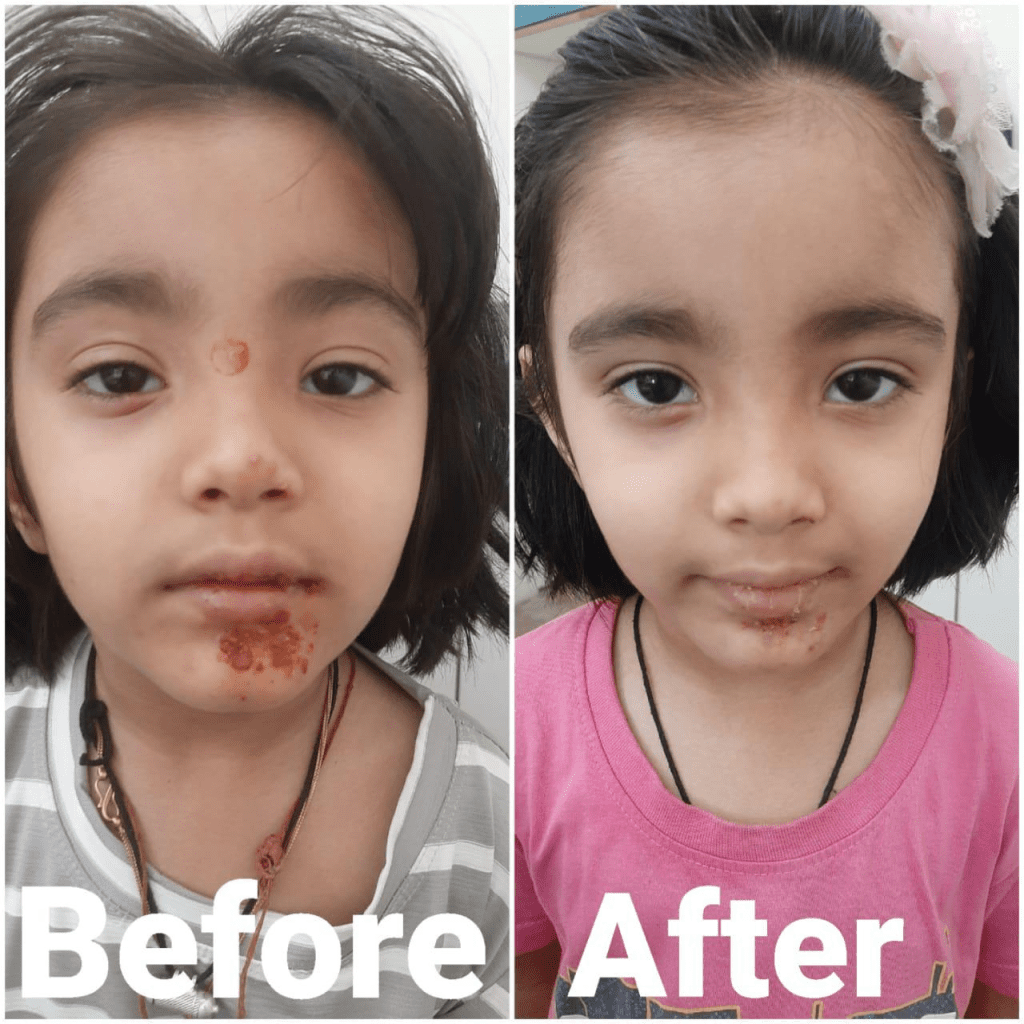
A 6-year-old girl was brought to the clinic with complaints of red, inflamed skin patches around her mouth for the past 4 days.
The lesions initially started as small reddish areas and gradually worsened, developing honey-colored crusts over the past 2 days.
Mild swelling around the affected area was noted, along with occasional itching, but no reported pain.
There are no associated symptoms such as fever, pus discharge, or systemic complaints. No similar skin lesions elsewhere on the body. The child has not used any new topical products, and there is no history of insect bites or skin trauma.
Location of Lesions:
- Around the mouth, especially the chin and upper lip.
- The nasal area also shows involvement with one lesion above the nostril.
- Possibly spreading toward the cheek.
- Crusted sores: Thick, yellowish-brown honey-colored crusts — typical of non-bullous impetigo.
- Erythema (redness) around the lesions.
- Some oozing or raw areas indicating active infection.
Diagnosis: Non-bullous impetigo (Staphylococcus aureus) mild swelling of the lips and surrounding tissues.
Treatment-
Graphites 200CH, 1 dose for 15 Days.
Local hygiene with plain water or Calendula lotion (externally)
Followed by placebo for 15 days BD for observation.
Follow-Up –
- Crusts drying, no oozing
- No new eruptions
- Residual scabs only
- General appearance improved
A Practical Case Review–
1. From Within Outwards-
- Before: The child shows clear skin lesions, but possibly mild internal discomfort or irritability.
- After: The child appears healthier mentally and emotionally (brighter expression), before the skin is fully healed.
Interpretation:
The child’s vital force (inner balance) is improving first, and this is being expressed outwardly through skin healing. This is in alignment with the “from within outwards” direction of cure.
2. From More Important Organs to Less Important Organs-
- Skin is a less vital organ, often used by the body to express deeper disturbances.
- If the remedy had pushed the disease inward (e.g., respiratory issues developing after skin cleared), that would be suppression — but in this case, the healing is staying at the skin level.
Interpretation:
No internal symptoms (e.g. cough, fever, or behavioral change) appeared during skin healing, which shows the disease is moving out rather than being suppressed. This supports the “more important to less important organs” aspect of cure.
3. From Above Downwards-
- The lesion above the lips and on the nose healed before the chin area, which still shows some scabbing.
- This healing direction (upper part healing first, lower part later) follows the “above to below” pattern.
Interpretation:
This healing from upper face to lower chin fits the expected top-to-bottom direction, again supporting natural and curative healing.
4. In the Reverse Order of Appearance of Symptoms-
- Lesions near the nose and upper lip may have appeared first.
- Lesions on the chin likely came later as infection spread.
In follow-up
The chin lesions remain longer, while upper ones have cleared.
- This is the reverse of their appearance — symptoms that came last are healing last.
Interpretation:
This is a positive sign of healing in reverse chronological order — the hallmark of deep, true cure in homoeopathy.
Clinical Message
- This case is a classic example of true healing under the influence of a well-selected homoeopathic remedy.
- Such progression confirms the correct remedy, the right potency and dose, and no need for repetition unless symptoms return or direction reverses.
Conclusion-
The practical application of Hering’s Law of Cure continues to hold clinical value in the assessment and management of both acute and chronic diseases within homoeopathic practice. Observations such as the reappearance of old symptoms, outward movement of eruptions, and mental-emotional improvement preceding physical changes affirm the direction of cure as outlined in classical texts. This principle not only guides remedy selection and follow-up evaluation but also strengthens the homoeopath’s confidence in the natural healing process. Reinforcing Hering’s Law through clinical observation bridges the gap between philosophy and practice, highlighting its enduring relevance in modern homoeopathy.
References
- Babu GN. Comprehensive Study of Organon of Medicine. 2nd ed. New Delhi: B. Jain Publishers Pvt. Ltd.; 2018. Chapter: Direction of Cure. pp. 129–134.
- Boericke W. Pocket Manual of Homoeopathic Materia Medica with Repertory. Reprint ed. New Delhi: B. Jain Publishers Pvt. Ltd.; 2007. Section: Graphites, Mezereum, Antimonium crudum. pp. 281–288.
- Kent JT. Repertory of the Homoeopathic Materia Medica. Reprint ed. New Delhi: B. Jain Publishers Pvt. Ltd.; 2004. Chapters: Skin – Eruptions – Crusty; Face – Eruptions – Around mouth. pp. 1265–1280.
- Allen HC. Keynotes and Characteristics with Comparisons of Some of the Leading Remedies of the Materia Medica. Reprint ed. New Delhi: B. Jain Publishers Pvt. Ltd.; 2004. Section: Skin Remedies – Graphites, Sulphur, Antimonium crudum. pp. 150–155.
- Nash EB. Expanded Works of Nash. Reprint ed. New Delhi: B. Jain Publishers Pvt. Ltd.; 1999. Section: Skin Affections and Their Clinical Management. pp. 17–22.
- Banerjea SK. Miasmatic Diagnosis: Practical Tips with Clinical Comparisons. New Delhi: B. Jain Publishers Pvt. Ltd.; 2003. Chapter: Psora, Sycosis, and Skin Conditions. pp. 73–80.
- Dhawale ML. Principles and Practice of Homoeopathy. 1st ed. Mumbai: Institute of Clinical Research; 1996. Chapter: Miasmatic Expression in Skin Disorders. pp. 324–330.
- Nayak D, Singh V, Oberai P, et al. Standard Treatment Guidelines in Homoeopathy: Skin Disorders. New Delhi: Central Council for Research in Homoeopathy, Ministry of AYUSH; 2018. Section: Impetigo. pp. 45–51.
- Pathak RK, Kumar S. Hering’s Law of Cure: A Clinical Perspective. Indian Journal of Research in Homoeopathy. 2014;8(3):153–158.
- Rossi E, Bartoli P, Bianchi A, et al. Homoeopathic aggravation with Quinquagintamillesimal potencies. Homoeopathy. 2012;101(2):112–120.