Looking for a nursing interview guide for preparing to acquire a nursing job in the UK? This nursing interview questions guide will address your queries regarding relevant questions, key strategies to impress interviewers, and common mistakes to avoid.
Introduction: Which Nursing Interview Are You Preparing For?
A nursing interview is not easy and is not the same as one conducted for another profession. The nursing interview tips provide detailed information regarding common nursing interview questions so that nurses can clear their interview at the first stage. Most of the nurses are seeking jobs in the NHS and other health services. Also, if you are a nursing student and need case study help or nursing assignment help, The Academic Papers UK can make this process easy for you. They make you able to view information on Band 5 interviews, revalidation, ward management, leadership, and clinical governance. According to the NHS, about 3 million job applications are submitted, and 35000 jobs are posted every month. If you are preparing for a nursing interview, your anxiety will be reduced after reading this blog, and you can impress the interviewer proficiently.
In this guide, you will recognise nursing interview tips and how you should be confident regarding scenario-based questions. On the other hand, if you are looking for nursing job interview questions, you are in the right place where the most common and NHS Band 5 questions are discussed. This guide is geared towards nursing university interview questions and includes MMI nursing interviews, values-based assessments, and scenario questions frequently asked by UK universities.
How University Nursing Interviews Work
According to the analysis, it has been recognised that most universities in the UK conduct panel interviews. Specifically, healthcare interview questions are asked in scenario-based questions. Multiple Mini Interview (MMI) format is used. In a panel interview, you will have one interview with an academic member, health worker, or admissions tutor. MMI is quite different from an MMI, which is a series of short stations, each testing a different skill and attribute.
For the NHS interview preparation, you will get tips along with examples so that you can clear the interview efficiently. There has been a growing trend in Universities to adopt a values-based style of interview. Interviewers are not being used to test in-depth clinical knowledge, but to see if candidates exhibit the attitudes and behaviours that are expected of nurses in the future.
Common areas assessed include:
- Communication skills
- Empathy and compassion
- Ethical awareness
- Teamwork
- Problem-solving ability
- Understanding of the nursing profession
- Commitment to patient-centred care
These are the domains of nursing interview examples that you must prepare before going for the interview. On the other hand, interviewers are more interested in your thinking than in getting a correct answer. Demonstrating reflection, professionalism, and a desire for learning will make an impact.
Motivation Questions: Why Nursing, Why This Field, and Why This University?
“Why do you want to be a nurse?”
The following are the key questions that need to be prepared:
- What inspired your interest in nursing?
- What experiences strengthened that interest?
- What are some of your strengths as a nurse?
- What positive difference do you hope to make as a nurse?
Motivation questions cluster around four themes: interest, experience, strengths, and the difference you want to make, and the same four themes resurface later in new graduate nursing interview questions when you apply for your first post. Considering them, you need to prepare these domains well. Examples of such experiences may include volunteering, health care and work experience, or having cared for others in a health care environment. It is important to describe learning, not just list activities.
On the other hand, many other common motivation questions are:
- Why have you selected a career in Adult Nursing, Mental Health Nursing, Children’s Nursing or Learning Disability Nursing?
- Why do you want to study at this university?
- What are the problems of the nurse in the modern world?
- What do you think makes a good nurse?
For the field-specific interview preparation, you need to show a significant understand regarding that specialty.
Values-Based Interviews and the 6Cs of Nursing
Value-based recruitment is now standard for nursing degrees, and the 6Cs of Nursing, Care, Compassion, Competence, Communication, Courage, and Commitment are the framework interviewers score against.
Do not recite definitions. Show each value through a clear example from your own experience; interviewers can tell the difference immediately.
For instance:
- Describe a time you supported someone who was struggling.
- Share with us a challenge you have overcome.
- Give an example of effective teamwork.
- Explain a situation where communication was important.
Important Note: If you do not know more about the NMC Code, you can describe confidentiality, respect, and patient safety.
Scenario and Ethics Stations: How to Approach Them
Nursing scenario interview questions are generally asked in which the interviewer evaluates your critical thinking, problem-solving skills, communication skills, and ethical judgment. Scenarios can be different according to the requirements of the Universities. Therefore, several scenarios are mentioned below:
- Patient confidentiality
- Safeguarding concerns
- Communication difficulties
- Teamwork challenges
- Managing distressed individuals
- Professional behaviour
For example:
Situation: Patient reveals confidential information and requests that it be kept confidential. What would you do?
In responding to scenario questions, think aloud: state your priority (patient safety), acknowledge confidentiality and its limits (safeguarding concerns must always be escalated), name who you would involve, and finish with what you would learn from the situation.
- Remain calm.
- Identify key issues.
- Consider patient safety.
- Be sympathetic and respectful.
- Clearly explain your reasoning.
These scenarios are related to nursing competency based questions in which the core focus is to determine how you will handle the situation. Your problem solving skill is recognised. In many instances, it is more important to show good judgment than to come up with one single “right” answer.
A Brief Note on NHS Band 5 Nursing Interview Questions
If you are already qualified and applying for an NHS post, prepare differently: a Band 5 job interview question is a different exercise from a university interview.
The following are the Registered Nurse and staff nurse interview questions. Band 5 typically covers:
- Clinical competencies
- Leadership skills
- Patient safety
- Quality improvement
- Professional accountability
- Experience-based examples
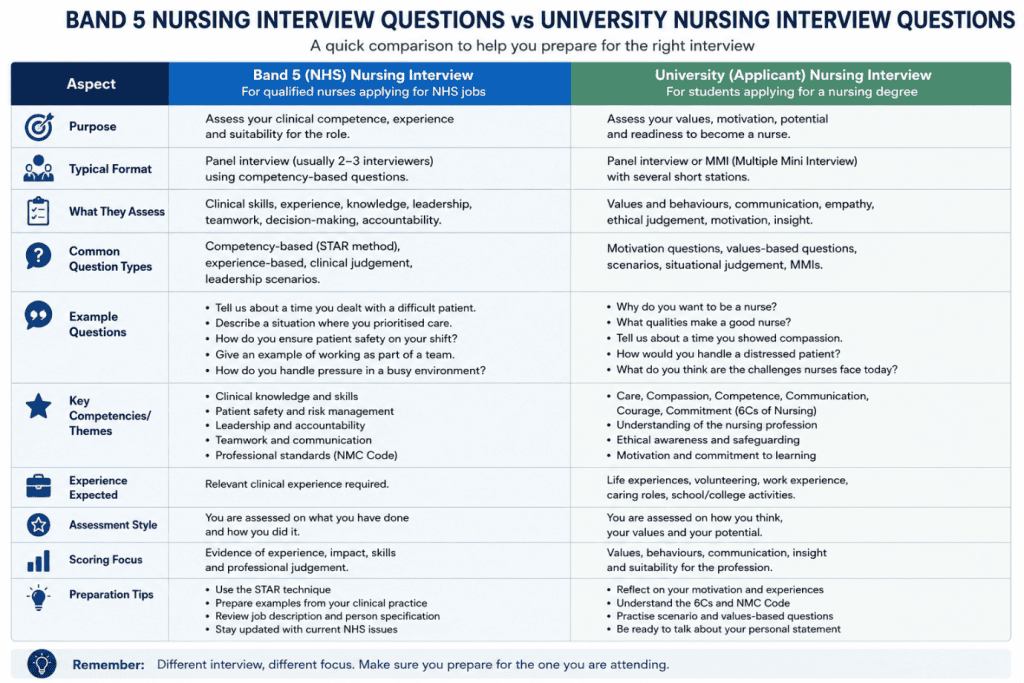
Furthermore, nursing leadership interview questions should also be prepared because leadership and management are fundamental skills in the healthcare sector. Numerous questions are based on the STAR format (Situation, Task, Action, Result), which ask candidates to talk about particular experiences in the workplace. Therefore, these questions are asked for a job interview, not for pursuing a nursing degree.
STAR Example
Question: Describe a situation one time where you encountered a challenging patient.
STAR Example:
Situation: The patient was distressed due to delayed treatment.
Task: According to the NMC Code of Conduct, ensure patient dignity and respond to concerns.
Action: Listened attentively, explained the situation clearly, and updated the nurse in charge.
Result: Patient was reassured, cooperative, and expressed gratitude to the team for the communication.
Scenario: What would you do if you noticed a colleague making a medication error?
Sample Answer:
- Provide prompt patient care.
- Communicate with the colleague respectfully.
- Raise to local NHS policy.
- Fill out the necessary paperwork and incident reporting.
- Consider what went well and what did not, and learn from it so it does not happen again.
Question: Tell about a situation in which you collaborated well with a multidisciplinary team.
Situation: The challenge was to coordinate the discharge plan for the patient.
Task: Provide correct patient information to the rest of the team.
Action: Worked with physiotherapists, doctors, and social workers.
Result: Safe and timely discharge.
Nursing Interview Preparation Checklist
Before going to appear in an NHS or University interview, you must prepare patient care interview questions, and you must be able to;
- Take your personal statement into careful consideration.
- Be ready to talk about all the experiences you have named.
- Read recent articles about the nursing field.
- Recognise the 6Cs of Nursing and how they are implemented in practice.
- Familiarise yourself with the basic principles of the NMC Code.
- Take part in mock interviews if possible.
- Keep up to date with major healthcare issues and developments. If you want guidance in nursing dissertation help or a structured nursing interview preparation, The Academic Papers UK offers mock-interview feedback sessions and personal statement reviews, coaching on your own answers and your own draft, before interview invitations land.
Conclusion
Whether you are facing an MMI next month or your first Band 5 Panel, the nursing interview questions above reflect what UK interviewers actually ask. Prepare a real example for every value, practice thinking aloud, and get feedback on your answers before the day. A mock interview and a polished personal statement are the two highest-return hours you can invest. FAQs
How should candidates prepare for a nursing interview?
Candidates must research the role and discuss nursing values, practise commonly asked questions, prepare examples, and understand professional standards.
What behavioural questions are asked in nursing interviews?
Behavioural questions focus on teamwork, communication, conflict resolution, leadership, compassion, problem solving, and exemplification of the professional nursing values.
How do nurses answer scenario-based interview questions?
Nurses should explain their reasoning, put patient safety first, follow policy, act professionally, and state clearly what they would do.
What questions are asked in Band 5 nursing interviews?
Band 5 interviews are typically used to evaluate clinical ability, patient safety, collaboration, communication, management, prioritisation and professional responsibility.
How do candidates demonstrate clinical skills in interviews
Clinical skills are shown by talking about their experiences, elaborating on what they did or did not do, drawing on evidence-based practice, and identifying patient-centred approaches.