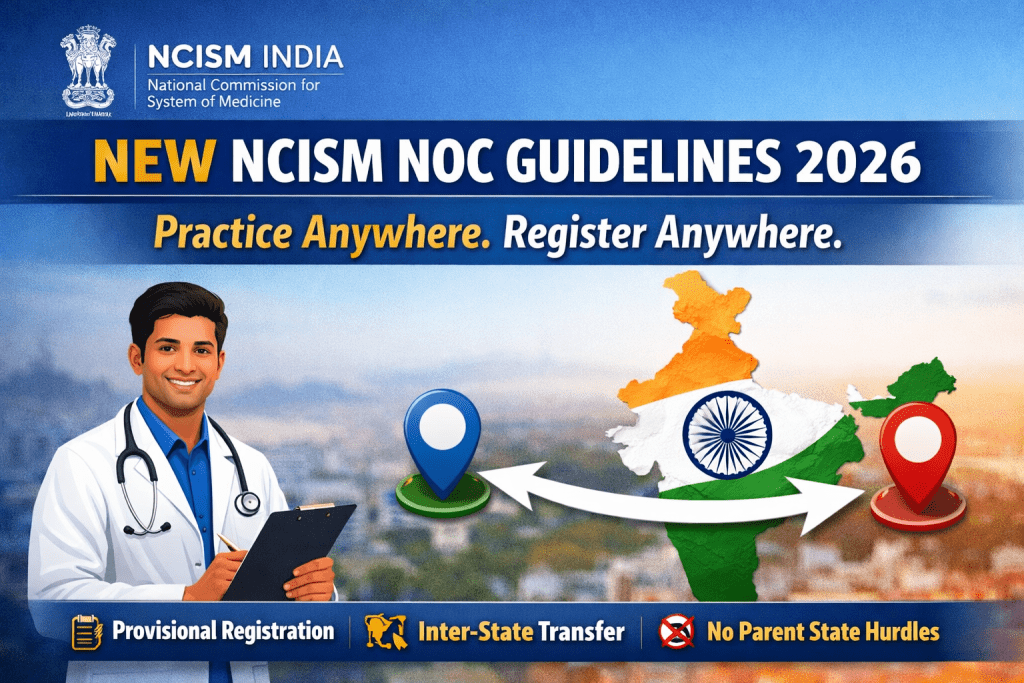
NCISM Issues New Guidelines on NOC for AYUSH Practitioners (March 16, 2026)
In a significant move aimed at simplifying the registration process for AYUSH practitioners, the National Commission for Indian System of Medicine (NCISM) has released new guidelines regarding the issuance of No Objection Certificates (NOCs). The directive, issued on March 16, 2026, brings much-needed flexibility for graduates of BAMS, BUMS, BSMS, and Sowa-Rigpa streams seeking registration across different states in India.
Key Highlights of the New Guidelines
1. Easier Inter-State Registration
AYUSH practitioners can now apply for permanent registration in a different state by obtaining a NOC from their original state council. This reform eliminates earlier procedural hurdles and supports professional mobility across India.
2. NOC Linked to Provisional Registration
A major shift in the policy allows practitioners to obtain a NOC based on their provisional registration—typically acquired during their internship period. This removes the earlier dependency on first securing permanent registration in the state of graduation.
3. No Mandatory Permanent Registration in Parent State
Doctors who do not intend to practice in the state where they completed their education are no longer required to obtain permanent registration there before moving to another state. This marks a progressive step in reducing administrative delays.
4. Immediate Implementation Across States
The guidelines have been issued to all state AYUSH councils for immediate adoption, ensuring uniformity in implementation nationwide.
Background and Regulatory Context
The directive aligns with the objectives of the NCISM Act 2020, which focuses on standardizing education and practice in Indian systems of medicine.
Under NCISM, the Medical Assessment and Rating Board for Indian System of Medicine plays a key role in regulating institutions. It is responsible for granting Letters of Intent (LOI) and Letters of Permission (LOP) to AYUSH colleges, ensuring compliance with infrastructure, faculty, and hospital requirements.
Impact on AYUSH Practitioners
This policy is expected to significantly benefit young practitioners by:
Reducing bureaucratic delays in registration
Allowing greater flexibility in choosing practice locations
Streamlining the transition from internship to professional practice
The new NOC guidelines reflect NCISM’s continued efforts to modernize governance and improve ease of practice within the AYUSH sector.