Abstract
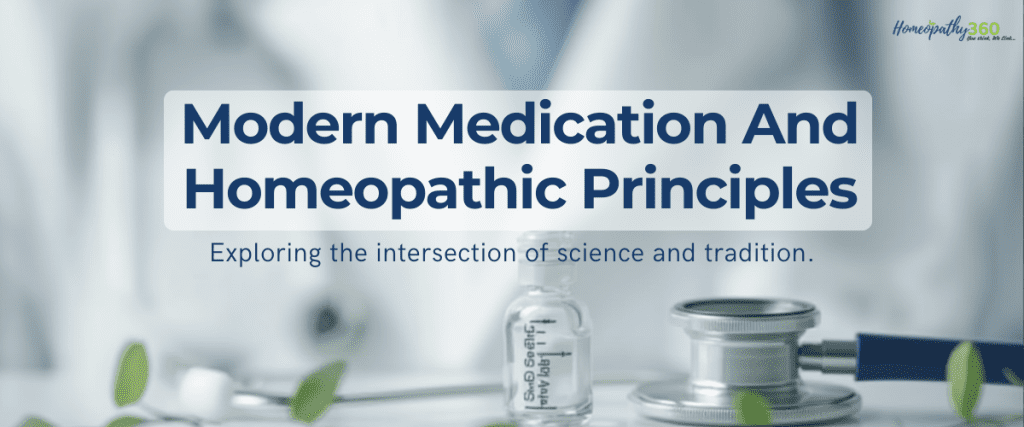
Modern medicine and homoeopathy represent two fundamentally different approaches to the understanding of disease and its treatment. Modern medicine, largely grounded in pathology, diagnostics, and biochemical intervention, primarily focuses on disease entities and symptomatic relief. While it has made remarkable advances in investigation and diagnosis, its therapeutic application often relies on empirical methods and suppressive measures, particularly through the use of synthetic drugs. These measures, though effective in controlling symptoms, may impose additional toxic burdens on the organism and disturb the natural balance of the vital force.
Homoeopathy, on the other hand, is founded upon immutable natural laws discovered through systematic experimentation and inductive reasoning, as laid down by Dr. Samuel Hahnemann. Its principles—such as the Law of Similia, minimum dose, individualization, and the concept of vital force—aim at treating the patient as a whole rather than isolated symptoms. This work attempts to define and explain the fundamental principles of homoeopathy, critically examine the foundation of modern medicine, and compare both systems from an Organon point of view. Special emphasis is laid on the adverse effects of synthetic drugs and the dangers of symptom suppression. The study highlights the superiority of homoeopathic principles in achieving true cure by stimulating the inherent healing power of the organism in accordance with natural law.
Introduction
The term modern medicine is used in a comparative sense to denote the dominant school of medical practice that has evolved with advances in pathology, diagnostics, biochemistry, and evidence-based research. Modern medicine possesses vast investigative capabilities and has contributed significantly to the understanding of structural and functional changes occurring in disease. However, despite these achievements, its therapeutic approach often lacks fixed guiding principles and continues to depend largely on empiricism and symptomatic management.
Synthetic drugs, widely used in modern medical practice, are primarily designed to suppress symptoms or target specific disease entities. While they may provide rapid relief, their action is frequently directed toward isolated symptoms rather than the patient as a whole. Such suppressive measures can mask disease expressions, burden the organism with drug toxicity, and ultimately weaken the vital force, leading to chronic and deeper pathological states.
In contrast, homoeopathy stands firmly upon natural and eternal laws that are independent of time, fashion, or changing therapeutic trends. Discovered through careful observation, drug provings on healthy individuals, and clinical verification, homoeopathic principles remain unchangeable. Dr. Samuel Hahnemann emphasized that disease is a dynamic disturbance of the vital force and that true cure can only be achieved by medicines capable of producing similar symptoms in healthy individuals, administered in the minimum dose.
From the Organon point of view, homoeopathy does not oppose scientific advancement but demands that all therapeutic measures be tested and applied in harmony with natural law. As rightly stated, it is unwise to reject the new merely because it is new, but it is equally dangerous to accept every new discovery blindly without evaluating its effects on the totality of the patient. This study therefore seeks to critically analyze modern medicine and homoeopathic principles, highlighting their conceptual differences, therapeutic approaches, and implications for true cure.
Aim
“To compare modern medicine and homoeopathic principles from an Organon point of view and to evaluate the effects of synthetic drugs.”
Objectives
- To define modern medicine and homoeopathy
- To explain homoeopathic principles
- To compare modern medicine and homoeopathy
- To study adverse effects of synthetic drugs
Discussion
The comparative study of modern medicine and homoeopathic principles reveals a fundamental difference in their philosophical foundations, concepts of disease, and therapeutic objectives. Modern medicine is primarily based on pathology, diagnostics, and biochemical intervention. Its chief concern lies in identifying structural and functional changes within organs and systems and controlling disease processes through pharmacological or surgical means. While this approach has greatly enhanced diagnostic accuracy and emergency management, its therapeutic methods are often directed toward disease entities and symptomatic relief rather than the individual patient.
Synthetic drugs used in modern medicine are largely designed to act on a specific symptom or a limited group of symptoms. Agents such as analgesics, antipyretics, antibiotics, and vitamins often provide rapid palliation, but their action may suppress the outward expression of disease without addressing the underlying disturbance of the vital force. As emphasized in the Organon of Medicine, suppression of symptoms does not constitute cure and may lead to deeper and more chronic disease states. The phenomenon of “never well since” is frequently observed following such suppressive treatment, indicating a disturbance of the organism’s natural defense mechanism.
Homoeopathy, in contrast, is founded upon immutable natural laws that have been discovered through careful experimentation, observation, and clinical verification. The Law of Similia, minimum dose, individualization, and the doctrine of vital force form the cornerstone of homoeopathic therapeutics. Disease, from a homoeopathic point of view, is a dynamic derangement of the vital force, and cure can only be achieved by a remedy capable of producing similar symptoms in a healthy individual. This approach respects the individuality of the patient and considers the totality of symptoms rather than isolated pathological findings.
The adverse effects associated with synthetic drugs further highlight the limitations of modern therapeutics. Drugs such as aspirin, sulphonamides, phenols, and artificial vitamins, though effective in controlling acute symptoms, are known to produce gastrointestinal, renal, hepatic, allergic, and neurological complications when used indiscriminately or for prolonged periods. Moreover, the elimination of pathogens through chemical means does not always result in recovery, as the organism must also overcome the toxic effects of the drugs themselves. The concept of “sterile death” illustrates this limitation, where death occurs despite eradication of microorganisms due to exhaustion of the vital force.
Homoeopathic physicians are trained to recognize these dangers and are cautious in the use of medicines, avoiding suppressive measures that may compromise long-term health. By applying the Law of Similars, homoeopathy aims to stimulate the organism’s innate healing capacity, allowing nature to restore balance in a gentle and permanent manner. The homoeopathic approach does not reject new discoveries but insists that all therapeutic agents, including synthetic drugs, must be evaluated and applied according to homoeopathic principles to ensure safety and true cure.
Thus, the discussion reinforces that while modern medicine excels in diagnostics and acute interventions, homoeopathy offers a rational, holistic, and principle-based system of therapeutics. Its emphasis on natural laws, individualization, and non-suppressive treatment provides a safer and more enduring approach to healing, as envisaged in the Organon of Medicine.
Relation To Organon Of Medicine
The principles of homoeopathy as discussed in this study are deeply rooted in the teachings of Dr. Samuel Hahnemann as laid down in the Organon of Medicine. The Organon emphasizes that the true physician’s high and only mission is to restore the sick to health in a rapid, gentle, and permanent manner (Aphorism 3). This objective stands in contrast to the symptomatic and suppressive approach commonly adopted in modern medicine.
According to Aphorism 22, the use of antipathic and palliative methods, which are frequently employed in modern therapeutics, provides only temporary relief and ultimately aggravates the disease condition. Modern medicine largely relies on such antipathic measures through synthetic drugs aimed at suppressing pain, fever, inflammation, or infection without addressing the underlying dynamic disturbance of the vital force.
The Organon clearly defines disease as a dynamic derangement of the vital force and not merely a structural or pathological alteration (Aphorisms 9–11). Modern medicine, with its emphasis on pathology and laboratory findings, often overlooks this dynamic aspect and treats disease as a localized or organ-based entity. Homoeopathy, in accordance with Organon teachings, treats the patient as a whole by considering the totality of symptoms as the only true guide to the selection of the remedy (Aphorisms 6 and 7).
The dangers of symptom suppression highlighted in this study are well supported by Hahnemann’s warnings against suppressive treatment, particularly in chronic diseases (Aphorisms 36–40 and footnotes). Suppression of external manifestations, such as skin eruptions or acute discharges, often leads to deeper internal pathology, a concept frequently observed in patients described as “never well since.”
The Organon also stresses the importance of the minimum dose (Aphorisms 275–277), which stands in sharp contrast to the large and repeated doses of synthetic drugs commonly used in modern medicine. Such drugs, when administered in crude form, may produce toxic effects, weaken the vital force, and create drug-induced diseases, as observed with prolonged use of analgesics, antibiotics, and artificial vitamins.
Furthermore, the doctrine of drug proving (Aphorisms 105–145) provides a scientific basis for homoeopathic therapeutics, unlike the empirical use of drugs in modern medicine where adverse effects are often discovered only after widespread use. The Organon encourages cautious evaluation and application of all medicinal substances according to the law of similars to ensure safety and certainty in cure.
Thus, the comparative analysis of modern medicine and homoeopathic principles strongly supports the teachings of the Organon of Medicine. It reaffirms that homoeopathy, being founded on natural and eternal laws, offers a rational, holistic, and non-suppressive approach to healing, while modern medicine, despite its diagnostic advancements, lacks fixed therapeutic principles and often deviates from the goal of true cure as envisioned by Hahnemann.
Conclusion
Modern medicine, though advanced in diagnostics and acute management, largely adopts a symptomatic and suppressive approach through the use of synthetic drugs, often without fixed therapeutic principles. Such treatment may provide temporary relief but can disturb the vital force and produce adverse effects, leading to deeper chronic states of disease. Homoeopathy, as expounded in the Organon of Medicine, is based on eternal natural laws and views disease as a dynamic derangement of the vital force. By applying the Law of Similia, minimum dose, and individualization, homoeopathy aims at a rapid, gentle, and permanent cure. Therefore, from an Organon point of view, homoeopathy offers a rational, holistic, and principle-governed system of therapeutics directed toward true restoration of health.
REFERENCES
1)Hahnemann, Samuel.
Organon of Medicine, 6th Edition.
Translated by William Boericke.
New Delhi: B. Jain Publishers (P) Ltd.
2)Roberts, Herbert A.
The Principles and Art of Cure by Homoeopathy.
Chapter 35: Modern Medication and Homoeopathic Principles.
New Delhi: B. Jain Publishers (P) Ltd.
3)Kent, J.T.
Lectures on Homoeopathic Philosophy.
New Delhi: B. Jain Publishers (P) Ltd.
4)Close, Stuart.
The Genius of Homoeopathy.
New Delhi: B. Jain Publishers (P) Ltd.
5)Schattner, Ami.
“The Spectrum of Harm Associated with Modern Medicine.” 6)Journal of the Royal Society of Medicine.
Authors
Dr. Babita Shrivastava,
Professor and HOD, Department of Organon of Medicine and Homoeopathic Philosophy, Government Homoeopathic Medical College and Hospital, Bhopal, Madhya Pradesh, India
Dr. Suresh Chandra Awasthi,
Professor, Department of Organon of Medicine and Homoeopathic Philosophy, Government Homoeopathic Medical College and Hospital, Bhopal, Madhya Pradesh, India